
The internet is full of resources for learning binary options trading — lessons from experienced mentors, specialist trading literature, practical video tutorials, and paid courses, among much else.
In practice, the effectiveness of learning binary options trading (whether free or paid) depends primarily on the individual: how much time and effort they are willing to invest in mastering this demanding discipline.
This guide covers the most important aspects of learning to trade binary options from scratch.

Level of Knowledge: Beginner
What binary options are, how they work, and a general introduction to this segment of the financial markets.
Course content:
- What Are Binary Options
- Who Invented Binary Options
- Are Binary Options a Scam?
- Pros and Cons of Binary Options
- Reliable Binary Options Brokers
- Types of Binary Options
- Binary Options vs. Forex: Key Differences
- Trader's Glossary
Level of Knowledge: Advanced
Core knowledge required for profitable binary options trading.
Course content:
- Trading Session Times
- Timeframes in Binary Options
- What Is Expiration?
- Risk Management
- Money Management
- Trading Psychology
- Why Use a Demo Account?
- MetaTrader 4 Terminal
- MetaTrader 4: A Beginner's Guide
- How to Install Indicators in MetaTrader 4
- MetaTrader 4 on macOS
- How to Use TradingView
- Live Chart for Binary Options
Level of Knowledge: Professional
The core principles of making money with binary options, including indicators, strategies, and technical analysis.
Part 1: Core Principles
Course content:
- How to Make Money with Binary Options
- The "Holy Grail" in Binary Options
- Why Many Traders Blow Their Accounts
- How to Grow a Small Deposit Aggressively
- How to Choose Currency Pairs for Trading
- Binary Options Trading Methods
- Scalping with Binary Options
Part 2: Technical Analysis
Course content:
- Fundamental Analysis
- Technical Analysis
- Trends: Types and How to Trade Them
- Bearish and Bullish Trends
- What Is a Flat Market?
- How to Read a Clean Chart
- Candlestick Analysis
- Price Action
- Volume in Trading
- Indicator Tutorial Videos
- Indicators for Binary Options
- Binary Options Strategies
- How to Adapt Forex Strategies to Binary Options
Additional Information
Supplementary resources for further reading.
Binary options regulation
Content:
Binary options brokers
Content:
- How to Choose a Binary Options Broker
- Minimum Deposit for Binary Options
- Binary Options Brokers
- An Honest Look at Pocket Option
- An Honest Look at Quotex
- An Honest Look at Binarium
- An Honest Look at Deriv
- Forex Brokers
- Blacklisted Brokers
General information
Content:
What Are Binary Options, Really?
Binary options are a relatively new but rapidly growing trading instrument built on the "all or nothing" principle. To trade them, you need to correctly predict the price movement of an underlying asset — a currency pair, stock, cryptocurrency, ETF, or other instrument. If the position closes in your favour, your profit can be up to 90% of the invested amount. If the forecast is wrong, you lose the full amount invested in the trade.
Part of binary options' appeal is the low barrier to entry: you can start trading with as little as $5, and the minimum trade size on most platforms is just $1. A correct prediction can return anywhere from 50% to 95% on a single trade, with nothing more required than choosing a direction — up or down. For many beginners, these are attractive conditions for taking their first steps in the financial markets, particularly when a structured training course is available.
The word "guess" is sometimes used in the context of binary options trading, but it does not accurately describe what a trader actually does. Guessing implies pure chance. A trader's job is to make a well-reasoned forecast of the likely direction of price movement — one with a genuine probability advantage. When done correctly, the share of successfully closed positions will be well above 50%, enabling consistent profitability. This is precisely what a solid binary options course aims to teach.
How long it takes to become a competent trader depends on the individual: their focus, persistence, and willingness to put in the work. One thing is worth stating clearly upfront: there are no magic indicators or guaranteed strategies that produce large returns effortlessly.
Getting Started: How to Place Your First Binary Options Trade
Once you have opened a live account, select an asset — for example, a currency pair — and predict whether its price will be higher or lower after a set period of time (the expiration).
If you believe the price will rise, press the Call button. If you expect it to fall, press Put.
Example: Let's use silver as the underlying asset. You predict that the price will be higher in 5 minutes and buy a Call option for $100. The payout rate is 80%:
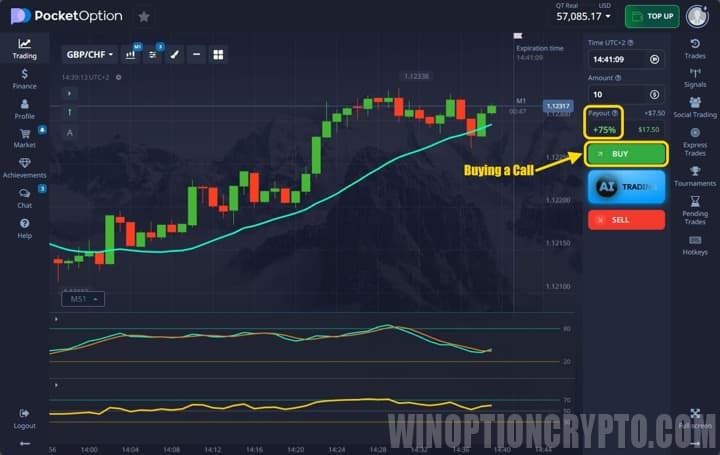
If the price at expiration is even slightly above its opening level, you receive $180 — your $100 investment returned plus $80 in profit. If the forecast was wrong, you lose the $100 invested.
Binary options can generate a significant return in a matter of minutes. However, that same high return potential comes with an equally high risk of losing your entire investment. This is precisely why structured training is essential for beginners.
What You Need to Learn to Trade Options Effectively
Traders spend a significant part of their working time monitoring price movements on charts. Since broker terminals are not always the most convenient environment for in-depth analysis, many traders supplement them with a standalone terminal such as MetaTrader 4 or a live charting platform like TradingView, where they can apply indicators and other technical tools and view price action across different timeframes.
A common and effective setup is to keep the broker's trading terminal open on one side of the screen and a third-party charting platform on the other:
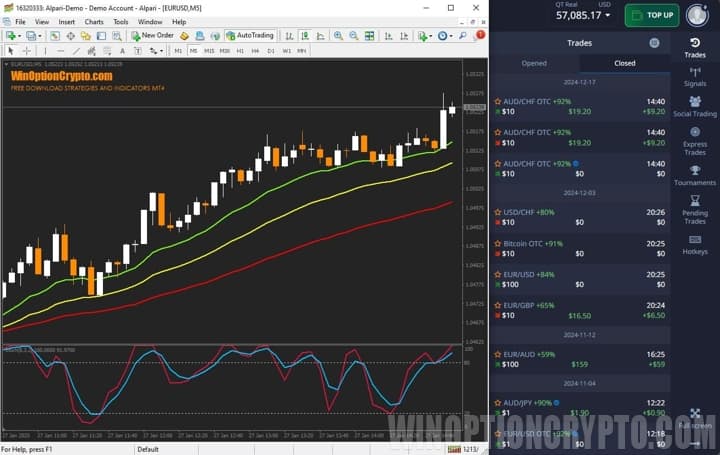
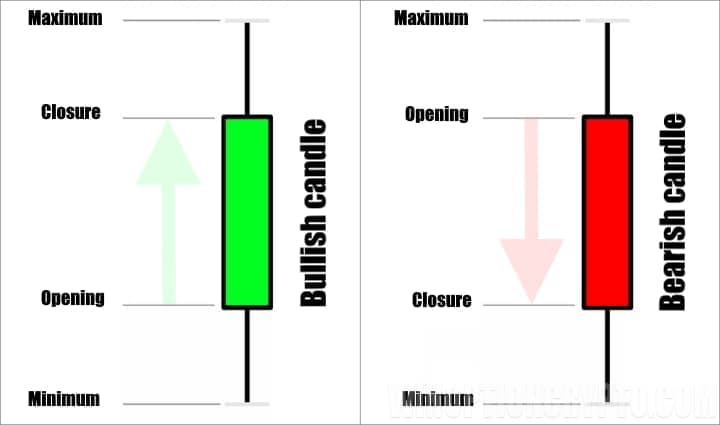
For market analysis, the candlestick chart is generally the best choice. It is the most information-rich format and the easiest to read visually. Each candle consists of a body and wicks (also called shadows). The body shows the opening and closing price levels, while the wicks show the high and low reached within that time period. The candle's colour indicates whether the price closed higher or lower than it opened:
Best Times to Trade Binary Options
Binary options markets are accessible 24 hours a day on weekdays. Some brokers also offer trading on weekends using OTC quotes. That said, not all hours are equally suitable for trading — experienced traders stick to specific windows of higher market activity.
For effective trading, the market needs to be active. Activity and volume peak when the trading sessions of major global exchanges overlap. These overlap periods offer the most favourable conditions for entering trades — something every beginner should factor into their approach from the start.
It is worth keeping the opening and closing times of the major world exchanges close to hand. The schedule of trading sessions is shown below:
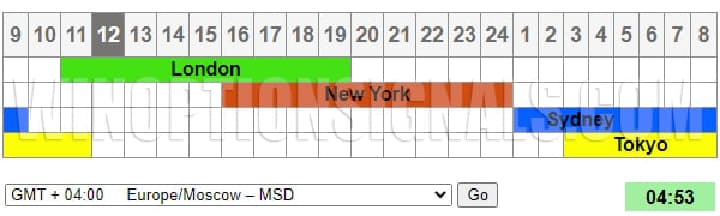
When two major exchanges are open at the same time, price movement accelerates and volatility increases — ideal conditions for trading. A calm, low-volatility market is more challenging to trade, particularly for beginners.
The most favourable trading windows in GMT+2 are:
- 03:00–09:00 (Australia + Japan sessions overlapping);
- 11:00–12:00 (Europe + Japan sessions overlapping);
- 16:00–19:00 (Europe + US sessions overlapping).
The highest activity typically occurs during the European and US session overlap. It is also important to watch for sharp, impulsive price moves around major economic news releases, which can be tracked using the economic calendar.
Which Days of the Week Are Best for Trading?
Monday is when the market is warming up after the weekend. Avoid trading early in the session.
Tuesday and Wednesday are generally the best days for trading. Indicators perform reliably and technical analysis tends to be more accurate.
Thursday is also a solid day for opening positions.
On Friday after 19:00, inexperienced traders should stay out of the market. As the weekly session draws to a close, conditions can become erratic and unpredictable, with sharp price moves in either direction.
Choosing the Right Expiration Time
Expiration is the point at which a trade automatically closes. Selecting an appropriate expiration period is critical to achieving consistent results. Most traders work with expiration times ranging from 30 seconds to 4 hours.
Beginners often confuse "expiration" with "timeframe" — these are two distinct concepts.
A timeframe is the period used to group price data on a chart — in other words, the length of time each candle represents.
Expiration is the duration of the trade itself — how long the option remains open before closing. It is set when the option is purchased in the broker's terminal. One important principle is to match the expiration time to the working timeframe. Opening a 30-second option while analysing an hourly chart, for example, makes no sense.
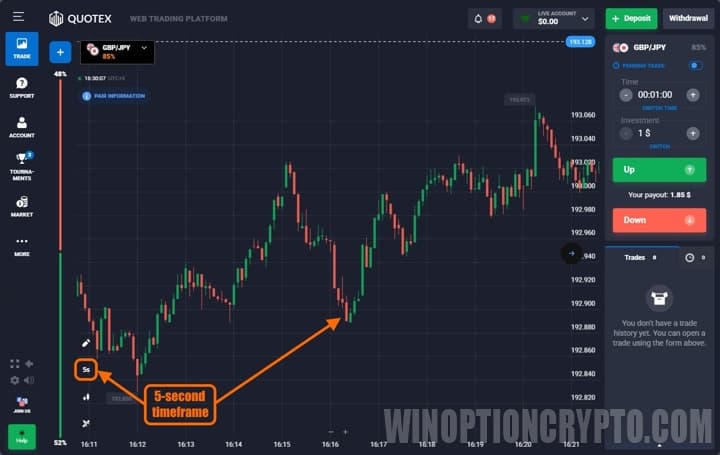
Take the 5-minute timeframe as an example: each candle represents five minutes of price movement. In general, the shorter the timeframe, the harder it is to forecast price direction. On a 5-second chart, price movement is essentially random noise:
The course covers in detail which timeframes work best with different expiration periods.
One fundamental rule is worth highlighting now: always trade in the direction of the trend. This significantly increases the percentage of winning trades. A trend is the prevailing direction of price movement over a given period. To identify it, open a chart with a longer timeframe than the one you are trading on.
For example, when trading turbo options on a 1-minute chart, use a 30-minute or hourly chart to gauge the overall trend. For timeframes of 5 to 60 minutes, look at the trend on a 4-hour or daily chart.
Expiration: 60 Seconds
Trading with this expiration requires a 1-minute chart. Predicting short-term price direction is challenging, and beginners are better off avoiding these trades initially — though with experience, they can be profitable.
Expiration: 5 to 15 Minutes
With this expiration window, price reversals before the trade closes are a real possibility. Identifying key turning points is essential, and the 5-minute timeframe is well suited for this purpose.
Expiration: 30 Minutes
For beginners, a 30-minute expiration is the most manageable starting point. The main thing to watch is scheduled economic news releases, which can cause sharp and unpredictable price moves.
Using Strategies When Starting Out in Binary Options
The mechanics of buying options can superficially resemble placing bets, which leads some beginners to open trades randomly in either direction, hoping for luck. This approach is fundamentally flawed. Binary options are a market trading instrument, and consistent profitability requires a defined set of rules for entering trades — and the discipline to follow them. Without this, trading becomes little more than a coin flip. There are many trading strategies to choose from, and finding the right one requires hands-on testing. Below are two straightforward strategies suitable for beginners.
MACD Indicator Strategy
The MACD indicator combines the properties of a trend-following tool and an oscillator. It is used both to identify the prevailing trend and to detect potential price reversals. MACD is built on two lines (the MACD line and the signal line) and is displayed as both a line indicator and a histogram.
To get started, add the MACD indicator to your chart by opening the "Indicators" tab and selecting MACD. The signals it generates will help you identify entry points.
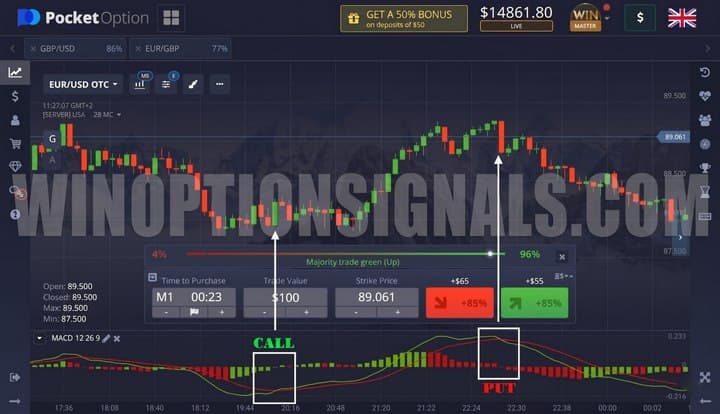
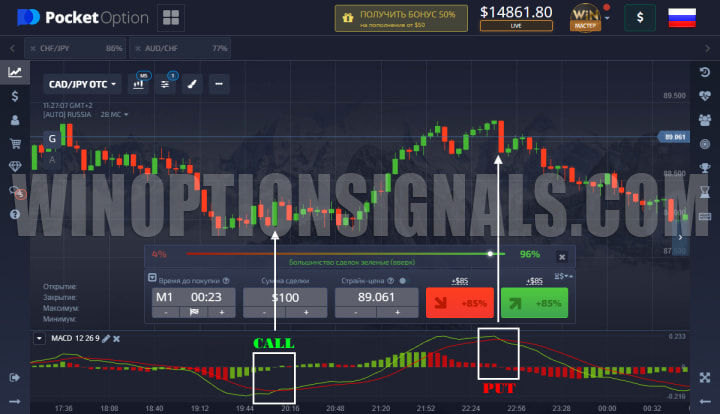
The rules are straightforward. When the MACD line crosses above the zero level and the two lines intersect, open a Call trade. When the MACD line crosses below the zero level, open a Put:
The Pinocchio (Pin Bar) Strategy
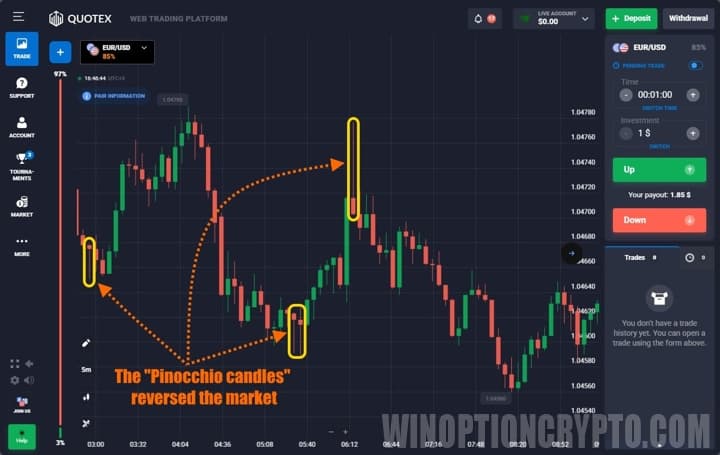
This strategy is based on candlestick analysis. A "Pinocchio" candle — more commonly known as a pin bar — is a candle with virtually no body and a long wick, resembling the nose of the famous wooden puppet.
The name reflects the logic of the pattern: just as Pinocchio's nose grew when he lied, a long wick signals that the market has temporarily pushed price in one direction but the move is likely to reverse. If the wick (the "nose") points upward, expect the price to fall. If it points downward, expect the price to rise:
You can open a trade immediately after the pin bar candle closes, or wait for the next candle to confirm the direction before entering.
Note that the Pinocchio strategy works in trending markets and is not effective in flat, low-volatility conditions.
The recommended expiration time is one to one and a half hours, with a chart timeframe of 5 to 15 minutes.
The Best Indicators for Binary Options Beginners
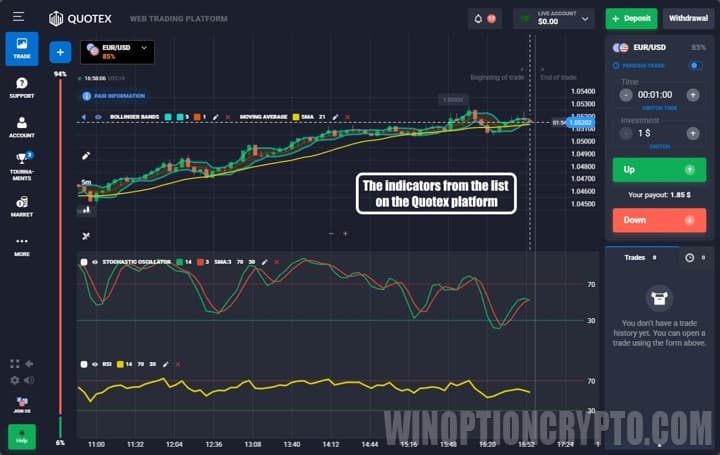
The most effective binary options strategies are built around indicator signals, which can be added to the chart in virtually any trading terminal.
The most widely used indicators for binary options are:
We recommend studying each of them carefully. At a minimum, pick any two to start with. That said, it is better to master a single indicator thoroughly than to jump between several without a clear understanding of how any of them work.
All of the indicators listed above are available in standard broker web terminals, so finding and applying them should not be a challenge even for complete beginners:
Choosing a Binary Options Broker as a Beginner
Be cautious of fraudulent platforms set up purely to collect deposits before disappearing. We recommend opening your first account with an established broker that has a proven track record and significant trading volume. The following are worth considering:
- Pocket Option — a modern broker with a strong reputation built over several years of operation;
- Quotex — a newer broker that has already established a solid standing among traders;
- Binarium — a straightforward platform with a $10 minimum deposit and a welcome bonus on the first deposit.
Binary Options vs. Forex
The forex market has existed for decades and is traded by millions of people worldwide. Individuals participate directly or through managed accounts, and banks conduct large-scale foreign exchange operations. Forex is widely known and heavily advertised.
Forex trading has a steeper learning curve. A trader must understand not only how the platform works, but also how to set stop-loss and take-profit levels correctly. An unexpected sharp price move without a stop-loss in place can wipe out an entire account. For this reason, binary options are often a better starting point for traders looking to develop their skills.
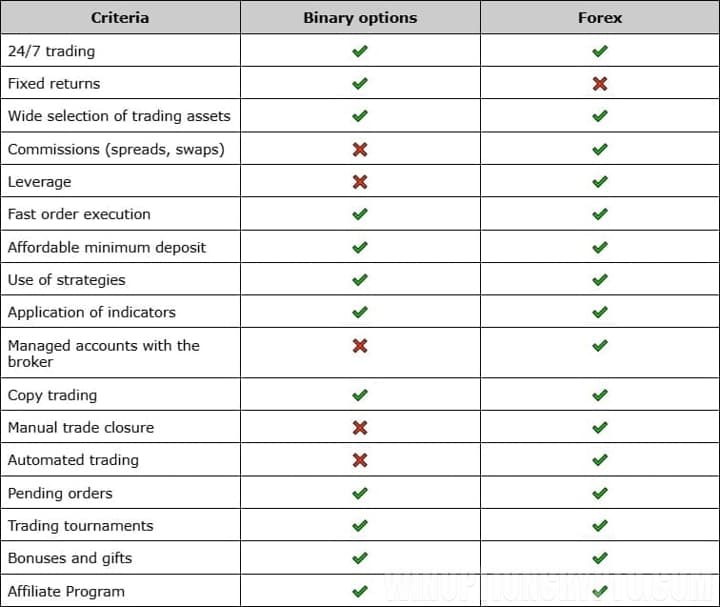
Advantages of binary options compared to forex:
- No broker commissions;
- High payout per trade (from 60%);
- Only the direction of the price move matters — not the magnitude;
- A wide range of tradable assets (currency pairs, metals, commodities, and more);
- Maximum loss per trade is limited to the amount invested, unlike forex where a single position can result in the loss of the entire account balance;
- A straightforward learning curve, with free educational resources available for beginners.
Advantages of forex compared to binary options:
- Forex is typically traded on MT4 or MT5, which offer an extensive selection of charting tools and technical indicators. Binary options brokers run trading through their own web platforms, which are less suited to in-depth analysis — most traders use third-party charting software alongside them;
- Leverage is available, allowing traders to open positions many times larger than their account balance (typically 100x to 500x).
- For those taking their first steps in financial markets, binary options offer a gentler introduction and allow newcomers to get comfortable with market dynamics more quickly.
A more detailed comparison between the two is shown in the table below:
How Hard Is It to Make Money with Binary Options?
Don't be taken in by marketing claims that binary options profits are easy to achieve. There is no value in paying for third-party trading signals or purchasing supposedly secret strategies. Use the free training resources available and develop your own analytical edge rather than depending on others.
Consistent profitability requires closing more than 60% of trades successfully. Reaching that level means developing a genuine understanding of the forces that drive the market and learning to interpret significant economic news. From there, the path is to build a working knowledge of technical analysis and then incorporate indicator-based signals into a defined trading approach.
Conclusion
Anyone starting out in binary options trading should focus first on the fundamentals of technical analysis — how to use indicators, how to read the economic calendar, and how to practice opening trades with a small initial deposit.
Progress will involve setbacks — that is unavoidable. But each mistake builds the experience needed to develop a personal trading strategy that improves over time. A positive, sustainable result is achievable within two to three months of dedicated study, depending on the individual's aptitude, commitment, and psychological resilience.
To leave a comment, you must register or log in to your account.