
Boosting a binary options deposit means applying aggressive money management and risk management to grow a trading account by two to three times — or more — in a short period. This approach is most commonly used with small accounts ($50–$150), with the goal of turning the resulting profit into a base for more conservative trading that can generate solid returns at a modest monthly growth rate of 5–10%.

To successfully boost a binary options deposit, a trader must follow certain rules and apply one of the strategies described below. These strategies are straightforward and require no special preparation — though the rules that govern them are not always widely understood.
Tips for Boosting Your Binary Options Deposit
The key rules and recommendations for deposit boosting can be grouped into the following areas:
- psychological preparation;
- asset selection;
- trading time;
- choice of indicator or trading strategy;
- risk per trade;
- protecting accumulated profit — the "STOP!" rule.
Psychological preparation and trading psychology are among the most important aspects of deposit boosting. The trader must understand that boosting inherently involves elevated risk and a real possibility of losing the entire account. It is therefore strongly inadvisable to attempt a boost using large amounts or money you cannot afford to lose. The psychological groundwork involves genuinely accepting that the funds allocated for boosting may be lost entirely — if a trader is not prepared for that outcome, boosting is not the right approach.
On asset selection: low-volatility or illiquid instruments — some exotic currency pairs and certain equities — are not suitable for boosting. Payout rates should be as high as possible, ideally 80–90%.
Choosing the right trading session is straightforward. For currency pairs, restrict trading to the European and American trading sessions, when currencies are most active and directional moves are more likely.
 Any indicator-based strategy can be used for boosting. If a trader already has a profitable strategy or indicator, it can be adapted for boosting purposes when combined with the position-sizing methods described below.
Standard risk per trade is around 2% of the account, but this is too conservative for deposit boosting. Increasing it to approximately 10% per trade allows the account to grow meaningfully while still providing enough buffer to absorb around ten consecutive losing trades. At 25% risk per trade, only four consecutive losses would wipe the account — which significantly reduces the probability of success.
The final — and equally important — rule is knowing when to stop. Greed reliably leads to giving back not only profits but the entire account. Once the deposit has grown by 100–200%, either stop trading entirely or take a break and return the following day.
Deposit Boosting Strategies for Binary Options
There are three main strategies for boosting a binary options deposit:
- Martingale;
- Anti-Martingale;
- Pyramiding.
Each has advantages and disadvantages. Without one of these methods, meaningful deposit growth in a short timeframe is difficult to achieve — but it is equally worth noting that each can reset the entire account just as quickly if used carelessly.
Martingale
The Martingale approach involves doubling the trade size after each loss, continuing until a winning trade recovers all previous losses and produces a profit. This makes it the fastest deposit boosting method — and the riskiest, since losses can accumulate just as rapidly.
Because binary options payouts are not fixed at 100%, calculating the correct trade size at each step manually is difficult. The Martingale calculator on our website simplifies this.
Martingale's principal limitation is the account size required to sustain a losing streak. Starting with a $1 initial trade at an 80% payout, the required trade size by the 10th consecutive loss would reach $1,437.
Before applying Martingale, decide in advance how many steps you are willing to use — the outcome depends directly on this limit.
Anti-Martingale
Anti-Martingale follows the same structure as Martingale but in reverse: trade size increases after a win rather than after a loss.
When using this method, it is advisable to cap the number of consecutive increases at three or four steps. A longer series means a single loss can erase all the profit accumulated during that run.
Calculating trade sizes with Anti-Martingale is complex; the Anti-Martingale calculator on our website handles this automatically:
| Initial deposit: | ||
|---|---|---|
| Payout percentage: | ||
| Risk per trade (%): |
5% |
|
| Available trades: |
20 |
|
| First trade: | Size: Potential profit: |
5 3.5 |
| Second trade: | Trade size if 1st trade wins: ...if 1st trade loses: Total potential profit: Profit already secured: |
7.8 5 6.16 0.7 |
| Third trade: | Trade size if 2nd trade wins: ...if 2nd trade loses: Total potential profit: Profit already secured: |
4.48 5 12.1 4.48 |
Pyramiding
Pyramiding involves opening multiple options positions in the direction of a developing move — stacking trades to build a pyramid of positions. This can be done using pending orders, available at Pocket Option and Quotex, or by entering trades manually.
With a $100 account, the position can be divided into 5 or 10 parts. If a sharp directional move is expected, trades of $20 each can be used; if the move is expected to develop more gradually, $10 per trade is more appropriate. Positions in the pyramid are spaced at fixed intervals: 5–10 pips apart for M1–M15 timeframes, and at least 15–20 pips apart for M30–H1.
The advantage of this method is that a sustained trend can produce profits on every position in the pyramid simultaneously. The disadvantage is that without a trending move, pyramiding can result in the loss of most of the deposit.
On the chart, pyramiding looks like this:
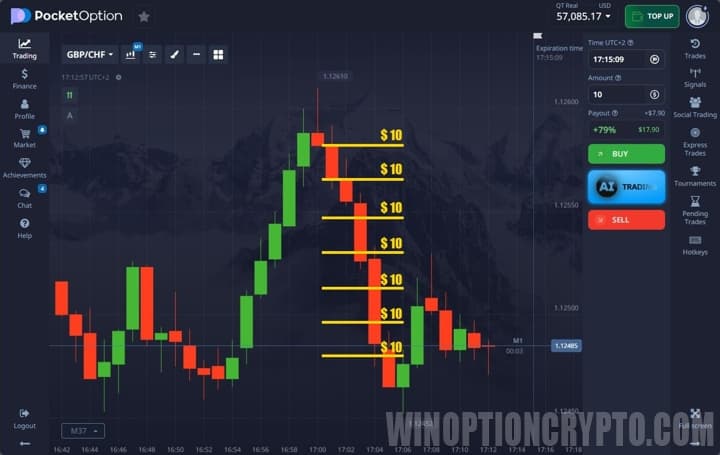
In the example shown, seven trades of $10 each ($70 total) at an 80% payout would return $56 in profit — an 80% return on the total amount deployed in a short window.
Pyramiding can also be applied by time rather than price. After opening an option with a 10-minute expiration, if price continues in the forecast direction after 5 minutes, a second option with the same expiration can be added. This process continues until price begins to reverse or enters a flat.
Conclusion
Boosting a binary options deposit can generate large returns very quickly, but it must be approached with care and discipline — the same speed that produces gains can also wipe out the account.
Even though standard money management rules are relaxed during a boosting session, the recommended approach is still to test the chosen method on a demo account first. If several demo attempts show that the results justify the risk, the method can then be applied on a real account — starting with no more than $10, not $50 or more.
To leave a comment, you must register or log in to your account.