
Adaptation of Forex Strategies for Binary Options
 Over the years, a huge number of different systems have been developed for trading on the over-the-counter foreign exchange market (Forex). Every trader, regardless of preferences and style, can easily find a suitable strategy.
For scalpers — short-term traders looking to capture small, quick profits; for intraday traders — medium-term systems designed for convenient work on H1–H4 timeframes; and fans of positional trading, aimed at holding trades for extended periods, are well catered for as well.
Some trading systems have existed for decades and still deliver excellent results today.
Compared to Forex, the binary options (BO) market is considerably younger, and the number of trading systems originally developed for it is significantly smaller. This is why many traders find themselves asking questions such as:
- whether it makes sense to use Forex strategies when trading with BO brokers;
- which strategies are best suited for adaptation to options, and what expiration time should be used;
- whether it is even worth adapting a Forex strategy for binary options, or whether it is better to use existing systems built specifically for BO.
To answer these questions clearly, it is essential to understand the key differences between the two markets.
What Is the Difference Between Forex and Binary Options
 To put it briefly: almost any Forex strategy can be adapted for options trading, provided its specific characteristics are taken into account. The key differences between BO and Forex are:
- a fixed and pre-agreed contract duration;
- a fixed profit amount (if the forecast is correct) and a fixed loss (if the price moves in the opposite direction);
- no stop losses or take profits.
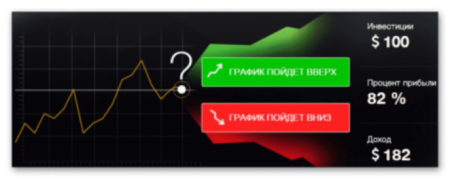
In other respects, the logic of options and Forex is similar: predict the direction the market will move and open the corresponding position. In Forex, that means Buy if the trend is bullish and Sell if it is bearish; in binary options, it means Call when you expect a rise and Put when you predict a fall.
Unlike binary options trading, Forex does not give you fixed profit and loss by default — these must be managed manually using Take Profit and Stop Loss orders. Incorrectly set or absent orders can lead to a Margin Call and ultimately a Stop Out. This distinction is critical to keep in mind when adapting any strategy for binary options.
Fortunately, in options you do not need to consider how many pips the price might travel — you only need to predict the direction. What does require careful thought when converting a Forex strategy to options trading is matching the working timeframes with the appropriate expiration periods. The core principle is simple: the price must have enough time to move confidently in the predicted direction before the option expires. This means correctly aligning the expiration time with the expected price movement on the chosen timeframe.
There are various approaches to selecting the correct expiration period. Rather than analyzing each one, we will focus on the most universal and practical method.
In general, all Forex systems suitable for adaptation to binary options can be divided into several types:
- Trend-following. One of the simplest yet most effective types: a clear directional trend makes price behavior more predictable. Trades are placed only in the direction of the trend, as continuation is the most likely outcome.
- Breakout. The core premise is a breakout of resistance or support levels, channel boundaries, and similar structures.
- Scalping. These involve a high frequency of short-term entries, each targeting a small profit.
- Patterns and chart formations. "Head and shoulders," "double top," "engulfing," and similar setups.
How to Adapt Strategies for Binary Options

As noted above, in options trading the only thing that matters is correctly predicting price direction. Whatever strategy you use, all focus should be directed at the aspects that generate entry signals.
In binary options, stop size, spread size, and other Forex-specific elements are irrelevant.
The most important practical question is how to correctly set the option expiration time. The following is a simple, universal method that works with virtually any strategy.
All that is required is to test the system on historical data, a demo account, or a live account, in order to determine how long it typically takes to achieve a stable positive result.
Open a series of trades according to the strategy rules, then review the completed trades and identify the profitable ones. Analyze how long each position was open before it closed in profit — either by hitting the target or being closed manually — then compare across trades and calculate the average. For example, if the price moved against you shortly after entry but did not reach the stop loss, then reversed and closed profitably an hour later, and this pattern repeats across other trades, that average duration becomes your baseline for setting expiration time.
Money Management when Transferring Forex Strategies to Options
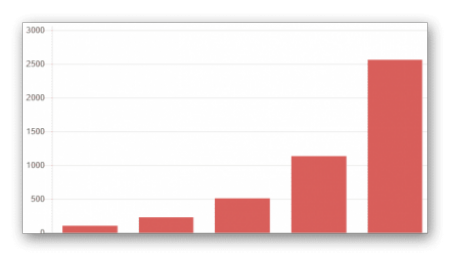
When it comes to money management, you generally do not need to change much — the original rules from the Forex strategy can largely remain intact. The main exception is strategies based on the Martingale principle or similar progressive lot-sizing systems, for which it is advisable to recalculate position sizes using a dedicated Martingale calculator for binary options.
Everything else should be straightforward. Unlike Forex, where risk is determined by stop size, in binary options both profit and loss are known in advance and are effectively equivalent to the trade amount. The standard rule applies: do not risk more than 1–2% of your total account balance on any single trade — that is $1–2 on a $100 account, $10–20 on a $1,000 account, and so on.
A Real Example: Adapting the "Calm River" Strategy from Forex to Binary Options
The best way to understand how this works in practice is through a real example. We will use the Calm River system — a classic short-term Forex strategy built around two EMAs (periods 20 and 50).
Transferring the strategy to binary options does not change its rules in any way — all option entries are made strictly in accordance with them. The entry conditions for the Calm River are straightforward: wait for the price to enter the zone between the two EMAs and bounce off the lower line without breaking through it.
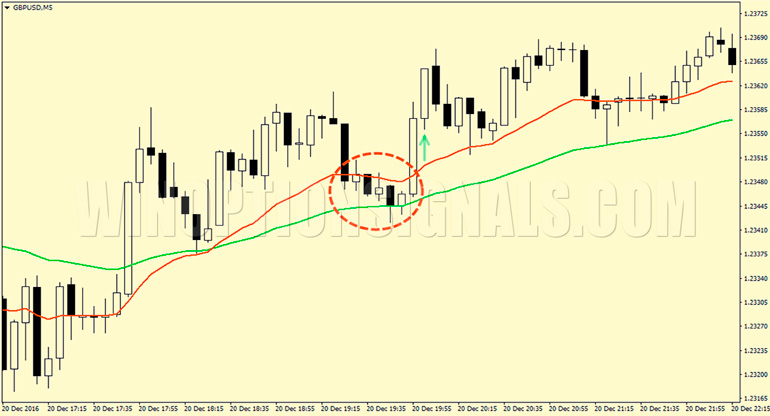
Once the bounce is confirmed, open a position — Call if the price fell and rebounded, Put if it rose and reversed. According to the strategy rules, the price typically remains within the EMA zone for no more than three candles, so entry should be made no later than the close of the third candle.
The optimal timeframes for scalping are generally M5–M15. For this strategy, the M5 chart is the most practical choice, though testing across different timeframes before committing is always worthwhile.
The more trades completed during testing, the more accurately the expiration time can be calibrated. As few as 4–5 trades can be enough to identify a reliable value.
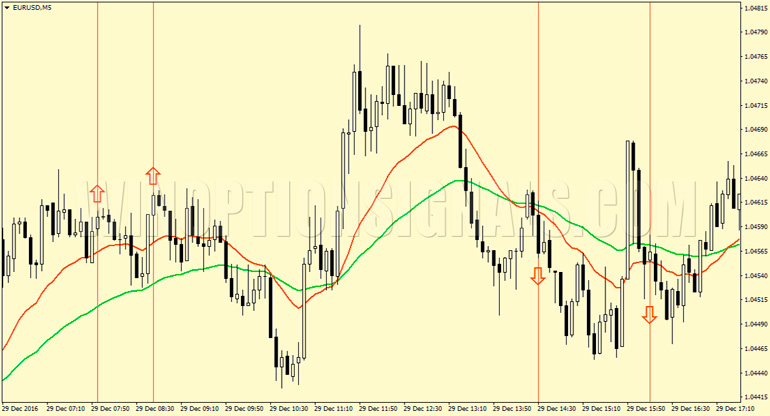
For example, if 75% of 5 trades closed in profit within one candle, and all 5 closed in profit by the end of the second five-minute candle, then 10 minutes is the optimal expiration period. As for risk management, standard rules apply: risk no more than 1–2% of account funds per trade — $1–2 on a $100 account, ten times that on a $1,000 account, and so on.
Conclusions
Time is an invaluable resource for any trader and should not be wasted. There is rarely a need to build a new binary options strategy from scratch when financial market professionals have already developed a vast number of proven systems over the years. In many cases, transferring a trading strategy from Forex or commodities markets to binary options not only preserves its effectiveness and profit potential, but can even improve its performance.

To leave a comment, you must register or log in to your account.