
In both the forex market and binary options, currency pairs are among the most popular trading assets. Experienced traders have, over many years, identified which pairs tend to offer the most consistent and predictable conditions — and this accumulated knowledge is invaluable for those just starting out.
Below, we cover the best currency pairs for binary options and which ones beginners should focus on first.

Currency Pairs in Binary Options
A currency pair represents the exchange rate between two currencies. When a trader buys one currency in the pair, they are simultaneously selling the other.
Many market professionals advise beginners to start with currency pairs because price movements are generally easier to predict — whether trading with a trend or in a flat market — compared to stock indices, equities, cryptocurrencies, and other popular assets. The high volatility of currency pairs and the fact that the forex market operates around the clock also make currencies a versatile choice. You can explore pair behaviour using the live binary options chart.
How Currency Pairs Work in Binary Options
A currency pair expresses the value of one currency in terms of another. The instrument originated in the forex market. The most widely traded pair — EUR/USD — shows how many US dollars are needed to buy one euro. The first currency in the pair is called the base currency (the one being bought); the second is the quote currency (the one used to make the purchase).
Types of Currency Pairs in Binary Options
Before trading currencies with binary options, beginners should understand how the market classifies these assets. Most binary options brokers and forex brokers offer three main groups, though the specific assets available in each group may vary.
Major Currency Pairs
Major pairs include the most widely traded currencies in the world and account for up to 80% of total forex market volume.
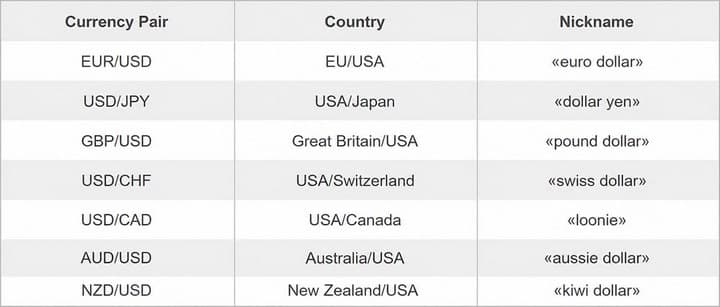
Their appeal lies in their high liquidity — demand for these pairs remains consistently strong regardless of broader market conditions. Most binary options trading strategies are designed with major pairs in mind.
Minor Currency Pairs (Cross Rates)
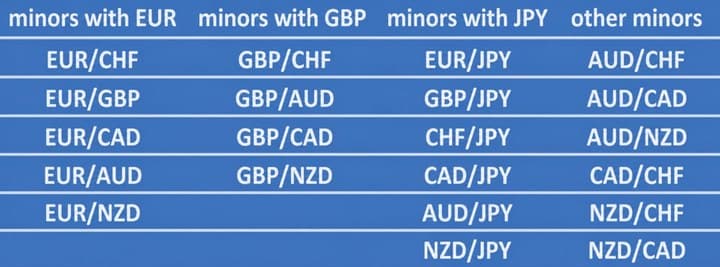
Minor pairs, also known as cross rates, do not include the US dollar. Their exchange rates are derived via a third currency. Some experienced traders consider minor pairs a good starting point for beginners, as their price behaviour can be more straightforward to analyse.
Exotic Currency Pairs
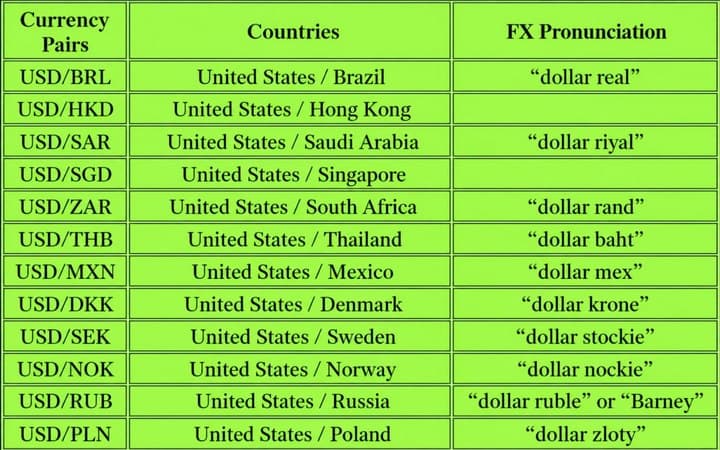
Exotic pairs combine a major currency with that of a smaller or emerging economy. They have lower liquidity than major pairs, which makes price forecasting more challenging. However, well-constructed trading strategies can generate strong returns with exotic pairs.
The Most Popular Currency Pairs for Binary Options
With so many currencies in circulation worldwide, binary options traders focus on a core group of highly liquid pairs. The most widely used are:
- EUR/USD. The most traded pair in the forex market, accounting for approximately 21% of all transactions according to the BIS 2025 Triennial Survey. Its extreme liquidity means it can also be characterised by high volatility at times, so most traders approach it using trend-based strategies — generally the most reliable approach for this instrument.
- USD/JPY. The second most popular pair globally, with a market share of around 14%. It is known for its potential for sharp exchange rate swings in either direction, making it one of the more demanding pairs to trade. Beginners are advised to approach it cautiously, but with experience, USD/JPY can be highly rewarding when traded with the right strategy.
- GBP/USD. Favoured by traders who prefer a more aggressive trading style. The pound sterling reacts strongly to economic and political news from the UK — as tracked through the economic calendar. Many traders use turbo options with expiration times of 30 or 60 seconds on GBP/USD, timing entries around key news releases.
- USD/CHF. This pair tends to move inversely to EUR/USD — when one rises, the other often falls. However, the two pairs sometimes move in the same direction, particularly during sustained trends with few sharp reversals. Technical analysis strategies are generally considered less effective for USD/CHF.
- AUD/USD. Characterised by moderate volatility, making it relatively straightforward to forecast. Around 5% of global FX volume is traded in this pair, but it is widely recommended for beginners because it responds well to trend-following strategies and is a good instrument for testing new approaches.
- NZD/USD. Similar in behaviour to AUD/USD — good trend movement and moderate volatility. The pair has grown in popularity in recent years and remains one of the more accessible options for novice traders.
- USD/CAD. Accounts for around 5% of global FX volume. The Canadian dollar has a strong inverse correlation with oil prices — when oil falls, USD/CAD typically rises, and vice versa. Trading this pair effectively requires monitoring the energy market and applying fundamental analysis.
- EUR/JPY. One of the more demanding popular pairs, with price direction that can be difficult to anticipate. It becomes more active during periods of economic instability and is generally not recommended for beginners.
- EUR/GBP. Significant and often unpredictable fluctuations in the pound sterling — driven by ongoing UK economic uncertainty, monetary policy divergence between the Bank of England and the ECB, and the structural legacy of Brexit — make long-term analysis of this pair challenging, and most experienced traders do not recommend it to beginners.
Global statistics on currency pair trading volumes are shown below:
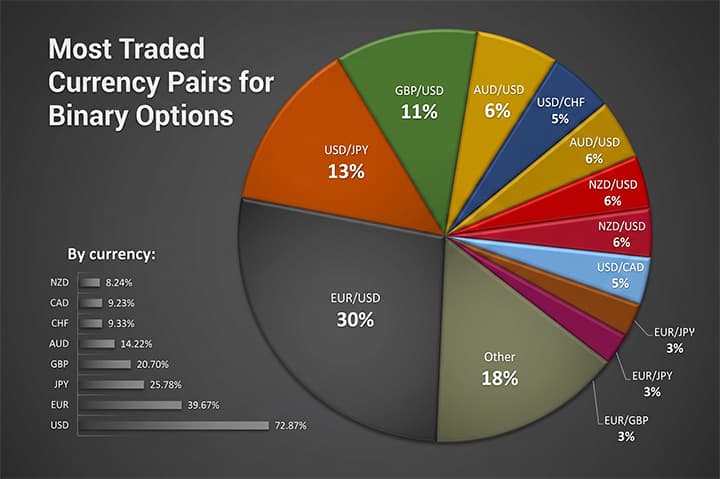
Despite the popularity of these pairs, no single strategy works equally well across all of them. At the outset, it is worth focusing on one pair at a time. This allows you to understand how a specific asset behaves and to calibrate your indicators to produce reliable signals for that instrument.
Which Currency Pair Should a Beginner Choose?
For traders just starting out with currency pairs in binary options, pairs like AUD/USD and NZD/USD are frequently recommended — their rates are more stable and easier to forecast. Less prominent pairs such as USD/CAD, which tends not to experience dramatic fluctuations, can also be profitable for beginners.
Ultimately, the choice depends on individual preference — and in practice, most traders arrive at their preferred instruments through experience rather than theory. One useful rule of thumb is to trade a pair when the relevant markets are most active. Pairs involving USD, for example, are most predictable during the US trading session; JPY pairs during the Asian session; and so on.
Avoid trading one currency in a pair when the other is experiencing sharp and unpredictable fluctuations, and avoid trading during closed sessions. For example, opening EUR/USD positions during the Asian session is generally inadvisable — during this period, the pair's movements become erratic and indicators frequently produce false signals.
 Volatility — the speed and magnitude of exchange rate changes — is another important selection criterion. USD/JPY, EUR/USD, and USD/CHF are all characterised by relatively contained volatility in the absence of major fundamental events such as central bank decisions or significant economic data releases.
Pairs involving the euro against the Canadian or Australian dollar carry higher risk, as their rates can shift sharply. For traders comfortable with high-risk, high-reward trading, GBP/USD tends to offer the most opportunities — provided the strategy is sound.
It is also worth noting that some currency pairs move in correlation with one another — one pair may rise or fall in tandem with another, or move inversely. This pattern does not hold consistently, however, so it should never be the sole basis for a trading decision. Correlation indicators for binary options can help you monitor these relationships more systematically.
Finally, do not limit yourself to a single currency pair. Different instruments suit different market conditions and strategies, and trading across several pairs simultaneously — particularly as you build experience — helps diversify risk and maintain profitability when one pair is behaving unpredictably.
Best Times to Trade Currency Pairs in Binary Options
Timing is one of the most important — and most underestimated — factors in binary options trading. Choosing the right time to enter the market directly affects the predictability of the trade and, consequently, the profitability of your strategy.
Broader market conditions matter too. News events, central bank announcements, and other developments all influence trend direction and rate fluctuations. However, selecting the right trading window helps both to manage the impact of these events and to exploit them profitably when they occur. A strategy that accounts only for exchange rate levels and volatility — without factoring in timing — will not produce consistent results over the long run.
 Experienced traders always keep a trading session schedule close to hand. Each major session has a distinct influence on the pairs associated with its region's currencies — just as oil prices affect USD/CAD, the opening of relevant exchanges drives activity in their related currency pairs.
Be mindful of your local time zone, and of the seasonal shift to and from daylight saving time, both of which affect when global sessions open and close relative to your clock.
Session openings tend to bring a spike in volatility as traders re-engage with the market and transaction volumes increase. While this can create profitable opportunities, it also brings a higher risk of sharp trend reversals. Trading immediately at the session open is therefore generally not recommended.
The period immediately before a session closes carries similar risks. As day traders unwind positions, price movements can become erratic. Avoid opening new trades shortly before a session ends.
Tuesday, Wednesday, and Thursday are generally the most favourable days for trading, as market activity settles into a more predictable rhythm. Technical analysis and trend-following methods tend to produce their most reliable signals on these days.
Avoid trading around major news releases unless you are specifically using fundamental analysis methods. The same applies to public holidays, when reduced market participation can produce sharp and unpredictable price moves. While many brokers offer weekend trading via OTC quotes, these conditions require a different approach.
What Drives Currency Pair Prices?
 The price behaviour and volatility of any given currency pair are shaped by several key factors:
- Political developments. Domestic, regional, or international events can shift market expectations for a currency significantly. A change of government, a geopolitical decision, or even a policy announcement by a neighbouring country can strengthen or weaken a currency. For example, a sharp EU decision to reduce oil imports from Russia would put immediate downward pressure on the rouble.
- Market sentiment. Investors do not react to events in isolation — they react to their interpretation of those events and what they imply for the future. News of rising unemployment, a widening deficit, or falling gross national income can depress a currency in the short term even if the underlying economic picture is more nuanced. Historical price patterns also feed into forward-looking expectations, which themselves drive price action.
- Anticipated events. Markets often price in expected outcomes before they occur. If an anticipated event fails to materialise — or turns out to be more serious than expected — the resulting surprise can trigger a sharp exchange rate move in either direction.
During periods of economic or political uncertainty, traders tend to move capital into traditionally stable currencies — the Swiss franc being the most prominent example. This "safe haven" demand pushes those currencies higher, which is reflected in the exchange rate of the associated pairs.
Forecasting Currency Pair Prices in Binary Options
A range of analytical methods exist for forecasting exchange rate movements across different timeframes — candlestick analysis, technical analysis, chart pattern analysis, wave analysis, and others covered in the binary options trading methods guide. Regardless of the approach, three principles apply universally:
 Analyse from higher timeframes down to lower ones. When reading binary options timeframes, start with the longer-term chart and work down to the shorter one. For example, a price breakout above a local resistance level on the 4-hour chart may suggest a buying opportunity — but if the weekly chart shows price near a major support level that has been repeatedly broken to the downside, the signal is far less reliable. Ignoring the higher timeframe context is one of the most common and costly mistakes traders make.
Always have a contingency plan. No trader, regardless of experience, can forecast the forex market with certainty. When trading currency pairs in binary options, be prepared to switch strategies if the initial scenario does not play out. Having an alternative approach ready helps limit losses and maintain consistency.
Learn from previous mistakes. If your current strategy is producing losses that consistently outweigh profits, stop trading and analyse what went wrong before continuing. Money management and risk management are essential tools in this diagnostic process.
Conclusion
Profitable binary options trading on currency pairs depends on two things above all: choosing the right asset and entering the market at the right time. Timing often proves to be the decisive factor, as it directly determines how predictable a given trade is. Every serious trader should have reliable access to a trading session schedule and stay informed about relevant news events. Without this, even the best strategy will produce inconsistent results over the long run.
To leave a comment, you must register or log in to your account.