
Trading in financial markets has been gaining momentum for many years, and for those looking to start profiting from trading, the question often arises: which is better, Forex or binary options? To understand the difference between binary options and Forex and get a clear answer, it is necessary to compare both trading methods in detail.
The basic principle is the same in both cases – you need to correctly predict the direction of price movement. On Forex, positions can be kept open for as long as you like, while binary options have a fixed duration limited by expiration. Binary options are potentially more profitable, though also riskier, which makes it difficult to declare one superior – Forex has its own advantages too.

Regulation of the Forex and Binary Options Markets: What Is the Difference?
Forex does not have a single trading platform, as this market is decentralized. Although Forex is often confused with a futures exchange because it involves currency trading assets, currency futures are derivative instruments rather than underlying ones.
Forex brokers do not always route clients’ orders to the interbank foreign exchange market; they often act as counterparties themselves, closing transactions against counter orders from other participants or at their own expense. The trader typically does not notice any difference – provided the broker pays out profits honestly.
The Forex market is regulated by law across many jurisdictions worldwide. Regulatory requirements vary significantly by country: stricter regulators impose limitations on leverage and account types, while offshore jurisdictions tend to offer more flexible trading conditions.
Forex brokers may be licensed by the following regulators:
- FCA (UK);
- CySEC (Cyprus);
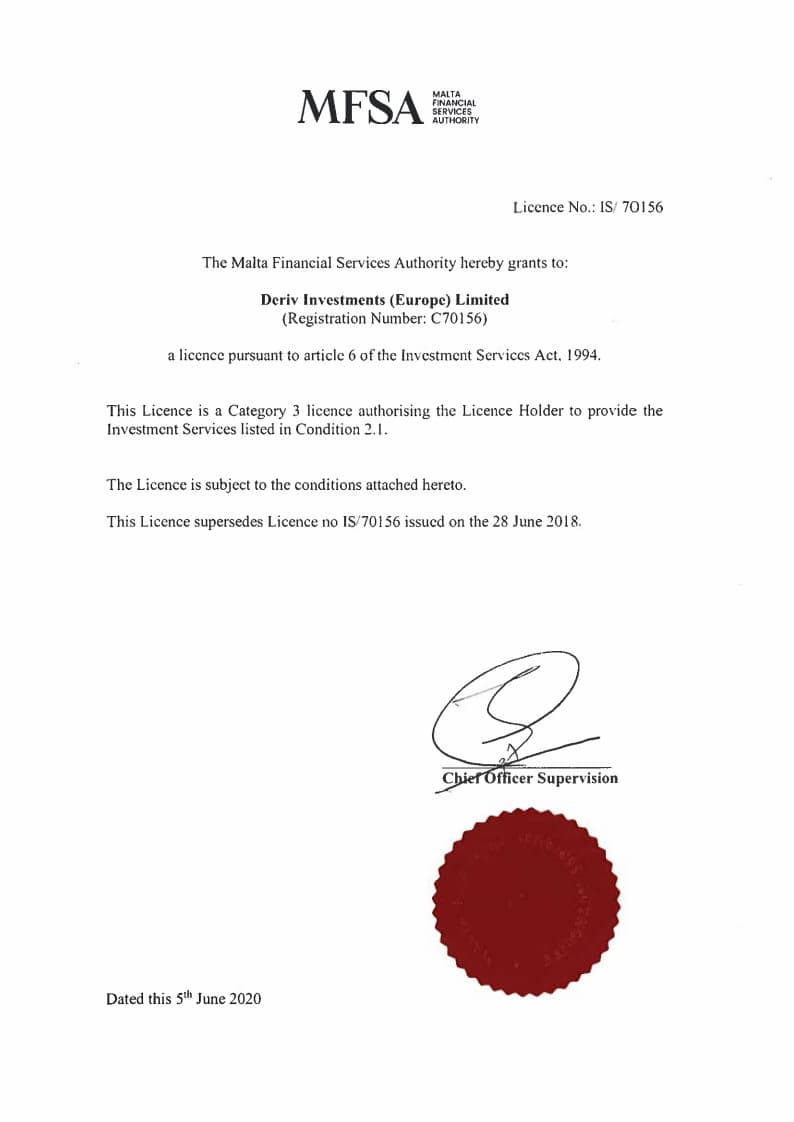
- MFSA (Malta);
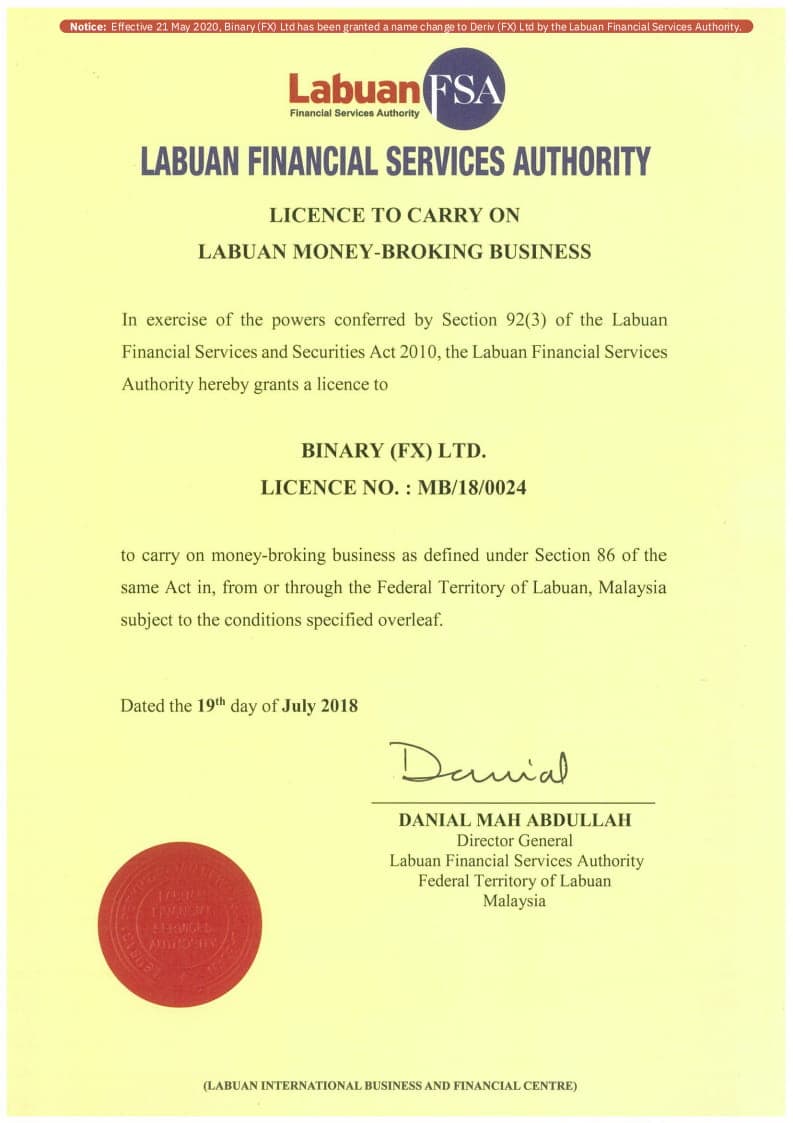
- LFSA (Labuan, Malaysia);
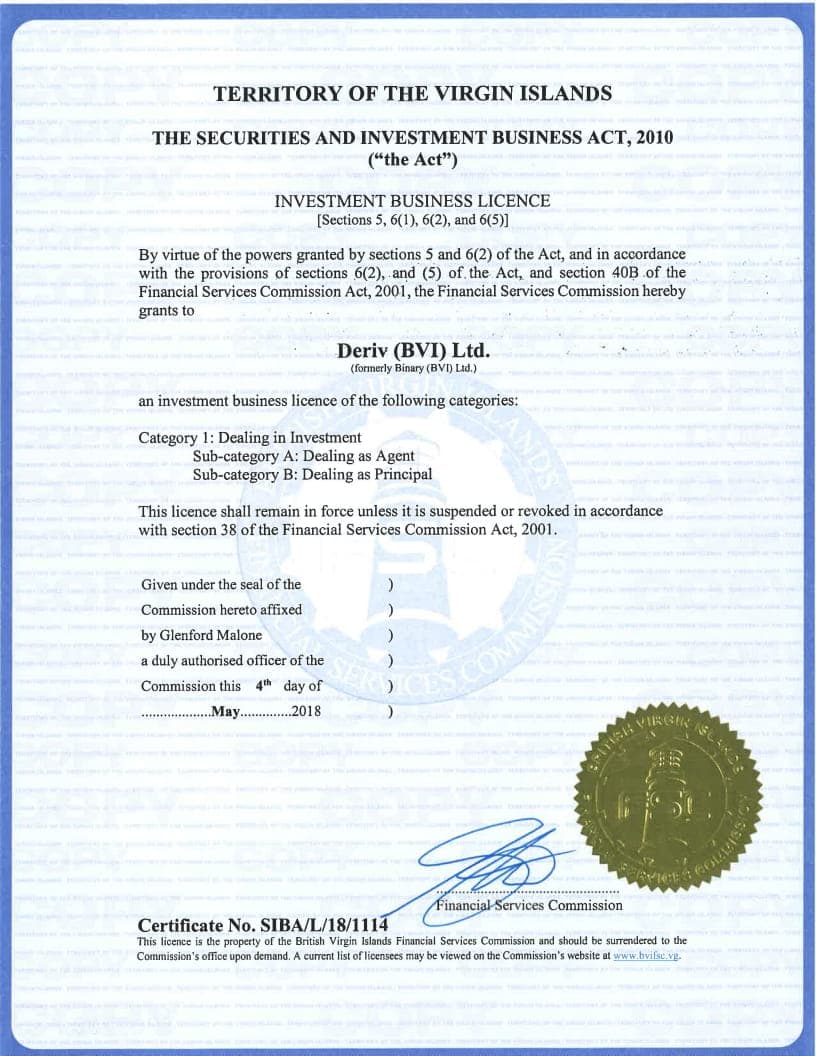
- BVI FSC (British Virgin Islands);
- VFSC (Vanuatu);
- FSC (Mauritius);
- SCA (UAE).
You can see how a multi-licensed broker operates using the example of Deriv, which provides trading in both binary options and the Forex market. Founded in 1999, Deriv holds licenses across multiple jurisdictions, enabling it to serve clients in different regions worldwide, including Europe, Asia, and the Middle East. Its current regulatory licences include MFSA (Malta), LFSA (Labuan), BVI FSC, VFSC (Vanuatu), FSC (Mauritius), CIMA (Cayman Islands), and SCA (UAE):
| Malta License | Labuan License | Virgin Islands License |
 |
 |
 |
| Vanuatu License No. 1 | Vanuatu License No. 2 |
 |
 |
Regulation of the Binary Options Market and Differences from Forex Regulators
Confidence in binary options was greatly undermined in the early 2010s, when the market was flooded with hundreds of fraudulent brokers positioning themselves as legitimate BO brokers. Their methods and types of fraud are the reason why negative and suspicious attitudes toward this type of trading persist to this day – and why some still believe that binary options are a scam.
Currently, binary options exist in a regulatory grey zone in most countries. There is no unified international framework governing them: in the EU and UK, binary options marketing to retail traders has been banned since 2018, while in other jurisdictions such as offshore financial centres they remain available and are overseen by local regulators. Binary options are not illegal in the majority of international markets, but dedicated retail-level regulation remains limited.
This does not mean that all BO brokers are dishonest or that profiting from binary trading is impossible. By reviewing the binary options broker ratings, you can confirm that legitimate choices exist and that all companies listed there pay out traders’ earned profits reliably.
The most respected licence for a BO broker is issued by the MFSA (Malta) – the most stringent supervisory authority overseeing brokerage companies. CySEC (Cyprus) ranks second in terms of trust and regulatory standards. Binary options brokers may also hold licences from Labuan, the British Virgin Islands, or Vanuatu.
In terms of regulation, binary options and Forex have very few differences when it comes to the licences and regulators that issue them.
How Does Forex Trading Differ from Binary Options?
The way transactions are executed is one of the key areas where binary options differ from Forex. The technical side of Forex trading is straightforward. To get started, a trader needs to download and install the MetaTrader 4 trading terminal, open a new account, log in to the personal area, and gain access to a trading account – a process that typically takes no more than 10 minutes, after which trades can be placed.
On Forex, it is possible to open positions at the current price (market orders) and at future prices (pending orders, also known as limit orders):
Market order – opens at the price available in the market at the time of the transaction. A buy or sell order is usually executed instantly:
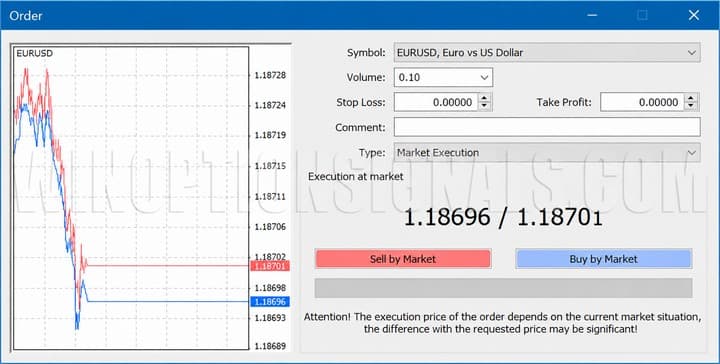
During periods of high market volatility, slippage or requotes can occur, though this is relatively uncommon.
Limit orders and Stop orders are pending orders that are triggered when the price reaches a specified level:
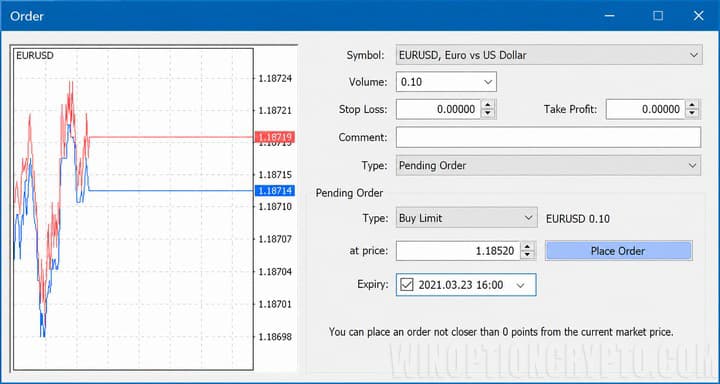
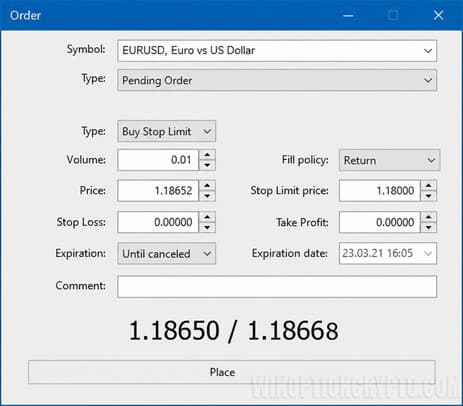
Sell Stop Limit and Buy Stop Limit are features introduced in the MT5 platform and are available only in that terminal. These order types are primarily designed for exchange-traded assets and are typically used by professional traders to manage take profit or stop loss, since order execution on a real exchange works differently from Forex:
Additional features that distinguish Forex from binary options include the following:
- When trading on Forex, a position can be closed for a profit or loss at almost any moment, regardless of how far the price has moved;
- A trader can close a position in several ways – manually or automatically (by setting a take profit, stop loss, or trailing stop);
- There is a spread – the difference between the Ask (buy) price and the Bid (sell) price – from which the broker earns, regardless of the outcome of the trade;
- When rolling an open position over to the next trading day, a swap is either credited or debited to the account (this applies to currency pairs and depends on the specific pair);
- The trader has full control over the trade in progress: positions can be partially closed, and take profit or stop loss levels can be added, removed, or adjusted;
- On Forex, a trader can reduce risk through specific tactics – for example, opening positions of equal volume in opposite directions (a “lock”), and then unwinding the lock when the price returns to the desired level;
- Carry trading is available – opening long-term positions to profit from a positive swap. This can generate modest guaranteed income, though the strategy is less effective in low interest rate environments;
- Before each Forex trade, it is important to calculate risks in order to determine where to place the stop loss, since the future direction and magnitude of a currency pair’s movement cannot be known in advance.
Difference in Trading Between Binary Options and Forex
Mastering binary options is easier than trading Forex, which is one reason some traders prefer binary options over Forex.
One of the most important differences between binary options and Forex is how trades are executed. Few would argue that binary options are technically much simpler for beginners to grasp than Forex trading. To open a trade with options, a trader simply selects the investment amount and expiration, then clicks the Call (“Higher”) or Put (“Lower”) button:
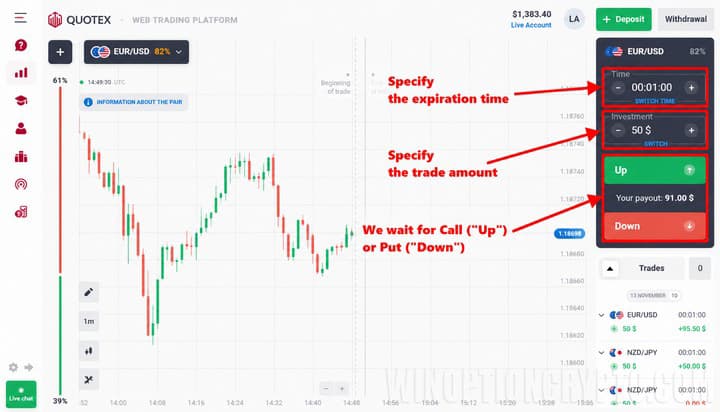
The profit amount is determined solely by the size of the investment. What matters at expiration (when the contract closes) is whether the price is above or below the level at which the trade was entered.
The duration of a binary option is fixed. A trader can choose an expiration time ranging from a few seconds, minutes, or ticks to several months or even years.
Pending orders are also available for binary options. On some brokerage platforms, it is possible to set not only the option entry level but also the desired payout – the trade will not open if the potential payout falls below that threshold. Currently, Pocket Option allows traders to place pending orders.
In addition to pending orders, binary options come in many different types that can be applied in various strategies or under specific market conditions.
Another difference between binary options and Forex is that BO brokers most commonly provide web-based trading platforms. In some cases, the broker may also offer a desktop terminal for PC.
Some brokers allow binary options trading through the MetaTrader 4 terminal via dedicated plugins. You can trade options via MT4 with Grand Capital and World Forex:
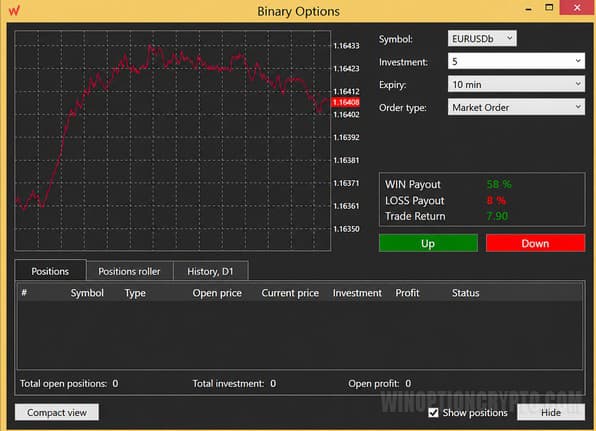
There is no spread in binary options, and brokers cannot charge a fee based on the difference between Bid and Ask prices. The chart displays a single price calculated as the arithmetic mean between Bid and Ask. Swaps for long-term positions are neither charged nor credited.
Additional differences between binary options and Forex include:
- Locking, trailing stops, and carry trading are not available in binary options trading;
- There is no way to manage a trade once it has been opened. After placing a position, a trader can only monitor price movements – it is not possible to influence the outcome of the contract or close the trade before expiration, in full or in part. Some brokers do offer partial solutions such as increasing volume, extending the expiration, or early close at a set point, but these still differ significantly from the flexibility offered by Forex;
- You cannot set take profit or stop loss. In essence, a binary option is a bet on whether the price of an asset will rise or fall. The trader either receives a profit of 80–90% of the trade amount or loses the entire investment. Since the profit/loss ratio is skewed in favour of the broker, a trader needs a win rate of at least 60% to be consistently profitable in binary options.
How Does Forex Profitability Differ from Binary Options Profitability?
The most notable difference between binary options and Forex is the high return on a single successful trade. One option expiring in 30 or 60 seconds can return 80–90% of the trade amount:
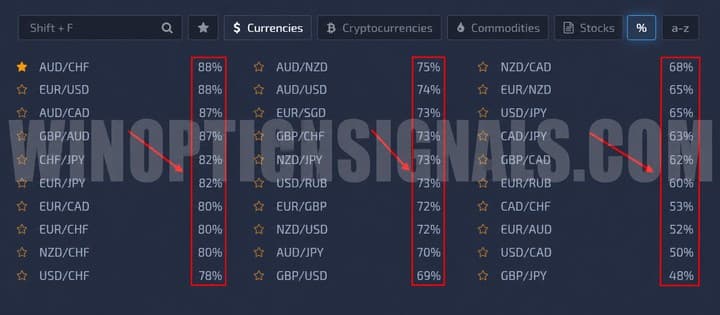
When discussing the profitability of Forex trading, it is difficult to give exact figures. A return of over 10% over the long term is considered an excellent result. With a conservative approach over a year, it is possible to double a deposit – achieving at least 100% profit with a risk of 2–3% per trade. If profits are reinvested rather than withdrawn, the account balance will grow exponentially through compound interest.
For binary options, high returns on individual trades do not guarantee rapid long-term deposit growth. Consider the following example: a trader has a $1,000 deposit and risks 2% per option. The maximum loss per trade is $20 ($1,000 × 0.02 = $20). This is the amount used when buying options.
Out of 100 trades per month, 60 may be profitable and 40 unprofitable, with a payout of 82% on winning trades. From a single profitable trade, the trader earns $16.40 ($20 × 82%). Monthly profit from 60 winning trades amounts to $984 ($16.40 × 60). Losses from 40 unsuccessful trades total $800 ($20 × 40). The net monthly result is +$184 ($984 – $800), which represents an 18.4% return on the deposit – a very strong outcome.
Overall, when comparing Forex and binary options, options have an edge in profitability, though the advantage is not dramatic. Given roughly the same capital management and trade frequency, Forex tends to generate slightly less profit per month. That said, a binary options account will not necessarily grow significantly faster than a Forex account over the long term.
Differences Between Trading Assets in Binary Options and Forex
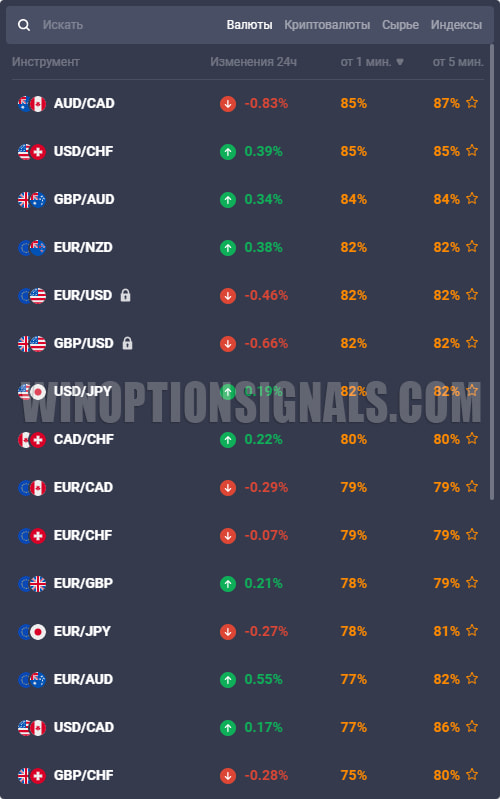
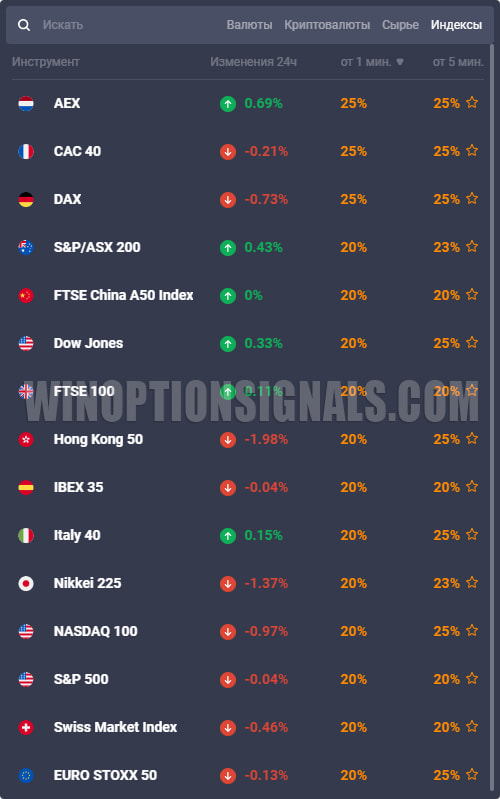
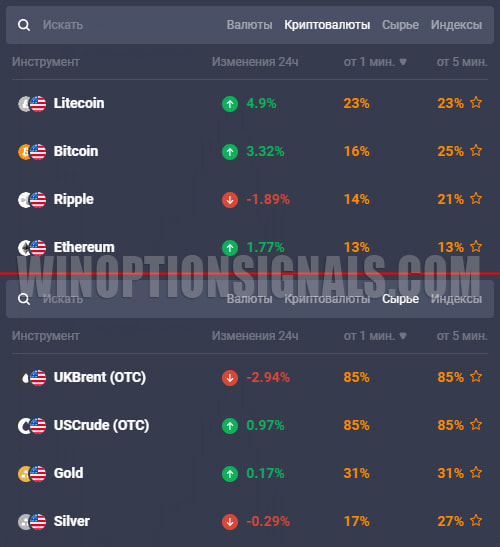
Both binary options brokers and Forex brokers now offer the ability to trade not only currency pairs, but also a wide range of other assets, including stocks, metals, cryptocurrencies, commodities, and more. Binary options brokers typically offer the following trading assets:
| Currency pairs in binary options | Indices in binary options | Commodities and cryptocurrencies in binary options |
 |
 |
 |
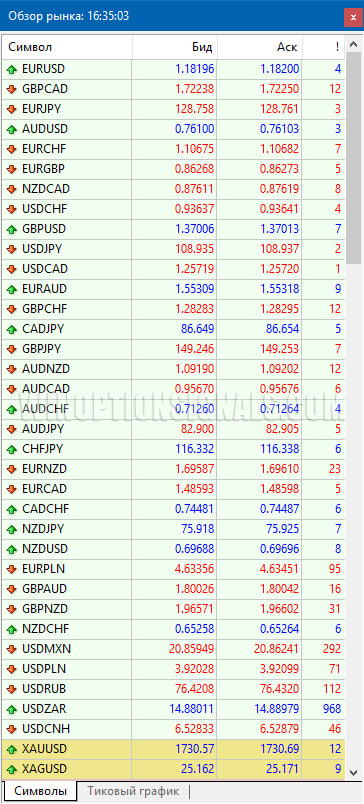
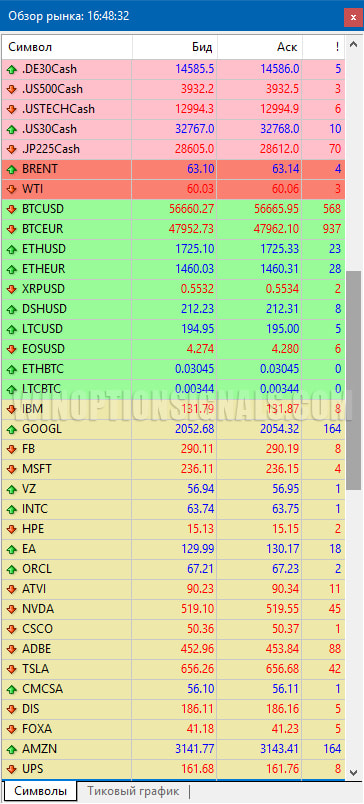
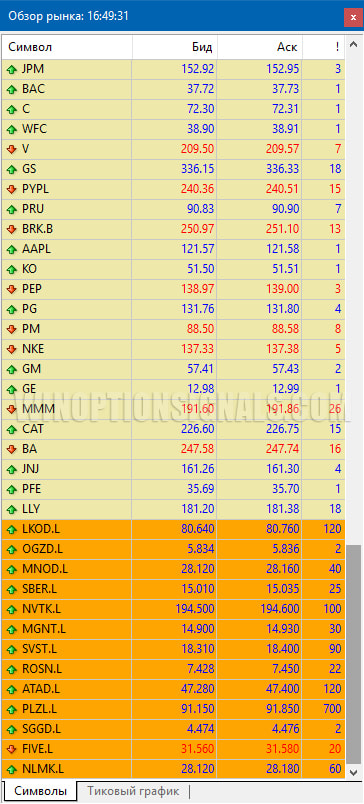
For Forex brokers, the asset selection may look different, but the scope is broadly the same:
| Currency pairs on Forex | Indices and cryptocurrencies on Forex | Shares on Forex |
 |
 |
 |
In terms of trading instrument selection, there are virtually no differences between binary options and Forex.
The only exception may be specialist bank Forex brokers that focus exclusively on currencies and metals, in which case other trading instruments will not be available.
Differences in Commissions Between Binary Options and Forex
In binary options, traders pay no commissions or fees. Brokers profit from clients’ losing trades and pay out profits on winning ones.
The Forex market involves several types of commissions, including the spread or per-trade commission, as well as the swap.
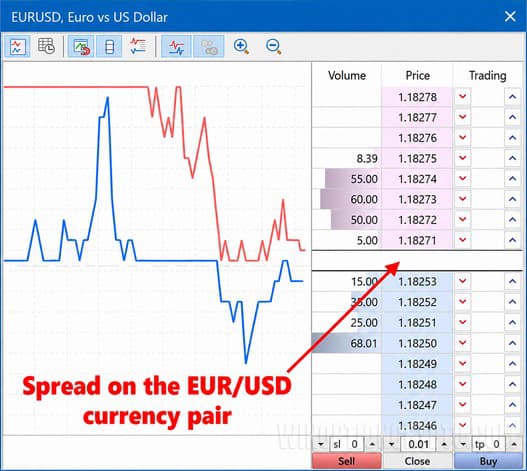
The spread is the difference between the Ask and Bid prices, which exists regardless of the broker – in global markets, no asset is bought and sold at exactly the same price. When trading through a broker, the spread is widened, and the broker takes this difference as payment for providing market access:
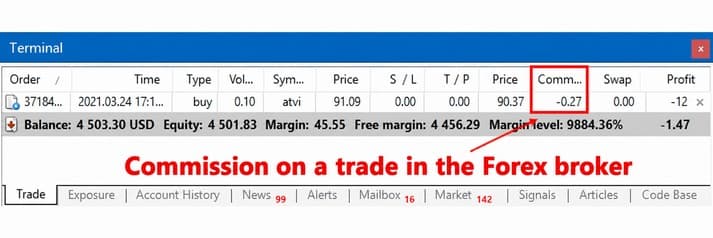
For some assets, instead of a spread, a fixed per-trade commission is charged. This does not differ greatly in cost from a spread but can be a more convenient structure in certain trading approaches:
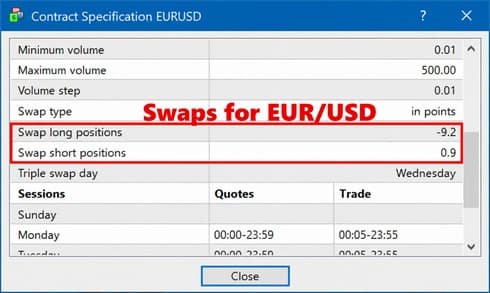
The swap is charged only when positions are carried overnight. It is worth noting that the swap can be positive – in which case, instead of being debited from the account, it is credited as profit. The swap for any currency pair can be viewed in MT4 by right-clicking the asset and selecting “Specification”:
How Do Risks Differ in Binary Options and Forex?
When it comes to overall losses from trading in financial markets, there is no need to compare binary options and Forex separately – the risk of losing the deposit exists in both, and only the trader can protect their own capital.
That said, when comparing the risk profiles of the two, there are some important factors to consider. In binary options, it does not matter how far the price rises or falls after entry – the loss and profit are always fixed values. If a Call option (“Higher”) is purchased but the price drops sharply by 200–400 points, this has no additional impact on the deposit. On Forex, the same move on a trade without a stop loss could result in a loss far exceeding the initial risk – even with a small trading volume.
In terms of potential profit, Forex offers the possibility of much larger returns on investment compared to binary options, but this requires correctly calculating stop loss and take profit levels, which is not a straightforward process. With options, both the potential profit and the maximum loss are known in advance, allowing for more disciplined risk and capital management.
It is also important to always follow the rules of money management and risk management – regardless of the type of trading, they help protect the deposit from significant losses and can sometimes accelerate deposit growth.
Analysis and Forecasts in Binary Options and Forex
The analytical process is the same in both cases and involves the use of:
Technical analysis can be further divided into:
- Price Action;
- Candlestick analysis;
- Graphical analysis.
Conducting analysis can be demanding in both Forex and binary options. With options, however, it is sufficient to identify the trend and the likely next direction of price movement, whereas in Forex trading it is also necessary to estimate how many points the asset will move, since this directly affects potential profit.
In strong trend conditions, Forex can be more advantageous: if analysis suggests an upward move is likely but the market is currently ranging, a binary options trade may expire before the breakout occurs, while a Forex position is not time-limited and can capture the full move. In ranging markets with a narrow price band of, say, 15 points, binary options are more effective – short-term trades within a flat can generate significantly more profit than equivalent Forex trades on the same asset.
Binary Options and Forex: What Is the Difference?
The points discussed above are summarised in the following comparison table:
| Criteria | Binary options | Forex |
| 24/7 trading | + | + |
| Fixed income | + | – |
| Wide selection of trading assets | + | + |
| Commissions (spreads, swaps, etc.) | – | + |
| Leverage | – | + |
| Fast execution of trades | + | + |
| Low minimum deposit | + | + |
| Applying strategies | + | + |
| Applying indicators | + | + |
| Trust management with a broker | – | + |
| Copying trades | + | + |
| Manual closing of trades | – | + |
| Automated trading | – | + |
| Pending orders | + | + |
| Trading tournaments | + | + |
| Bonuses and promotions | + | + |
| Affiliate program | + | + |
The criteria listed above do not mean that binary options or the Forex market are inherently better or worse. It is possible to earn well in both, but it is essential to understand the mechanics of trading and to practise on a demo account first.
Conclusion
Both beginners and experienced traders can trade binary options. Before starting, it is important to understand the specifics of binary options and to recognise that high returns from a single contract do not guarantee rapid account growth. With sound money management, a trader can realistically earn 10–30% of the deposit per month – expecting significantly more than this at an early stage will almost inevitably lead to losing the entire deposit.
Binary options can offer higher profitability than Forex trading, but this is complicated by the need to correctly predict not only the direction of price movement, but also the timeframe within which that prediction needs to be realised.

To leave a comment, you must register or log in to your account.