
There are many binary options trading methods, and each can be useful in its own way — but most are quite difficult to understand and are not suitable for beginners. Price Action is different: this trading technique is straightforward and does not require any indicators or auxiliary tools.
The essence of Price Action in binary options is finding candlestick patterns and setups that repeat periodically across any market. The probability of profit when using these formations is significantly higher than with many binary options trading strategies.

Price Action can also be considered the "twin brother" of another effective technique: candlestick analysis in binary options trading. The key difference is that candlestick analysis contains far more patterns and setups — many of which are difficult to memorize, as they can span a large number of candles — whereas Price Action focuses on setups of just two or three candles.
What Are Patterns and What Types Appear in Price Action for Binary Options
A pattern is a repeating formation that can be expressed in many ways, including through candlestick formations. Price Action patterns can consist of one candle or several, but the count rarely exceeds three.
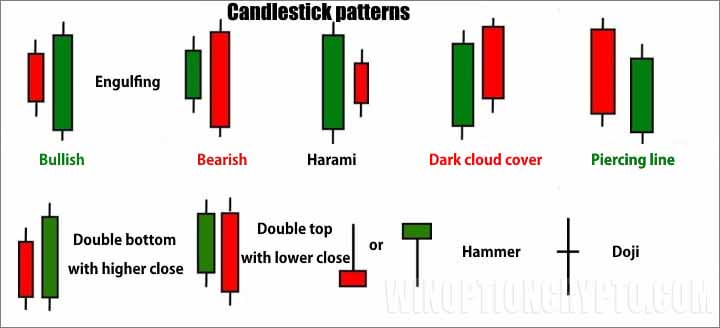
The simplest single-candle patterns include the Pinbar, Doji, Hammer, and others. These are very popular, and even traders who have never heard of Price Action in binary options are likely already familiar with them.
Slightly more complex are the 2-bar and 3-bar patterns, which include the Inside Bar, Outside Bar, Rails, Engulfing, and others. These patterns are more effective than single-candle formations, yet they are not significantly harder to understand:
How to Use Price Action in Binary Options
You can look for patterns on a clean chart, but this approach is less effective, since any formation can appear not only at reversals but also during trending moves. A more reliable approach is to combine patterns with key levels or price zones.
If drawing levels manually is difficult, you can use support and resistance level indicators that plot them automatically. It is also worth noting that price channels can be used in place of horizontal levels — with equally good results.
Despite the large number of patterns available, there is no need to study all of them, as many appear quite rarely. Below, we will look at the three most effective and frequently occurring Price Action patterns in binary options — patterns that, when used correctly, can already generate consistent profits.
Pinbar
Pinbars appear frequently across all markets and timeframes, and when identified and used correctly, they are powerful reversal patterns.
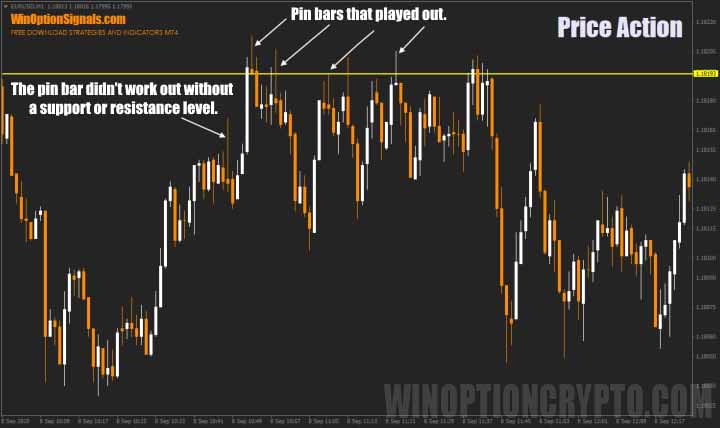
A Pinbar almost always has a long shadow (two to three times longer than the body) and a small candle body. The chart section below shows how Pinbars play out at a key level, while a Pinbar that lacked proper confirmation simply failed to follow through:
Engulfing
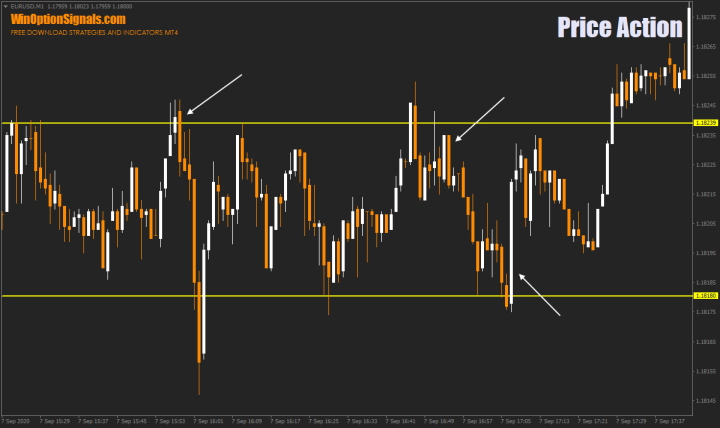
Engulfing is a pattern in which a new candle covers the price range of the previous one. In the classic version, it is sufficient for the body of the new candle to cover the body of the prior one (excluding shadows), but a stronger and more reliable signal occurs when the entire candle — including shadows — is engulfed. Engulfing can be bullish or bearish, which only determines the direction of the trade. The example below shows how call options could be placed within a price channel following the appearance of Engulfing patterns:
Rails
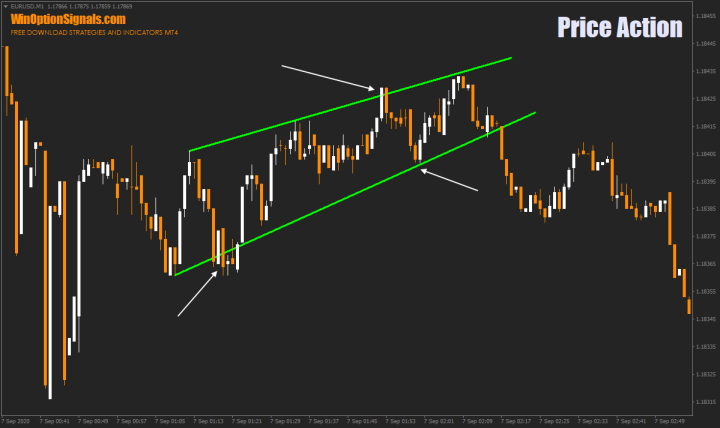
The Rails pattern consists of two roughly equal candles side by side — a slight difference in size is acceptable. In some cases, Rails can combine with Engulfing, which only strengthens the formation.
In the image below, you can see a price channel in which two of the three patterns occurred together with engulfing, even though the candles differed in size by several points:
Pros and Cons of Price Action in Binary Options
Like any trading method, Price Action has its advantages and disadvantages. The advantages include:
- Simple, intuitive patterns that are nonetheless highly effective.
- No complex indicators required.
- Patterns work across any market and timeframe.
- Compatible with any strategies and indicators.
- All you need is a candlestick chart.
The disadvantages are fewer, but worth noting:
- Patterns appear frequently in any phase of a trend, which can mislead not only beginners but also experienced traders.
- The full range of patterns is large and difficult to memorize, making it hard to apply them in live trading without reference tools.
Tips for Beginners Using Price Action in Binary Options
There are several ways to improve your Price Action results. One of them is trend trading. As shown in some of the examples above, counter-trend patterns are generally best avoided — the market rarely reverses on the strength of a single candle alone. However, during corrections and pullbacks, Price Action patterns can be very useful in signaling when a return to the trend is likely.
It is also advisable to limit yourself to no more than two or three patterns. Using too many will likely create confusion; it is far more effective to pick one or two patterns and study them thoroughly before applying them in trading.
The following recommendation applies not only to candlestick analysis but to trading in general: always use money management and risk management. These disciplines help you allocate trading funds correctly and protect your capital.
Conclusion
As you can see, Price Action in binary options can be highly effective and deliver consistent profits even for beginners. That said, any approach or method should be carefully studied and practiced — this is what allows you to master all of its nuances.
Candlestick analysis also has significant potential as a standalone system. Deeper study reveals many additional formations, and a major advantage is that Price Action can be traded from a smartphone or tablet, since all you need to execute trades is a candlestick chart.

To leave a comment, you must register or log in to your account.