
Before starting binary options trading, beginners have many questions, one of which is: which timeframe is better for binary options? To answer this question, it is necessary to consider all existing timeframes and what types of trading each one is suited for. It is also worth noting that choosing the right timeframe is not the most difficult process, and with experience it will come naturally.

What Is a Binary Options Timeframe?
Every trader who has explored the capabilities of various trading platforms knows that each one has a panel displaying all available timeframes. A timeframe is a time interval that allows you to view price changes over any given period. To put it simply, changing the timeframe lets you examine any hour, day, week, or month in greater detail — as if looking through a microscope.
For example, if a 5-minute binary options timeframe is selected, the chart will plot candles or bars for every five minutes of the current trading session. The same logic applies to all other timeframes:
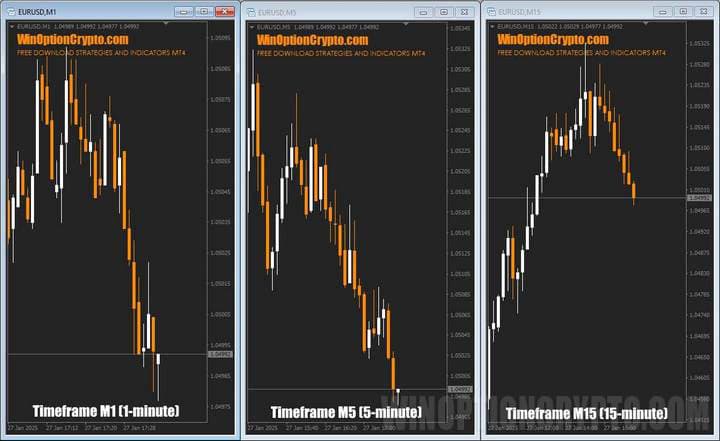
Some novice traders may confuse the concept of a timeframe with the expiration time of binary options, but it is important to understand that these are entirely different concepts.
Types of Time Frames in Binary Options
Timeframes come in a variety of types, with the most common ranging from M1 (one-minute) to 1M (monthly).
However, these are not the only timeframes available for trading digital contracts. Using the TradingView platform as an example, you can see that a number of additional time periods are also available:
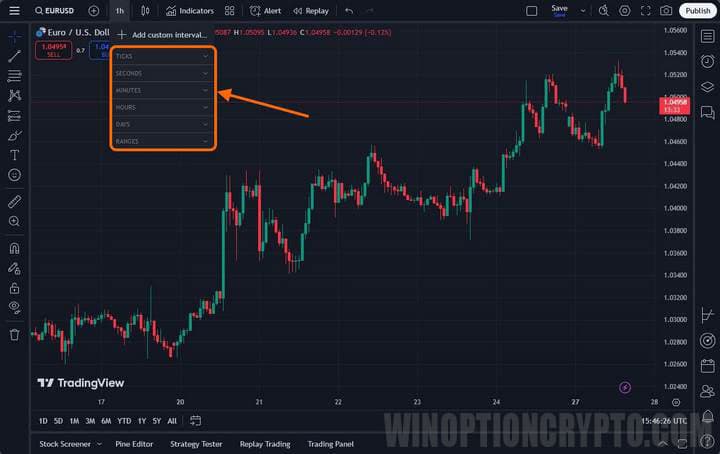
While minutes, hours, and days are available in most trading terminals, including MetaTrader 4, second-based timeframes and range charts are not supported everywhere.
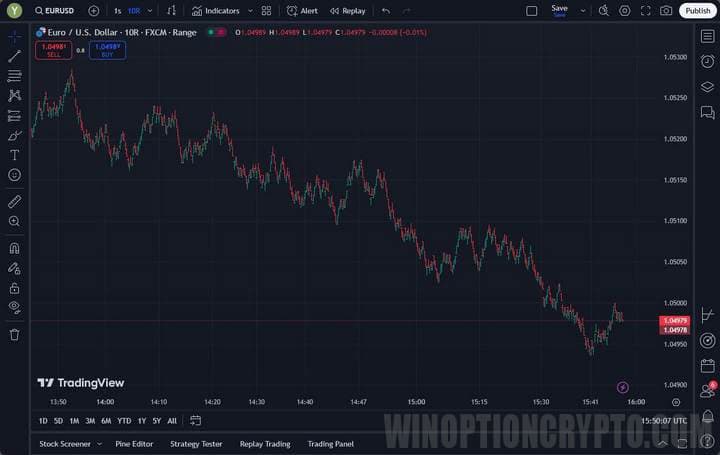
Second-based timeframes are typically divided into 1, 5, 15, and 30 seconds, allowing traders to observe very rapid price movements. Range charts, on the other hand, are not built on fixed time intervals but on a specified price range. For example, if the EUR/USD currency pair has a range of 10 points, a new candle or bar is only drawn once the pair moves up or down by 10 points. The Range(10) chart looks like this:
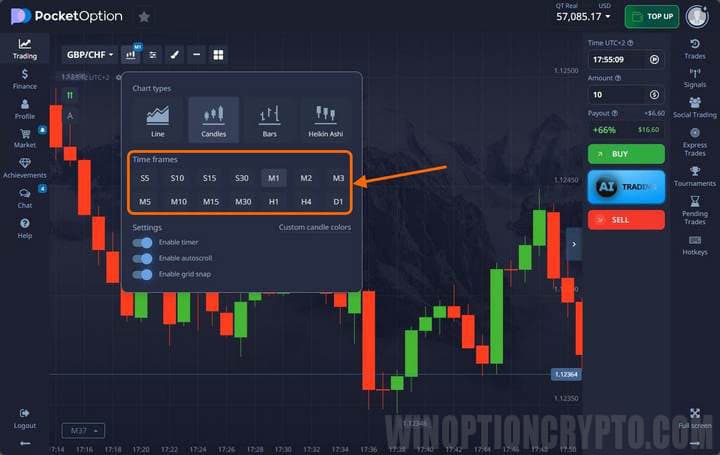
For traders who need to analyze second-based charts, most binary options brokers support this option, including Pocket Option:
Which Time Frame is Better for Binary Options
To determine which timeframe suits your trading, start by identifying your trading style. The main styles are:
- Scalping (turbo options).
- Intraday trading.
- Medium- and long-term trading.
It is worth noting right away that beginners are better off avoiding scalping. In addition to the higher risks that come with a large number of trades, this style demands experience, fast decision-making, and strong psychological resilience.
Long-term trading also requires knowledge and experience, but compared to scalping it carries significantly lower risks.
Once you have chosen your trading style, the next step is to decide on your analytical approach, which can be based on:
Clean chart trading can be further broken down into candlestick analysis, trading with support and resistance levels, graphical analysis, and Price Action.
Each approach has its pros and cons. Beginners most often gravitate toward strategies and indicators, as these are the most straightforward and require less prior knowledge. The other approaches demand a deeper understanding of patterns and rules, but they tend to be more effective and versatile — applicable across any market or timeframe.
Best Time Frame for Turbo Options
For turbo options trading, the best timeframes are M1 and M5, and ideally they should be used together. A practical approach is to conduct analysis on the M5 timeframe and then look for an entry point on M1. Expiration for this style of trading does not exceed 5 minutes, and is most commonly set to 1–3 minutes.
Some traders rely solely on the M1 timeframe for both analysis and trade execution. This approach requires experience, as you need a solid understanding of your trading instrument and a clear sense of when conditions are — and are not — suitable for a trade.
A straightforward example of turbo options trading involves analysis with the MACD indicator. On the one-minute chart below, you can see how the indicator crossing the zero level (or the Moving Averages on the indicator) generates a signal to buy a Call option with a 1-minute expiration:
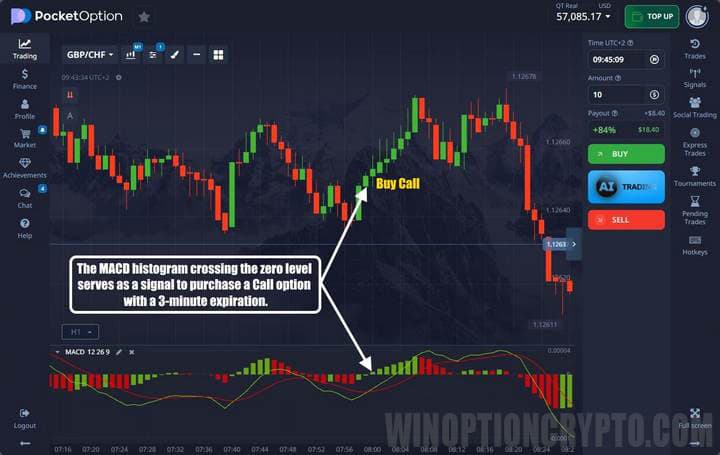
Note that a longer expiration could also have been applied in this case.
Here is another example of trading on short timeframes, this time using Price Action:
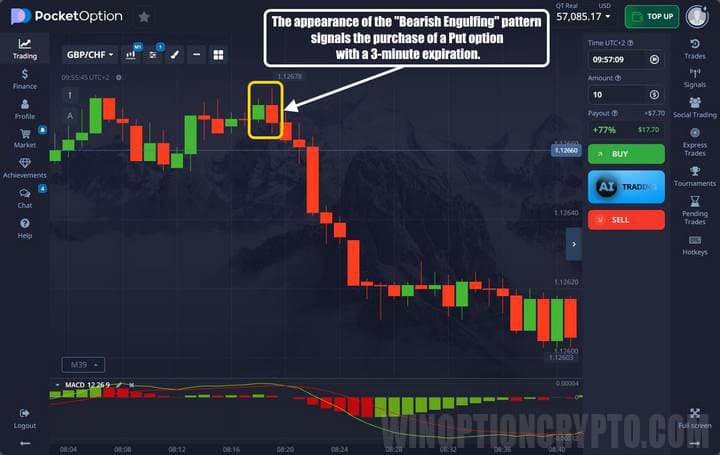
It is worth emphasizing that the examples above represent just a few of the many approaches to binary options trading. Before applying any of them, always test on a demo account first.
Best Time Frame for Long Term Options
For intraday trading, the best timeframes are M5 and M15, with trades typically held for at least 1 hour. Medium- and long-term trading uses timeframes from H1 and above, with expirations ranging from several days to several months.
The same methods and approaches demonstrated in the turbo options examples above can be applied to medium/long-term and intraday trading. In practice, only the timeframe changes — the market itself behaves the same way, and indicators and patterns function identically across all timeframes. The main distinction with larger timeframes is that fundamental factors carry more weight, which is why fundamental analysis becomes more relevant.
Below is a straightforward example of trading on the daily timeframe using levels built from the origins of strong price movements:
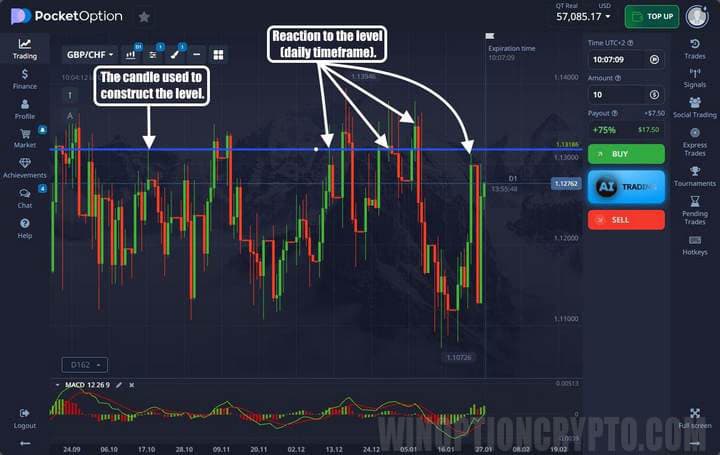
As you can see, even on the daily binary options timeframe, the same principles apply as on the one-minute chart.
Recommendations for Beginners in Choosing a Time Frame for Binary Options
When choosing the right timeframe for binary options, keep the following points in mind:
- Before selecting a timeframe, define your trading style — scalping, intraday trading, or long-term trading.
- Choose your analytical approach. Technical analysis and its various methods can be applied to any timeframe, while fundamental analysis is best suited to timeframes from H1 and above.
- Assess your risk tolerance. The higher the risk a trader is willing to accept, the greater the number of trades they can place — and the appropriate timeframe follows from that.
- At the early stages, beginners should avoid second-based or exotic timeframes such as range charts or volume-based candles.
Conclusion
You don't need to be a professional trader to determine which timeframe works best for binary options. That said, the examples above should not be taken as ready-made trading tactics or as a recommendation to trade in exactly this way. Successful binary options trading involves far more than copying someone else's approach. It is essential to develop your own trading method and build genuine experience — without it, generating consistent income in the financial markets is not realistic.
Test all your ideas on a demo account first, and only then transition to live trading. When trading with real funds, always follow the principles of money management and risk management.

To leave a comment, you must register or log in to your account.