
 There are many forms of analysis available to binary options traders, and fundamental analysis is one of the most powerful.
Fundamental analysis involves studying the underlying factors that affect exchange rates or the value of individual companies. Using this method, market forecasts are grounded in real-world events — factors that either reinforce an existing trend or trigger the formation of a new one.
Beyond identifying the direction of a price move, fundamental analysis reveals the force driving it. Understanding the basics of fundamental analysis will help take your trading performance to the next level.
What Is Fundamental Analysis?
When applying fundamental analysis to binary options, a trader or investor studies the economy of the country whose currency they are interested in. Changes in inflation, GDP, trade balance, and employment levels all influence currency values. Positive economic developments tend to strengthen a currency's exchange rate; negative developments weaken it.
The financial sector is another important factor. Changes in a central bank's base interest rate or a country's gold and foreign exchange reserves can cause the exchange rate to rise or fall.
Internal or external political instability also consistently affects exchange rate stability and should always be factored into the analysis.
Methods of Fundamental Analysis
Fundamental analysis is a complex discipline, and beginners are generally better off avoiding it in the early stages of their development. Understanding it properly requires experience and the ability to weigh many different factors — domestic and international events, macroeconomic data, and more. For this reason, fundamental analysis works best when used alongside technical analysis: the combination provides a more complete picture of the market, and when a macroeconomic judgement turns out to be incorrect, technical analysis can help correct the forecast.
The simplest application of fundamental analysis is news trading, which can be planned using the economic calendar. However, trading on news alone will not always be reliable, as many news events have only a short-term impact that is difficult to exploit in binary options. The main methods of applying fundamental analysis include:
- Data comparison.
- Seasonal analysis.
- Indicator correlation.
- Separation method.
- Generalisation method.
Data Comparison
This approach involves comparing the same economic indicators across different countries — for example, comparing GDP figures or interest rates to produce a directional forecast for a currency pair. Any significant macroeconomic indicator can be used, as these are universally applicable inputs.

Seasonal Analysis
This method applies to both currency and commodity assets such as oil, wheat, and natural gas. The premise is that commodity prices tend to move in predictable ways at certain times of year — rising or falling depending on harvest cycles (wheat, soybeans, sugar) or seasonal production patterns (oil, gas). For currencies, increased or decreased consumption of key goods during holidays and vacation seasons can affect the broader economy and thereby strengthen or weaken a country's currency.
Indicator Correlation
This approach uses not just the primary macroeconomic indicators but also secondary ones to build a forecast. By comparing data across multiple inputs, it becomes possible to identify correlations between them that point to a likely price direction.
Separation Method
Using this approach, an analyst groups currencies into categories and then calculates indices for each group. This method requires a high level of professional expertise and a thorough understanding of the underlying calculations — it is not suitable for beginners.
How to Apply Fundamental Analysis in Trading
Fundamental analysis can be applied in several ways. Some approaches suit short-term trades; others are designed for medium- or long-term positions. What they have in common is that all are triggered by specific news events or developments.
Short-Term Binary Options Trading on News
The most accessible application of fundamental analysis is short-term news trading. A clear example is trading around FOMC (Federal Open Market Committee) statements. Announcements from this Federal Reserve committee almost always have a significant impact on the currency markets — particularly on EUR/USD:
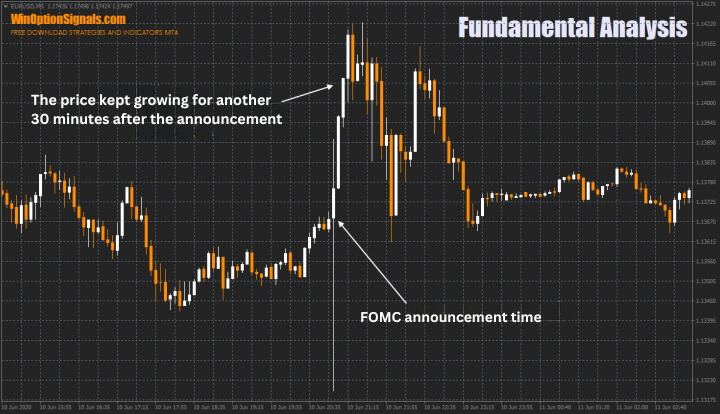
As shown, price began to rise following the committee's announcement. Binary options have an inherent advantage in this context: the size of the price move is irrelevant, and a temporary false breakout in the opposite direction does not affect the trade outcome, since the maximum loss is always fixed.
For news-based trades, options with expirations of 15 to 30 minutes are generally appropriate, depending on the impact of the release.
It is also worth noting that thorough fundamental analysis is particularly valuable for events that are technically difficult to forecast using indicators, strategies, or price levels alone.
Natural Disasters
Such events are rare, but they are always worth monitoring — they can create significant trading opportunities.
One well-documented example is Hurricane Katrina, one of the most destructive natural disasters in US history, which caused enormous economic damage. The event occurred at the end of August 2005:
.png)
As the chart shows, the US dollar weakened significantly at the time of the disaster (with the euro rising correspondingly, as this is a currency pair, not a single currency). Once the immediate crisis passed and recovery work began — creating new employment and stabilising the economy — the dollar recovered.
Fundamental Analysis and Stock Prices
Fundamental analysis can also be used to assess the value of company shares. Earnings reports are the most commonly used input, but many other factors can move a stock's price.
For example, Apple shares have risen in approximately 90% of cases following the launch of a new iPhone:
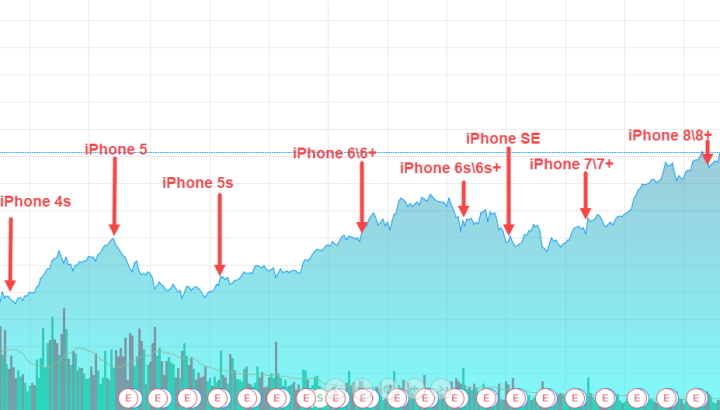
As shown above, the only exception over the period studied was the iPhone 5 launch, where the stock did not rise. In all other cases, a positive price reaction followed.
Conclusion
Fundamental analysis is more complex than most other forms of market analysis, but it can be genuinely valuable in both short-term and longer-term binary options trading.
It should not be used in isolation, however. Fundamental analysis is most effective when supported by technical analysis — using both together ensures that the same price direction is confirmed by multiple methods before a trade is opened.

To leave a comment, you must register or log in to your account.