
 Professional online trading comes with a large number of specialist terms, and without understanding them it can be difficult to make sense of information in this field. Every binary options trader who is serious about trading will need to learn a great deal, and to make that process easier we have put together a binary options glossary covering the most widely used terms.
This article contains core definitions relating to binary options trading and trading in general. The material will be useful not only for beginners, but also for traders who want to deepen their knowledge and expand their professional vocabulary. Some of these terms may already be familiar — others will likely be new.
Binary Options Trader's Glossary in Plain Language
Binary options trading — and trading in general — involves a vast number of words, phrases, and concepts, many of which even experienced professionals may not know. It is worth noting that most of these terms are not necessary to learn, as they simply do not come up in everyday binary options trading. What follows is an overview of the most commonly used words and phrases that traders encounter in forum discussions and trading communities.
Binary Options and Their Types
A binary option is a digital contract purchased by a buyer from a seller, granting the right to buy an underlying asset at a set price either at any point before expiration (American-style binary options) or at the moment of expiration (European-style binary options).
A Call option ("Higher") is a binary option that entitles its holder to a fixed payout if the price of the underlying instrument is above the initial price at the expiration time.
A Put option ("Lower") is a binary option that entitles its holder to a fixed payout if the price of the underlying instrument is below the initial price at the expiration time.
American binary options are options that the buyer may exercise before the expiration time — in other words, these types of binary options can be closed early. The drawback is that early closure returns a significantly smaller amount than was originally invested. Not all brokers offer American binary options, though they are not uncommon.
 European binary options are options that can only be closed at expiration. This is the standard option type and is available at every broker.
All-or-nothing options are the general term for a standard binary option that will either deliver a fixed return or expire worthless at expiration. The buyer must correctly predict the direction of the asset's price movement by the time the option expires.
"Higher/Lower" options are a digital contract in which the trader must predict in advance whether the price will rise or fall. This is the most common option type and is offered by all brokers.
"Up/Down" options are a digital contract similar to "Higher/Lower" options, in that the trader must predict the direction of price movement — but with the added requirement that the price must be above or below a specific level at the moment of expiration.
Touch options are options based on the trader's prediction that the price will reach a specific level before the contract expires. With a Touch Call option, the trader expects the asset to rise to a particular level during the life of the contract. With a Touch Put option, the trader expects the asset to fall to a particular level during the life of the contract.
"No Touch" options are binary options that pay out only if the price does not touch a specified level before expiration.
"Range" options are contracts based on the prediction that the underlying asset's price will remain within a defined range. For a Call option, the price must rise above the initial level but stay within the upper boundary. For a Put option, the price must fall below the initial level but remain within the lower boundary.
"Out of Range" options are digital contracts that pay out if the price moves outside a defined range before expiration.
"Turbo" options are binary options with very short expiration times. The expiration can start from just a few ticks, though 60 seconds is the most common setting. The maximum expiration time for turbo options is typically 5 minutes.
 "Spread" options are a type of option in which the trader must not only predict the direction of price movement but also how many points the price will move from the option's purchase price.
"Express" options are binary options in which a single trade combines three or more individual positions. For example, one express option might include a Call on EUR/USD, a Put on gold, and a Call on Apple shares.
Trading Binary Options
Underlying asset (base asset) — the common term in binary options trading for the currency pairs, stocks, cryptocurrencies, or stock indices that form the basis for calculating the value of derivative instruments such as binary options. While derivatives are entirely dependent on their underlying asset, the value of the underlying itself is driven by real-world factors including commodity prices, news events, and political and economic conditions.
Rate (price) — the current market value of the underlying asset. At the moment a binary option is purchased, this value becomes the initial price.
The initial price is the value of the underlying asset at the time the option is purchased. Whether the asset's price is above or below this level at expiration determines whether the trade is profitable.
Expiration price is the price of the underlying asset at the exact moment the option expires. This value determines whether the option finishes in profit.
Expiration time is the set time at which the option contract ends. At this point the option is considered closed. The trader's profit depends in part on choosing the right expiration time, since it is at this moment that the position of the underlying asset determines whether the option wins or expires worthless.
A trading strategy is a defined set of rules and principles that guide a trader's decision-making. The quality and type of strategy directly affect profitability, win rate, and risk exposure.
 The amount at risk is the amount of money invested in a contract that could be lost if the trade does not go in the trader's favour. By increasing or decreasing the position size, a trader proportionally increases or reduces their capital at risk.
The profit amount is the fixed return a trader receives if their option finishes "in the money" — that is, with a positive outcome. This figure is determined before the position is opened. Regardless of how far the price moves beyond the initial level, the profit percentage remains fixed once the forecast is correct.
ITM ("in the money") refers to an option that produced a profit at expiration — the underlying asset's price was in a favourable position for the trader. For example, a Call option is "in the money" when the underlying asset's value exceeds the initial price at expiration.
OTM ("out of the money") refers to an option that expired without meeting the trader's forecast. The underlying asset's price was in an unfavourable position. For example, a Call option is "out of the money" when the underlying asset's value is below the initial price at expiration.
ATM ("at the money") refers to an option where, at the moment of expiration, the value of the underlying instrument is exactly equal to the initial price.
A binary options robot (advisor) is a third-party plugin or program that trades binary options automatically based on a predefined strategy or algorithm built into the software.
Binary options signals are trading recommendations that specify which option to buy, when to buy it, and with what expiration time. Signals may be provided by a broker or an independent trader, and can be either free or paid.
Types of Trading Assets
Currency pairs are a type of trading asset made up of two currencies. Buying one currency automatically means selling the other. For example, buying the EUR/USD pair means buying the euro and selling the dollar.
Cryptocurrencies are a type of trading asset based on digital currencies that operate on a blockchain and may consist of coins or tokens. Examples include Bitcoin and Ethereum.
Shares are securities issued by a company to raise capital. Examples of companies whose shares are traded on global exchanges include Apple, Microsoft, and Coca-Cola.

Commodities are trading assets based on raw materials such as oil, gold, silver, and natural gas.
A CFD is a contract between a buyer and a seller to exchange the difference between the opening value of a position and its value at the time it is closed.
An ETF is a fund traded on an exchange. When you buy an ETF, you are not buying a single asset but a diversified portfolio based on a specific sector or theme — for example, an ETF made up of oil industry companies or precious metals mining firms.
An index is a calculated value that reflects the combined change in price of all the assets it includes.
A stock index is a value that reflects overall price movements across a group of stocks. Examples include the Dow Jones, S&P, and Nikkei indices.
Analysis and Forecasting
Technical analysis is a set of methods for analysing the price behaviour of an underlying asset using technical tools — whether mathematical calculations or charts. This includes indicators and chart-based techniques that help assess the likely direction of price movement. A well-known example is the moving average, which tracks the average price over time and helps identify trends.
Fundamental analysis is a set of non-technical methods for analysing factors that can influence the price of an underlying asset. These include economic and political events, changes in commodity and currency prices, and company-specific factors such as earnings reports. Traders who use fundamental analysis typically monitor the news for significant developments that may affect market conditions.
A trend is a sustained directional movement in asset prices over a given period of time, typically driven by consistent buying or selling pressure. Identifying a trend early allows a trader to make a more confident forecast when buying a binary option — which is why recognising price trends is a core trading skill.
A bullish trend ("bulls") is an uptrend in which the price rises most of the time.
 A bearish trend ("bears") is a downtrend in which the price falls most of the time.
A flat (sideways trend, consolidation) is a market condition in which the price moves within a defined range for an extended period.
Support and resistance are price levels to which the market reacts — the price tends to reverse or stall when approaching them.
Everything About Binary Options Brokers
Binary options brokers are companies that provide traders with access to financial markets. This category includes binary options brokers, Forex brokers, cryptocurrency exchanges, and others.
A live account is a trading account funded with real money for trading binary options or other instruments.
A demo account is a virtual account that requires no deposit and allows the trader to practise under the same conditions as a live account, but without the ability to withdraw any profits.
A deposit is the amount a trader funds their live account with in order to place trades.
Verification is the process of confirming your identity after opening a trading account. It is required to prevent money laundering and is mandated by financial regulators.
Trading tournaments are competitions organised by binary options brokers for their traders, offering the chance to win real money, bonuses, and other prizes.
A regulator is an authority that oversees brokers to prevent fraud and protect traders. Examples include CySEC (Cyprus) and IFSC (Belize).
Bonuses and Promotions
Bonuses are incentives offered by binary options brokers, which may take the form of cash, risk-free trades, or other rewards.
Promotional codes are alphanumeric codes that can be entered when making a deposit or in your broker's account area to activate a deposit bonus, risk-free trades, cashback, or other offers.
A risk-free trade is a trade that is cancelled in the event of a loss. For example, if you buy a Call option and it expires out of the money, applying a risk-free trade returns the full amount invested to your trading account.
A deposit bonus is a cash bonus received when funding your trading account. It may be credited as real money or as bonus funds, depending on the broker's terms.
A no-deposit bonus is a type of bonus awarded after registration with a binary options broker without requiring any initial deposit. The main condition is typically that you must not have any other active accounts with the same broker. This type of bonus is relatively rare and usually does not exceed $5.
Cashback is a type of bonus that returns a percentage of your losses on unprofitable trades. For example, if you place a Put option trade and lose $100, and the broker offers 5% cashback, you will receive $5 back into your account.
Terminals and Trading Platforms
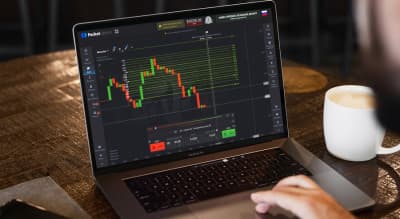
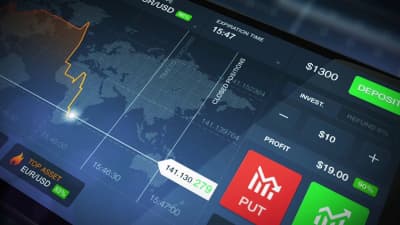 A trading platform (terminal) is an application through which traders access and trade on financial markets remotely. Most platforms also include built-in indicators and technical analysis tools.
MetaTrader 4 (MT4) is one of the most widely used trading terminals, supporting custom indicators and a full range of market analysis tools.
A chart is a tool for tracking price movements, conducting technical analysis, and monitoring trends. Charts can be displayed as candlestick, bar, or line charts across various timeframes.
A candlestick chart is a chart made up of individual candles, each consisting of a body and wicks (shadows). The body shows the price range between the open and close during a given period, while the wicks show the full high-to-low range.
A bar chart is functionally identical to a candlestick chart but displays price data in the form of bars, with marks indicating the open and close prices and the full price range.
A line chart is a simplified chart that displays only the closing prices, connected by a continuous line.
Timeframes are the time intervals by which chart candles or bars are grouped. Standard timeframes include 1, 5, 15, and 30 minutes; 1 and 4 hours; and 1 day, 1 week, and 1 month.
Indicators are algorithmic tools written in code that analyse price movements and generate trading signals.
General Concepts in Binary Options
Trader — a person who buys and sells instruments on financial markets.
Trading history is a record of all trades placed by a trader over a given period.
OTC — over-the-counter quotes that are available not only on weekdays but also on weekends and public holidays, when standard market quotes are unavailable due to bank closures.
Scam — fraud; in the context of binary options, this refers to brokers who deceive traders and refuse to process withdrawals.
Wiping out a deposit is a situation in which a trader loses their entire account balance and is unable to place further trades until they make a new deposit.
Growing a deposit is a situation in which a trader significantly increases their balance through trading. For example, if you deposited $100 and your account reaches $1,000 after a month, you have grown your deposit tenfold — a 1,000% increase.
Volatility is the degree of price movement in a trading asset. For example, ahead of major news releases, the volatility of currency pairs can increase sharply as large volumes of buying and selling occur simultaneously, causing prices to move hundreds of points in minutes.
"Holy Grail" is the informal term for a trading system, indicator, or method that supposedly generates 100% profitable signals. In reality, no such system exists.
 Martingale is a money management method in which the trade size is doubled after each loss. The resulting sequence looks like this: $1 – $2 – $4 – $8 – $16 – $32, and so on.
Anti-Martingale is a method that works in reverse: the trade size increases after a winning trade, not a losing one.
The bid price is the highest price at which buyers are willing to purchase an asset on the exchange.
The ask price is the lowest price at which sellers are willing to sell an asset on the exchange.
Return value (% protection) — a percentage of the initial investment that is returned to the trader if the option expires out of the money. For example, if a trader buys an option for $100 with 15% protection set, they will receive $15 back if the trade is unsuccessful. This return percentage is defined before the position is opened, as is the payout for a winning trade.
Trading session hours refer to the times during which options can be traded. Trading may be restricted not only by time of day but also by specific days of the week or calendar dates.
End of the trading day — the close of the trading session.
Turnover is the total volume of an underlying asset (such as shares) bought or sold within a given time period. For example, if two trades of 100 and 250 units each take place within an hour, the total turnover for that period is 350 units.
Money management is the practice of managing trading capital to maximise returns and limit losses — in practical terms, it means controlling the size of each position.
Risk management is the practice of identifying and controlling the risks involved in trading to protect capital and improve long-term results.
A trading journal is a record in which a trader logs all their trades and analyses them to identify and correct mistakes. For example, a journal can reveal patterns such as taking on excessive risk after a loss, or consistently missing profit opportunities.
Trading psychology covers the techniques and practical exercises that help traders develop the mental qualities that support profitable trading, while reducing the influence of emotional factors that work against it.
Correlation is a relationship between certain trading assets that tend to move in a similar way and react similarly to news and fundamental events.
Investment — the amount of money committed when opening a position.
Straddle is a combination of a Call and a Put option with the same expiration time, in which the initial price of the Call is lower than that of the Put. This type of position is used to reduce overall risk.

To leave a comment, you must register or log in to your account.