
Choosing the correct binary options expiration is extremely important in trading. Your trading strategy is the main factor influencing this choice, as it determines how frequently you buy binary options based on emerging signals. When purchasing a Call or Put option, the trader sets the expiration time — the interval during which the digital contract remains valid. At the end of this period, the trade closes automatically. Expiration time is not just a minor setting; it significantly affects your potential profit.
Expiration is one of the key features that distinguishes binary options from the Forex market. It is therefore essential to understand how to choose the correct expiration time for a binary option.

Contents:
- What is expiration time in binary options;
- Types of binary options expirations;
- Turbo (expiration from 30 seconds to 5 minutes);
- Ultra-short (intraday trading);
- Short-term (expiration from 1 day to 1 week);
- Medium-term (expiration from 7 to 30 days);
- Long-term options (expiration from 1 month to 1 year);
- How to choose the right expiration time for a binary option;
- Selecting the optimal expiration time for a binary option;
- The relationship of strategies and timeframes with the expiration time of binary options;
- How is the expiration time of a binary option and the timeframe related?
- Relationship between expiration and trading strategy;
- Conclusion: how to choose the right expiration time for a binary option.
What Is Expiration Time in Binary Options
The expiration of a binary option refers to the period after which the trade closes with a defined financial result. For example, if the expiration time is set to 15 minutes, the trade will close automatically after that period and the trader will know whether the position finished in the money or at a loss. Expirations can also be much longer — some brokers allow trading options with expirations ranging from 1 day to several months. It is important to understand that the expiration time must always be selected before entering a trade.
Different types of binary options allow the trader to choose the most suitable expiration. The specific options available depend on your broker's trading platform:
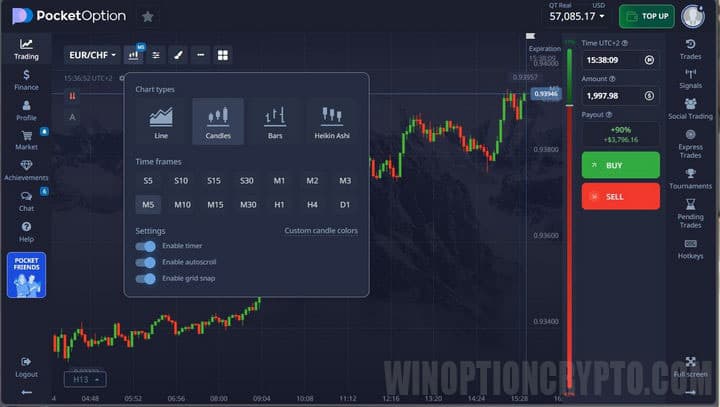
Traders most commonly use minute-based expirations, but many other periods are available:
- seconds (30 seconds);
- minutes (1, 2, 3, 5, 10, 15, 30, 45 minutes);
- hourly (1, 2, 3, or 4 hours);
- daily (1 day);
- weekly (1 week);
- monthly (1 month);
- quarterly (3 months).
Types of Binary Options Expirations
Each broker has its own trading conditions, and expiration options can vary accordingly. There are short-term trades and contracts lasting 30 days or more. Each type carries a different level of risk and, consequently, a different payout percentage.
Novice traders often pay little attention to the time factor, underestimating its impact on the final result. This tends to change only after they gain some experience in the financial markets.
Based on the expiration period, binary options can be divided into the following categories:
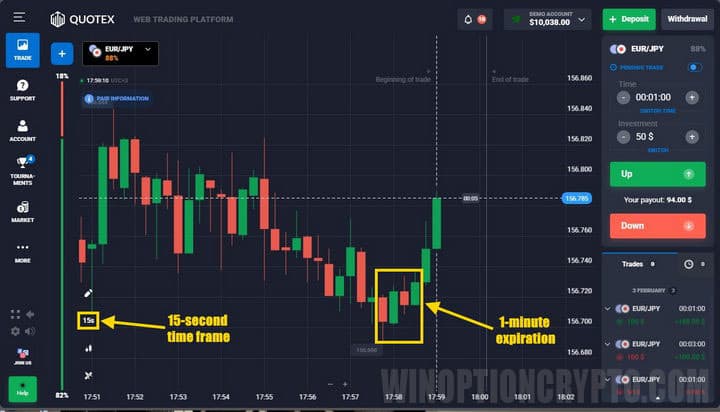
- Turbo. Expirations of no more than 5 minutes, most often 60 seconds (1 minute) or less. Binary options with such short expirations should only be used by experienced traders, as predicting price movements within such a limited time frame is extremely difficult.
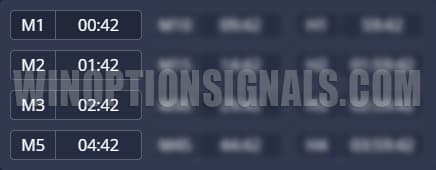
- Ultra-short. Valid for 1–24 hours. The optimal starting point is from 1 hour. These options are worth trading when paired with an appropriate strategy that accounts for their specific characteristics. Effective forecasting is challenging because available data is minimal.

- Short-term. Cover a period from one day to one week. It is advisable to close all positions no later than Friday, as unexpected events over the weekend can significantly affect price movements.
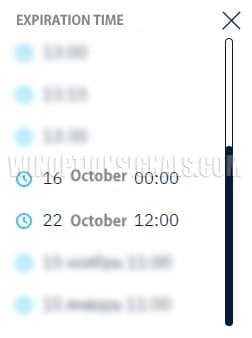
- Medium-term. Last 7–30 days. Trading signals must be filtered and confirmed from multiple sources. The full range of factors influencing the price should also be incorporated into the analysis.
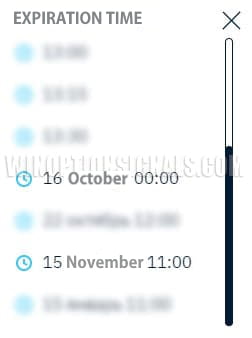
- Long-term. Primarily used by professional traders, including large financial institutions. The contract duration ranges from one month to a year or more. Trading conditions differ significantly from other option types — for example, the minimum trade size is much higher. When modeling future market conditions, all fundamental factors are taken into account, such as the political environment, the actions of major commodity producers, and similar macro-level influences.
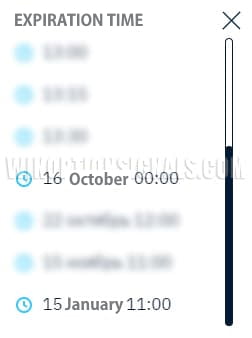
The expiration of a binary option also depends directly on its type. An American option is a more flexible instrument that allows the trader to shorten the expiration on an open position — useful when a trader realizes they have made a mistake and wants to exit as quickly as possible. European binary options do not offer this feature.
Some brokers offer clients another useful feature: extending the closing time. If a trader is confident that the price will reverse and reach the desired level, they can select this option to increase their chances of finishing in the money.
Each of these expiration types is covered in more detail below.
Turbo (Expiration from 30 Seconds to 5 Minutes)
The expiration time for these options ranges from 30 seconds to five minutes. This time frame is used exclusively by experienced traders, as operating within such a limited window demands strong emotional discipline, psychological resilience, and professional skill. This style of trading is known as binary options scalping, and traders who specialize in turbo options are called scalpers.
Traders can execute a large number of trades within a single session. Turbo options can generate a higher payout percentage from the broker. However, this style of trading carries significant risk. Market noise is an unavoidable factor when working on such compressed time frames, which prevents indicators and other tools from generating reliable signals.
The Martingale and Anti-Martingale methods are popular among turbo options traders. These approaches can increase profits but also require a larger trading deposit:
Ultra-Short (Intraday Trading)
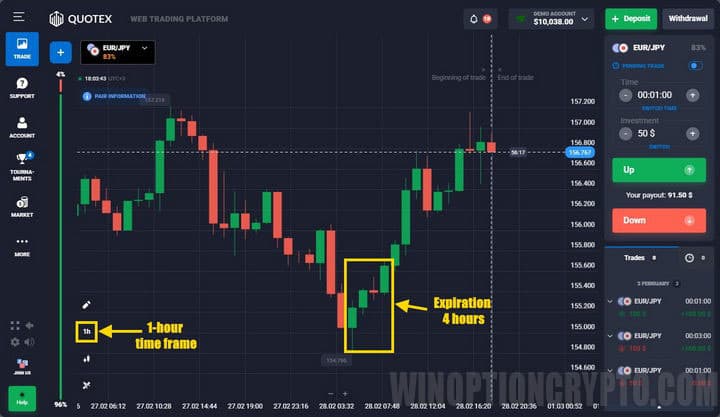
In this format, traders work with binary options whose expiration time ranges from 1 to 24 hours. Compared to turbo trading, this approach gives traders access to a broader set of analytical tools, since price movements can be tracked over a longer period. This makes it easier to identify trend direction and reduces the distorting effect of market noise. Intraday traders can also make more effective use of:
- indicators;
- trend analysis;
- support and resistance levels;
- graphical analysis;
- candlestick analysis;
- Price Action.
For intraday trading, brokers typically offer a relatively high payout percentage:
Short-Term (Expiration from 1 Day to 1 Week)
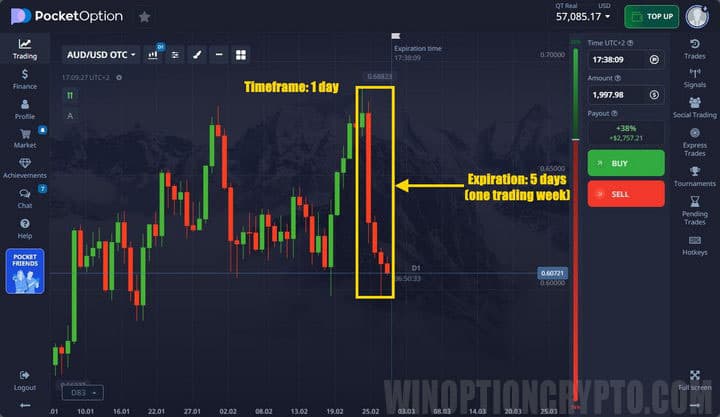
Traders working with these expirations also have access to the full range of tools described above. However, with longer binary options expirations, particular emphasis should be placed on technical and fundamental analysis. When all parameters are properly accounted for, traders can produce reasonably accurate forecasts.
It is worth noting that this trading format limits the number of trades per session on a given asset. When you purchase an option with a one-day expiration, no additional trades can be opened on that asset until the position closes.
Traders who prefer to minimize losing trades often gravitate toward these expirations. By factoring in the news background alongside price direction, they can better gauge the current market sentiment:
Medium-Term (Expiration from 7 to 30 Days)
Medium-term binary options trading differs from the previous category primarily in duration. The analytical approach remains the same, with the main emphasis on fundamental factors supported by technical analysis and trend confirmation. Only experienced traders typically use expirations in this range:
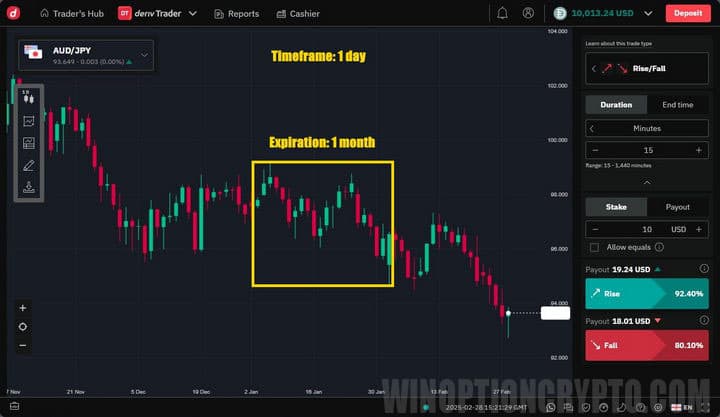
Long-Term Options (Expiration from 1 Month to 1 Year)
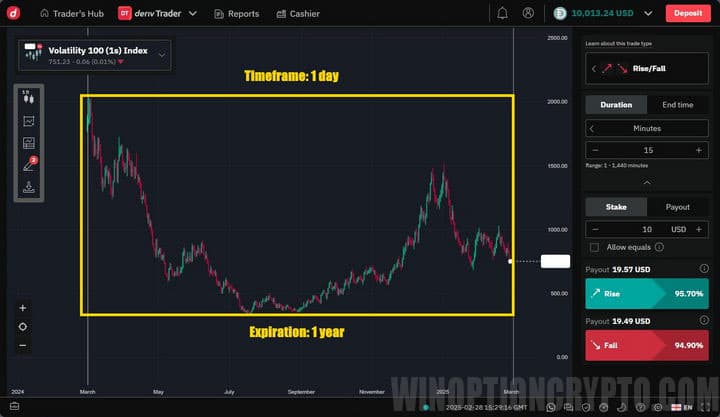
These binary options are also the domain of experienced traders who understand the dynamics of long-term market behavior. Expiration periods in this category range from 1 month to 1 year, and placing orders with such extended expirations requires a substantial trading budget.
One notable limitation of this approach is that not all brokers support these time intervals:
How to Choose the Right Expiration Time for a Binary Option
Choosing the right expiration time is one of the most important decisions a trader makes. Its significance increases with the size of the trade. The underlying principle is straightforward: the success of a binary options trade depends on the accuracy of the forecast. If a trader correctly predicts the price direction and that direction holds throughout the entire expiration period, the trade finishes in the money. This is why the same trade — for example, a Call option on the same asset — can be profitable at a 10-minute expiration and unprofitable at 30 minutes, or vice versa.
When in doubt about which expiration to choose, opt for the longer one. Short expirations reflect only a fragment of the broader picture, so it is worth analyzing trends on a wider scale and reviewing price movements across multiple timeframes to identify new trend formations or corrections in time.
Trading intraday requires a solid understanding of chart analysis on shorter time frames. Options with brief durations — from a few minutes to an hour — carry the highest risk. Beginners are often drawn to them for the promise of quick results and high payouts, but the outcome is frequently disappointing: traders lose their deposit before grasping the finer points of this style.
Classic technical analysis is largely ineffective for turbo options. Trading purely on news releases is also unreliable, as some brokers restrict short-term trades ahead of major publications. In practice, traders must either rely on price action approaches such as trend lines — where a breakout serves as a clear entry signal — or accept a higher degree of uncertainty.
Experienced traders recommend that beginners focus on longer-term trades first, as their outcomes are considerably easier to forecast. The associated risks are lower, as are the payouts. Economic factors and broader external conditions have a strong influence on future price movements, which can form the basis of a strategy without relying heavily on technical data.
The more experience a trader accumulates, the better their judgment becomes when selecting the appropriate expiration for any given situation.
Choosing the Optimal Expiration Time for a Binary Option
Traders who prefer short-term trading need to match the binary option type to the appropriate expiration time. Working at short intervals is a fast way to build experience, but it is not recommended for beginners with no prior trading background.
Trading assets and expiration times can be matched by asset type as follows:
-
from 5 minutes to 1 hour — currency pairs
-
from 1 hour to 1 day — indices, commodities
-
from 1 day to 1 month — cryptocurrencies, shares
-
from 1 month to 1 year — any instruments; note that at this horizon, the activity is better described as investing rather than active trading
The relationship between asset type and optimal expiration period is not covered in sufficient depth in most trading literature. A novice trader needs practical guidance to plan their work effectively. For example, the prices of some currency pairs are relatively stable compared to commodities such as gold or oil, which tend to be highly volatile intraday. Price movements in currency pairs are therefore easier to forecast, and professionals recommend opening trades for shorter durations (from 1 hour) and increasing trade frequency. Currency pairs can of course also show significant volatility, but sharp moves in currencies are more often driven by fundamental factors — political developments and other global events — rather than supply and demand dynamics alone.
Experienced traders recommend that beginners practicing on demo accounts set the expiration time to 3 to 5 candles relative to their chosen timeframe:
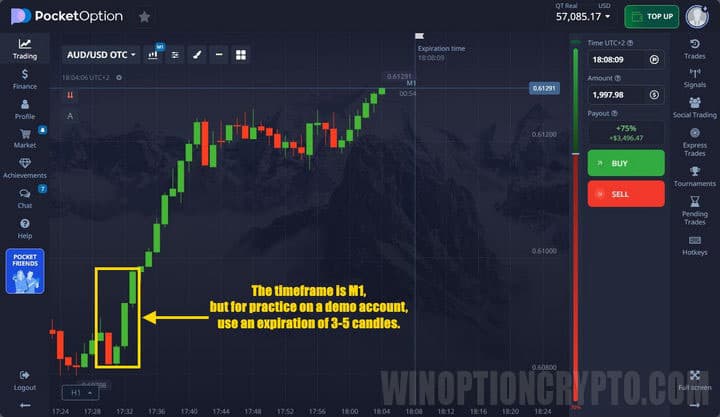
This rule can be applied across different assets and chart types. However, it is primarily useful during the practice stage. Once a trader has built up sufficient experience, it is worth developing a personal trading strategy with a tailored approach to expiration selection.
The expiration period also depends on the underlying asset. As noted earlier, short-term trading is best suited to currency pairs, commodities, and stock indices, since the prices of these assets tend to move more predictably without sudden sharp swings. This makes it easier for traders to forecast price changes over short expirations.
Cryptocurrencies and stocks are more commonly traded with medium- and long-term expirations. The prices of these assets are subject to the influence of numerous factors and can shift significantly within relatively short time intervals.
As noted earlier, the choice of expiration time must take the timeframe into account. Both parameters are important tools in developing a binary options trading strategy. The section below examines how expiration and timeframe relate to one another.
The Relationship Between Strategies and Timeframes and the Expiration Time of Binary Options
A timeframe is the time interval at the end of which a candle or bar closes on the chart. The expiration of a binary option is the period after which the trade closes automatically.
When trading binary options, traders do not use tools such as stop loss and take profit. To make a profit, a trader only needs to correctly determine the direction of price movement for the chosen expiration period. Based on their forecast, the trader decides whether to buy a Call or Put option.
How Is the Expiration Time of a Binary Option and the Timeframe Related?
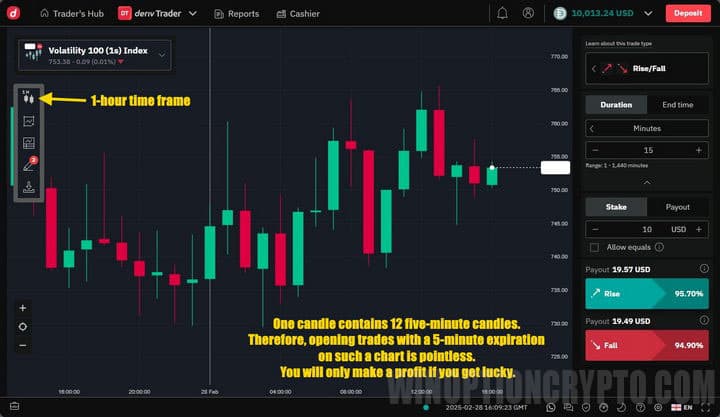
Many novice traders fail to see the connection between these two concepts. As a result, some make consistent mistakes by opening losing trades. A common error is selecting an incompatible timeframe and expiration. For example, setting a 5-minute expiration while working on an hourly chart makes accurate forecasting nearly impossible — under these conditions, trade outcomes are largely determined by chance. This significantly increases the risk of losing your deposit. The conclusion is clear: the expiration time of a binary option must align with the selected timeframe:
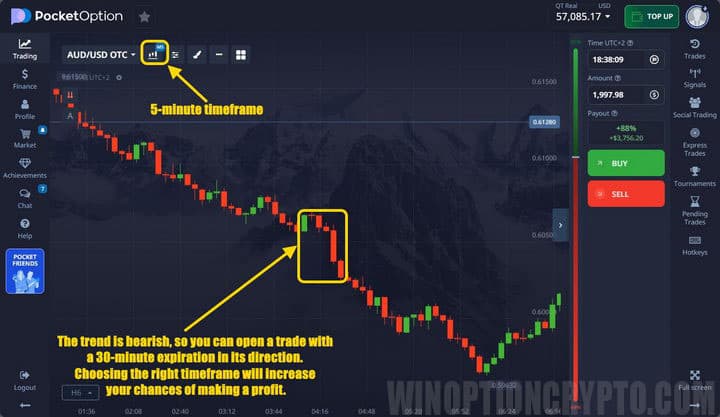
If the M5 timeframe is selected, each candle on the chart takes 5 minutes to form. After conducting the relevant analysis, a trader can estimate what price level may be reached after, say, 30–60 minutes. By multiplying the number of candles by the timeframe duration, an approximate expiration time can be calculated.
Here is a practical example: on an M5 chart, a bullish trend begins to develop. Based on this, the trader estimates that after approximately five candles the price will exceed the current level. In this case, buying a Call option with a 25-minute expiration would be a logical choice.
A key rule to follow: the expiration time of a binary option must never be shorter than the timeframe in use. If it is, the candle does not have enough time to fully form during the expiration period, meaning that price direction cannot be confirmed. The probability of making an accurate forecast under these conditions is very low, and there is a high risk of short-term price impulses producing erratic moves that, while irrelevant over a longer horizon, will cause the trade to close at a loss:
Relationship Between Expiration and Trading Strategy
The contract duration is an essential factor in the effectiveness of any trading strategy. When using ready-made strategies or indicators, the rules typically already specify a recommended expiration. When working with a system sourced from the internet, keep the following in mind:
-
Each strategy was developed with a specific expiration time in mind.
-
Long-term expirations require a fundamentally different analytical approach compared to short-term strategies. Forecasting over extended periods relies heavily on fundamental factors.
-
For short-term chart periods, technical analysis based on indicator signals and other binary options trading methods takes priority.
Beginners also need to learn how to trade around news releases. This requires knowing the publication schedule for key economic data and understanding their likely impact on the market. This information can always be found in advance in the economic calendar.
One effective method for finding entry points is to monitor several charts simultaneously. The primary chart uses the base timeframe, while a second chart uses a timeframe two levels lower. For example, if your base timeframe is D1, you would use H1 as the secondary chart to time your entries. This principle also applies to setting expiration times. When trading on the M5 chart, for instance, an expiration of 30 minutes is a common starting point.
Conclusion: How to Choose the Right Binary Option Expiration Time
Expiration time is a critical component of any strategy and directly influences the level of risk involved. With the right expiration, a trader can find opportunities across any market and time frame.
The specific contract duration is determined after a thorough analysis of the chart and depends on the type of financial instrument being traded. Different expiration periods are appropriate for indices, currency pairs, stocks, and cryptocurrencies.
The expiration must always be selected in line with the timeframe. Turbo options, for example, should not be traded on an hourly chart. Equally, opening long-term digital contracts while working on a several-minute chart is inadvisable.
The optimal approach is for the expiration period to be a whole-number multiple of the timeframe. For example, when trading on the M5 chart, suitable expirations would be 10, 15, 20 minutes, and so on.
To leave a comment, you must register or log in to your account.