
Binary options are a simple and accessible financial instrument, which explains the rapid growth of their popularity. Despite being a relatively recent development, there are now many different types of binary options available.
The most popular varieties today are "Up/Down" and "Higher/Lower," though these are far from the only ones.
The underlying principle is the same across all types of binary options: to complete a trade, you buy a call or put option based on your forecast. Profitability varies depending on the type — with classic options, returns typically range from 55% to 95%, while exotic options can yield 500% or more.

Below, we will look in detail at all the types of binary options currently available.
Contents:
- Pros of trading binary options;
- Types of binary options;
- Types of classic binary options;
- Binary options "Higher/Lower";
- Using "Higher/Lower" options in trading;
- Binary options "Up/Down";
- Using Up/Down options in trading;
- Binary options "Touch";
- Using Touch options in trading;
- Binary options "No Touch"
- Using binary options "No Touch" in trading;
- Binary options "Range";
- Using binary options "Range" in trading;
- Binary options "Out of Range";
- Using binary options "Out of Range" in trading;
- Binary options "Turbo" or turbo options;
- Using turbo options in trading;
- Binary options "Spread";
- Using binary options "Spread" in trading;
- Binary options "Express" or express options;
- Using binary options "Express" in trading;
- Exotic types of binary options;
- Which type of binary options to choose?
Pros of Trading Binary Options
When trading on the Forex market, for example, a trader who opens a position on a currency pair for 0.1 lot expects to earn $80 if the price moves 80 pips — each pip has a fixed monetary value. When opening a position, the trader does not know how long it will take for the price to reach the target level; this depends on market volatility, the activity of other participants, and other factors. The price may never reach the take-profit level, reversing instead and turning a potential profit into a loss.
Binary options work differently. The key difference between binary options and Forex is that with binary options, you do not need to predict how many points the price will move — only the direction of the price at the time the option expires matters. For some option types, the expiry can be as short as one or two minutes; for others, it can be weeks or even months.
As a result, profit on a binary options trade depends solely on which direction the price moves. Some traders prefer to make a large number of short-term trades in a single day, while others prefer longer-term positions. To accommodate all trading styles and attract the widest range of clients, binary options brokers regularly introduce new option types, making trading more flexible.
Types of Binary Options
Binary options are first divided into categories, and then into specific types. Varieties such as "Up/Down," "Higher/Lower," and others represent the different types, while the broader categories include:
- European binary options;
- American binary options;
- Bermuda binary options.
 Each category has its own trading conditions. European options are the most common: the trade is opened with a set expiration and closes only when that expiration is reached. American options can be closed early at any time, though the profit percentage will be significantly lower. Bermuda options can also be closed early, but only at specific predetermined dates or times.
The wide variety of binary option categories and types can be confusing for newer traders and can make it difficult to select the right instrument. Choosing the wrong type can result in significant losses. For this reason, beginners are advised to start with classic binary options before exploring other varieties.
Types of Classic Binary Options
Classic binary options ("Higher/Lower") are where binary trading began. All subsequent types are built on the same core principles. Brokers may use different names for the contracts they offer, but the essence remains the same: predict the direction of price movement, select an expiration, and place the trade. A correct prediction yields a profit of 55% to 95% (and sometimes more) per trade.
Around 90% of traders use High/Low options, as they are the most transparent and straightforward. Other option types were largely developed to differentiate brokers from one another. For example, Quotex also offers turbo options, and Pocket Option offers express options and Up/Down options. The greatest variety is found at Deriv, which offers more than 15 types of binary options.
Beyond classic options, the other types are less well known and less widely used. They are often riskier or harder to understand than classic instruments. Even so, there are a considerable number of them; the most popular and widely available are covered below.
Binary Options "High/Low"
The most accessible and widely used type of binary options is the "Higher/Lower" option, which forms the basis of most traders' daily activity.
The principle of this classic option is straightforward: predict where the price will be relative to the entry price at the moment the contract expires. A profit is earned even if the asset moves by just one point above or below the entry price:

For example, if a trader believes the price will rise, they select an expiration and buy a call option, opening a position at the current price. When the specified time elapses, the contract closes and the outcome is recorded.
If the asset price at expiration is higher than the entry price, the trader receives the profit that was determined when the position was opened.
If the price at expiration is lower than the entry price, the trader loses the full amount invested in the trade.
Using High/Low Options in Trading
This type of binary option can be used in virtually any market condition. Both trending price movement and range-bound trading in a price corridor (flat) are suitable. The only thing that matters is that the price moves at least one point in the required direction before the contract closes.
If the closing price equals the opening price, the invested amount is returned to the trader's account. Note that this provision does not apply universally — trading conditions vary by broker and should be reviewed carefully before trading.
Expiration for "Higher/Lower" options can range from 30 seconds to 3 months. Longer-term trades with an accurate forecast can be less risky, since the price may move well away from the entry level, but their profit percentage is typically lower than with shorter expirations.
As an example, here is a put option trade opened in the direction of the prevailing trend:
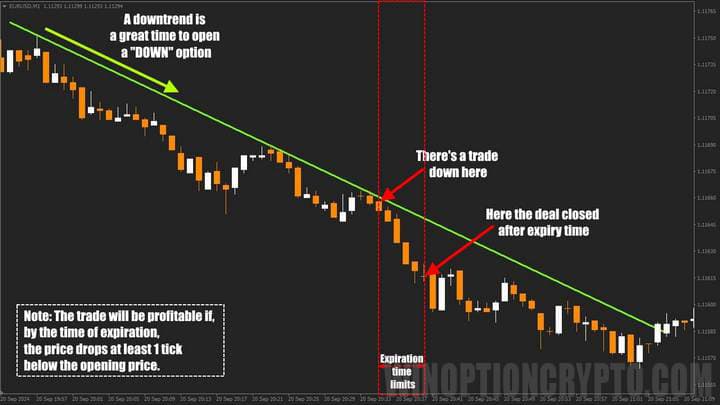
A "Higher" option closes in profit if the price at expiration is above the entry price; a "Lower" option closes in profit if the price at expiration is below the entry price.
Binary Options "Up/Down"
Now let's look at a riskier but potentially more rewarding type — "Up/Down" options.
As with other options, the trader must predict the direction of price movement. However, there is an additional condition: the price must be above or below a specific level at the time the contract closes. A profit is only made if both conditions are met:

In simple terms, with an "Up/Down" option the position is opened at the market price, but it begins in a loss-making state because a threshold level — set in advance — must first be crossed before the trade moves into profit.
If at expiration the price is above the level set when the option was purchased, the trade closes in profit and the predetermined profit amount is credited to the trader's account. If the price at expiration is below that level, the contract closes at a loss and the trader loses the full amount invested.
Using Up/Down Options in Trading
"Up/Down" options are only worth buying when there is a strong trend in the market. During a flat period, when the price moves within a narrow range, this type of option will most often result in a loss.
News trading is an excellent strategy for this option type. Following the release of significant news, the price can move sharply in one direction, creating conditions for a profitable trade.
An example of a trade using a "Boost" option during the release of major news:

"Up/Down" options have a longer expiration time than most other option types and are not suited to short-term trading. An expiration of at least 15–30 minutes is recommended; otherwise the price may not have sufficient time to reach the required level.
Binary Options "Touch"
When trading "Touch" options, the trader earns a profit if the price reaches a specific level at any point during the expiration period. A single touch of that level is sufficient for the trade to close in profit:
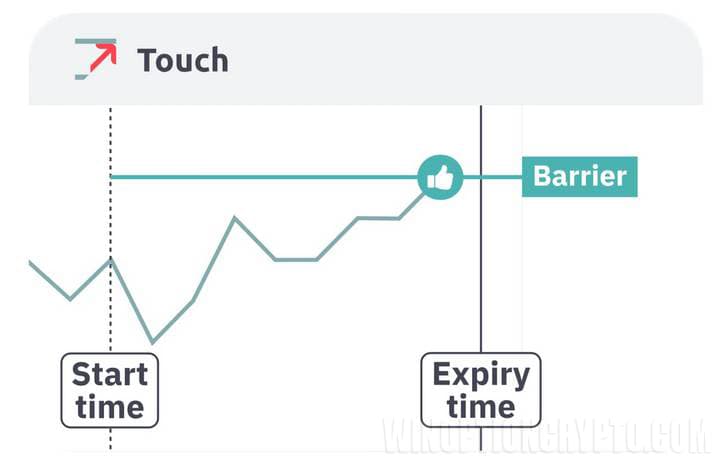
For example, suppose a trader anticipates a price decline and buys a put option. Below the current price, a target level is set (known at the time the trade is opened) that the price must reach before expiration. As soon as the price touches that level, the position closes early and the predetermined profit is credited to the trader's account.
If the price does not reach the target level before expiration, the trader loses the amount invested in the option.
The trading conditions for Touch options are appealing to both traders and brokers, and a wide variety of strategies have been developed for this option type.
Using Touch Options in Trading
As might be expected, Touch options work best during strong price impulses or sharp trend movements. Price impulses frequently occur around support and resistance levels, where the price either breaks through or bounces. In a flat market, these options tend to be ineffective, as the price is unlikely to reach the target level.
Traders using Touch options should also develop skills in technical analysis and learn how to identify strong support and resistance levels accurately. If the price is unable to break through such a level, the trade will close at a loss.
On the chart, a Touch option trade looks like this:
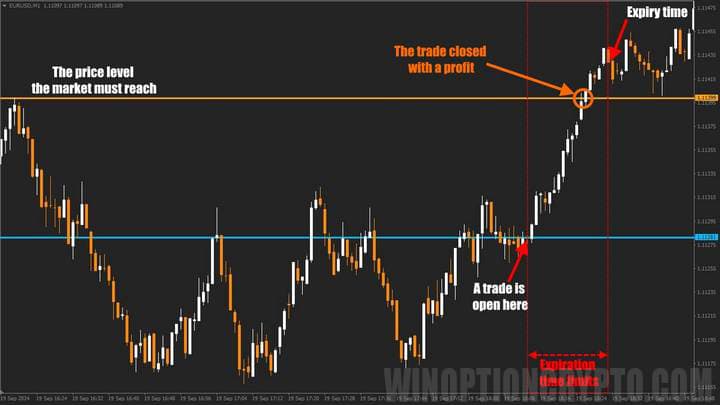
Short expirations are not used when trading Touch options. The expiration must be at least 15 minutes. Generally, the longer the trade duration, the further from the current price the target level will be set.
Binary Options "No Touch"
"No Touch" is the opposite of the Touch option. The trader profits if the price does not reach a specified level during the expiration period:

For example, a trader buys a call option. Below the current price, a boundary level is defined (known at the time the trade is opened) that the price must not reach before the contract expires. If the price touches that level at any point before expiration, the position closes early at a loss. If the price does not touch the level throughout the duration of the trade, the option closes in profit at the predetermined amount.
Using Binary Options "No Touch" in Trading
"No Touch" options can be used both in sideways markets (flat) and during trending conditions. The core task is to predict where the price will not go.
When using this option type during a trend, the trader should wait for a period of low market activity and open a position so that the boundary level — which the price must not touch — is placed in the opposite direction of the trend rather than in its path.
Trading in a flat requires a little more work: the trader must first identify the boundaries of the price range in which quotes are moving, then select conditions under which the boundary level falls outside that range. This maximises the probability that the price will not touch the level and increases the chances of a profitable trade.
On the chart, this option type looks like this:
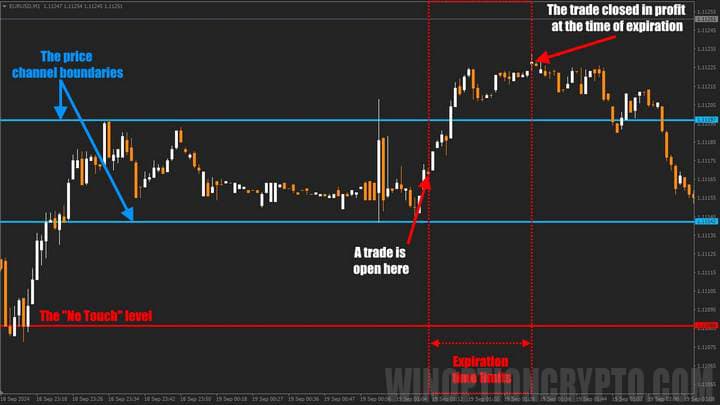
No Touch options can be purchased with any expiration. Time can work either for or against the trader — against if the price drifts closer and closer to the boundary level, and in favour if the price moves in the opposite direction. In general, the sooner the expiration arrives, the lower the probability of the price touching the boundary level and the better the trader's chances of a profit.
Binary Options "Range"
"Range" options — also known as "Ends Between" options — allow the trader to profit if the price at the time of expiration is within a range defined by two boundary lines:
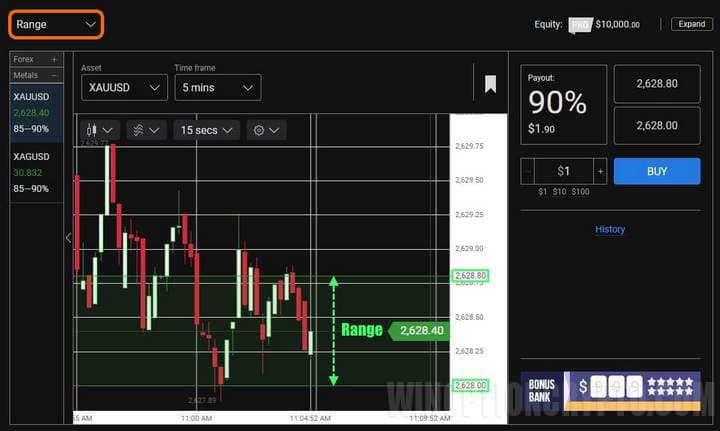
This option type is appropriate when the trader believes the asset price will remain within a narrow range for a period of time, with no strong impulses or trend movements expected. When buying the option, the upper and lower boundaries of the price range are specified — both levels are known to the trader before the position is opened, as is the profit that will be received if the price is within those boundaries at expiration. If the price exits the channel at expiration, the trade closes at a loss.
It is worth noting that during the life of the trade, the price may move outside the range. What matters is that it is within the boundaries at the moment of expiration. This option closes precisely at the specified time, with profit or loss determined by the position of the price at that moment.

Using Binary Options "Range" in Trading
"Range" options are most effective in calm market conditions — a weak trend or a flat. They are not suited to news trading.
The trader must accurately identify the flat and correctly define the price range boundaries, then compare them with the channel offered by the broker's "Range" option. If the conditions align, a position can be opened. Note that expiration period and channel width are inversely related: the shorter the trade duration, the wider the price channel, and vice versa:

Binary Options "Out of Range"
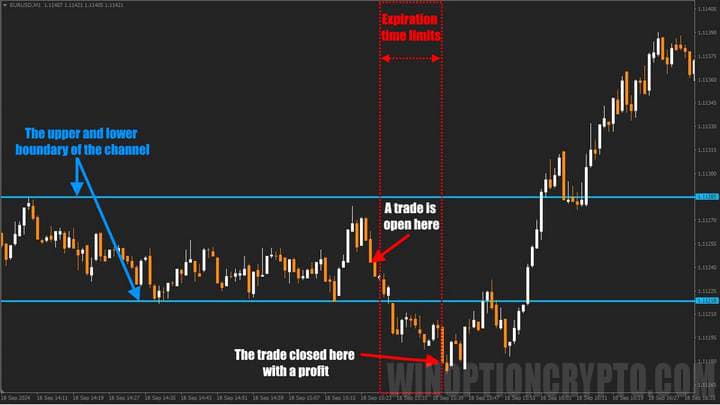
The opposite of the Range option is the "Out of Range" option — also known as "Ends Outside." This type pays out if the price at expiration is outside the specified price channel:

This option type is suited to situations where the trader believes the asset price will be in a trending move and will not enter a flat or consolidation phase.
When placing the order, the upper and lower boundaries of the price channel are specified, and both levels are known to the trader before the position is opened. If at expiration the price is within the channel, the trade closes at a loss. If the price is outside the channel at expiration, the trade closes in profit at the predetermined amount.
As with Range options, only the price at the moment of expiration determines the outcome. During the life of the trade, the price may cross the channel boundaries multiple times — what matters is where it is when the contract expires.
Using Out of Range Binary Options in Trading
Out of Range options work best during strong trends or around the release of important economic news. The trader must anticipate trending price movement or the end of a flat period followed by a breakout. In calm markets with a narrow price range, the option is unlikely to be effective. It is also worth noting that the longer the contract duration, the wider the price channel will be:
Binary Options "Turbo" or Turbo Options
Turbo options are short-duration binary options that can be based on either elapsed time or a specified number of price ticks:
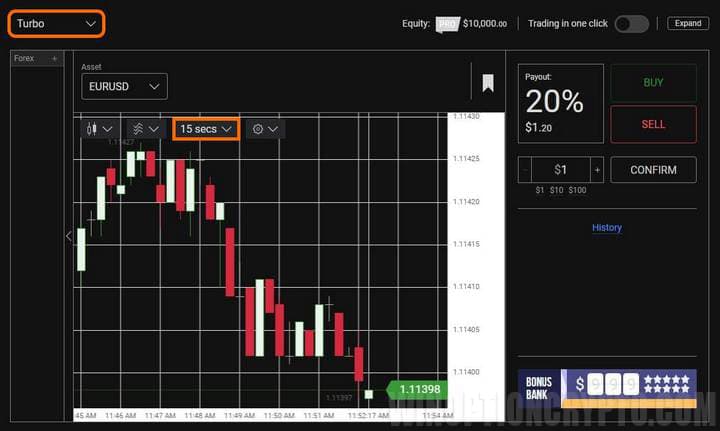
The principle is similar to "Higher/Lower" options, but turbo options allow for very short expirations (from 30 to 60 seconds) or tick-based closings.
For example, if a trader expects the price to rise, they buy a call option. The position is opened at the market price. With a 30-second expiration, the trade closes after that time and a profit is made if the price is above the entry level.
If ticks are used instead, the trade closes after the price moves a specified number of ticks (on a 5-digit currency pair, one tick equals 0.00001). The profit condition is the same — the price must be above the entry level at close. The profit amount is determined before the option is opened.
If the asset price at the end of the contract is below the entry level under either expiration method, the trade closes at a loss and the trader loses the amount invested.
Note that turbo options include both tick-based trades and any trade with a time expiration of 30 to 60 seconds.
This option type carries significant risk and should only be used by experienced traders.
Using Turbo Options in Trading
Turbo options can be applied in any market — trending, ranging, or during impulse moves following news releases.
It is worth being candid: turbo options resemble speculation more than considered trading. In such a short timeframe, even the most experienced trader will struggle to make a reliable price forecast, and there is inevitably an element of chance involved.
Trading turbo options with a 30-second expiration looks like this:

In such a short timeframe, the price can reverse multiple times, which is why turbo options are considered both risky and difficult to predict.
Binary Options "Spread"
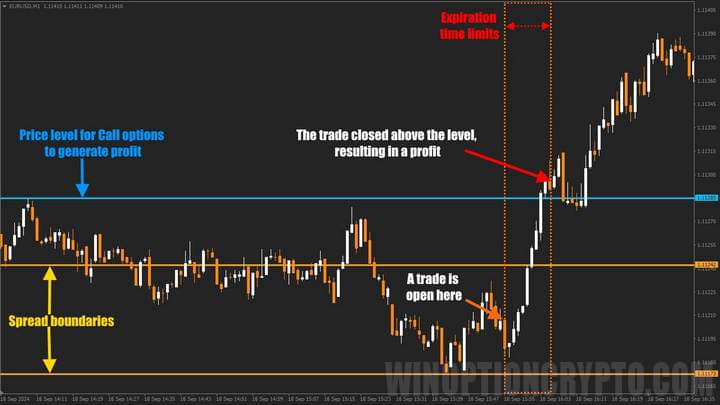
"Spread" options are similar to "Up/Down" options, but require the trader to predict not only the direction of price movement but also the magnitude — specifically, how many points above or below the entry price the quotes will be at the time the trade closes:

Using Binary Options "Spread" in Trading
The approach to trading Spread options is essentially the same as for "Up/Down" options. Before buying, the trader can see the levels the price must reach for the trade to be profitable.
On the chart it looks like this:
Binary Options "Express" or Express Options
"Express" options (also called express options) can generate very high returns, but they are among the most complex to trade. Returns on this type can reach 500% or more — with a complex express option involving many assets, payouts can theoretically reach 10,000%. The trade-off is that the probability of an express option closing in profit is very low:
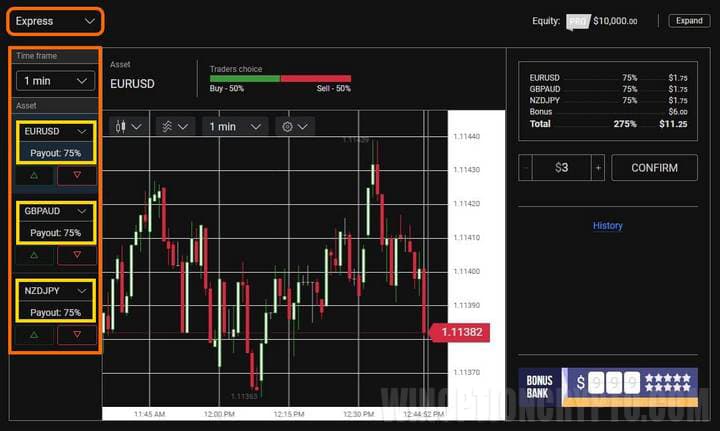
The concept behind express options is to make a combined forecast across several trading assets — essentially placing two or more trades within a single option. The more assets included, the higher the potential profit. Any trading assets and expiration times can be combined.
For example, a trader could create an express option by buying a call on EUR/USD with a 1-hour expiration, a put on gold with a 4-hour expiration, and a call on oil with a 10-minute expiration. If all three close in profit, the trader receives the combined payout determined before the position was opened.
If even one trade in the express closes at a loss, the trader loses the full amount invested in the option.
Using Binary Options "Express" in Trading
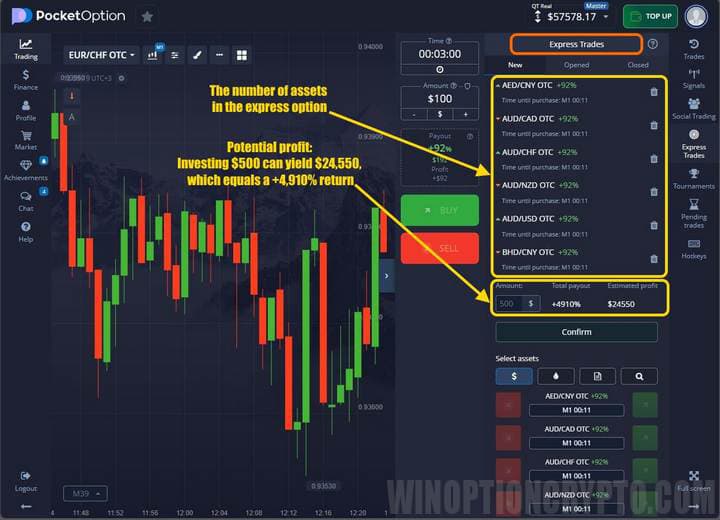
Express options can generate high returns from a single successful trade, since payouts when the forecast is correct average around 500% of the investment. A $10 option could therefore return $60. With a complex express option involving six assets, the same $10 could potentially return $450. Naturally, brokers price this risk accordingly, which is why the option is considered very high risk.
Express option terms are generally not favourable for short expirations — using 60-second expirations while simultaneously forecasting three assets leaves very little room for success. Express options are more suitable with longer expirations (one hour or more).
A trader using express options must objectively assess the likely price direction, the strength of the move, and set appropriate expirations. Express options work well around news releases or during strong directional moves in the market:
Exotic Types of Binary Options
It is worth noting that this article has covered only the most widely available types of binary options — there are others. Less common exotic types include:
- "Stays Between/Goes Outside";
- "Matches/Differs";
- "Even/Odd";
- "Over/Under";
- "Reset Call/Reset Put";
- "High Tick/Low Tick";
- "Asian";
- "Only Ups/Only Downs";
- "High-Close/Close-Low";
- "Higher/Lower."
Further details on all option types can be found in the article "What are binary options?" and in our review of the Deriv broker, which offers more than 15 types of binary options on its platform.
Which Type of Binary Options to Choose?
With so many types of binary options available, each with its own appeal, advantages, and disadvantages, and with profitability varying widely, choosing the right one can be challenging.
As a general rule, higher-yielding options carry higher risk — the greater the potential profit, the greater the chance of loss. Conversely, lower-return options tend to involve less risk. Forex contracts may be an exception to this rule, but they are considerably more complex than other option types and are not accessible to all traders. Ultimately, the choice of option type depends on your preferences, trading experience, and the level of risk you are willing to accept.
Beginners should start with classic binary options ("Higher/Lower"), as they are straightforward to understand and provide a solid foundation in the core principles of binary options trading. Trading these options also significantly reduces the risk of losing your deposit.
Experienced traders can explore any type of option, as they are already familiar with the principles of money management and risk management and are better placed to limit losses even when a trade goes wrong.

To leave a comment, you must register or log in to your account.