
Today, binary options (BO) have become one of the main financial instruments used by private investors alongside stocks and other assets to generate returns. Binary options offer substantial earning potential which, with proper preparation and the right skills, can be significant in today's economy. Despite this, many traders avoid this instrument because they are unfamiliar with the history of binary options.
In some respects, binary options are a relatively straightforward way to participate in financial markets. Working with this instrument requires a reliable internet connection and a solid understanding of trading. One of the defining features of binary options is that earning potential is not limited to a single asset — traders can profit from stock indices, currency pairs, stocks, cryptocurrencies, and more. Binary options are considered a high-return instrument that, under the right conditions, can deliver up to 92% net profit per trade.

Binary Options: History of Appearance
Looking closely at the concept of a "binary option," it becomes clear that similar instruments were used in ancient times, even though the term itself came much later. According to historical records, the origins of binary options can be traced to antiquity, when people used special contracts — effectively the predecessors of binary options — to buy and sell goods between parties at a pre-agreed price within a specified timeframe.
For example, historians have found a contract from Ancient Rome in which one party (an olive supplier) agreed to deliver olives to the other party during the season in exchange for goods needed to run the farm.
While these ancient contracts share some similarities with binary options, the mechanics of the two instruments are fundamentally different. Nevertheless, as the history of binary options shows, these early agreements laid the conceptual groundwork for the structures that allow traders today to profit on foreign exchange markets and exchanges.
History of Exchange-Traded Binary Options
In the form in which they are known today, binary options first appeared in the 1920s. Over time, the instrument grew in popularity, but rapid development was held back by a number of restrictions — in particular, parties wishing to trade binary options had to negotiate and agree on all contract terms individually.
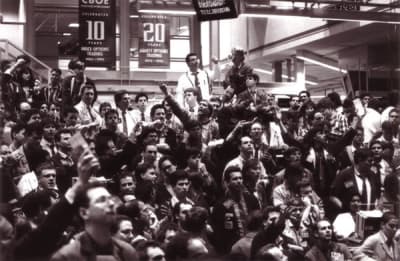 This changed dramatically in 1973, when the Chicago Board of Trade launched the Chicago Board Options Exchange (CBOE). This development fundamentally transformed the way these instruments were traded. Traders no longer needed to conduct individual negotiations with counterparties over contract terms. The establishment of the CBOE standardised the trading mechanism for binary options, simplifying transactions and significantly improving efficiency.
This market transformation gave rise to specialised binary options brokers who began offering clients dedicated trading platforms. Standardisation also had another important consequence: it reduced the number of fraudulent brokers in the market. After the launch of the CBOE, brokers were required to conduct transactions in accordance with established market rules and regulations, which in turn reduced the risks faced by private investors.
The development of this market segment did not stop there. In 2012, the Cyprus Securities and Exchange Commission (CySEC) — the regulator overseeing the European financial market — added binary options to its official list of regulated financial instruments, further confirming the legality of trading these contracts.
History of Online Binary Options Trading
Binary options reached their widest audience after internet usage began to grow rapidly. The first websites for trading these instruments appeared in the late 1990s, marking a pivotal moment in the history of binary options — one that brought a large number of new investors into the market, including those with relatively modest capital. The digitalisation of binary options trading opened up the opportunity to profit from binary options in real time, from home, to people who had never previously had access to such financial instruments.
In the early 2000s, dealing centres grew noticeably in number, improving trading conditions through the adoption of new technologies and expanding the range of underlying assets available. Today, this market segment continues to evolve, with exotic types of digital contracts now also available.
Myths About Binary Options
There are many myths surrounding binary options, most of which centre on the idea that trading these contracts is simple and can generate large profits with minimal investment. In practice, traders who believe such claims almost invariably lose their deposit quickly — which is why claims that binary options are a scam frequently appear online.
 These situations arise because binary options are traded with real money in real time. Like any other form of trading, this activity requires training, knowledge, and skill. In some respects, trading binary options can be more challenging than trading stocks or other assets, since predicting the direction of price movement within a short expiration time (1, 5, or 10 minutes, for example) is genuinely difficult.
Traders who approach binary options as they would a casino tend to act on impulse and lose money quickly. Driven by emotion, they then attribute their losses to brokers, market conditions, and other external factors rather than examining their own approach.
Binary options trading operates within a defined set of rules that must be followed. It requires ongoing analysis of both the market as a whole (technical analysis and fundamental analysis) and individual assets. Making money from binary options is not a matter of luck — it requires learning to predict price behaviour accurately rather than simply guessing direction.
How to Make Money on Binary Options
To get started with binary options, a trader needs to select a broker whose terms of service match their specific needs and register on the company's official website. The registration process is generally straightforward, requiring the user to provide personal information and a phone number to secure the account.
The next step is to review the broker's terms of service carefully and complete some training in binary options trading. Exploring ready-made binary options strategies and indicators that simplify trading is also recommended. As a trader gains experience, they can develop their own trading methods.
At first glance, binary options may appear to be a simple and quick way to earn high returns. In practice, however, consistent profit requires an integrated approach — one that involves analysing the market and the price movements of individual assets, selecting the right moment to open and close a trade, and more. Even so, many beginners start trading on instinct, disregarding the advice of experienced traders.
 Put simply, the core principle of binary options trading is this: the trader must determine whether the price of a selected asset will rise or fall within a given timeframe. Unlike trading stocks or similar instruments, there is no need to predict the exact price — only the direction.
For example, a trader selects Apple shares as the underlying asset. By placing an order to buy a call option predicting that the stock will rise within 15 minutes, the trader will earn a profit even if the price increases by just 1 point. The size of the payout per trade depends on the broker's terms. Returns (or fixed payouts) are typically 60–92% of the invested amount.
It is worth noting that brokers today offer a wide range of binary option types. Some digital contracts, for example, pay out when the price reaches a specific level at any point during a given period (one-touch options). Standard expiration periods — after which the trade closes automatically — are typically 1, 2, 5, 10, or 15 minutes, one hour, or one day, though some brokers offer other options.
The minimum trade size also varies by broker. Some allow digital contracts to be purchased for as little as $1; others require a higher minimum.
Some traders assume that brokers profit when their clients lose money. In practice, this is not always the case. Brokers earn a percentage of each completed trade regardless of whether the trader made a profit. For example, if two traders each invest $100 in a call option, and the first correctly predicts the price direction and receives 70% profit while the second makes an incorrect prediction and loses the full $100 — the broker receives the same 30% commission in both cases.
A broker's income depends directly on the number of active clients. In reality, it is in the broker's interest for traders to be profitable, since those who continually lose money will leave the platform.
Binary Options Trading
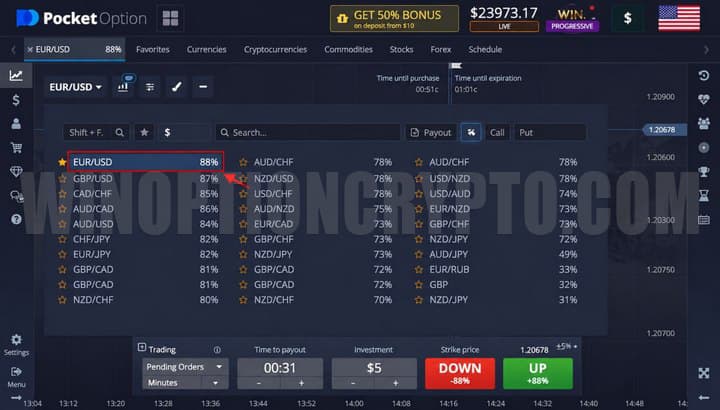
To illustrate the features of binary options trading, consider the example of Pocket Option. This broker allows users to explore the trading platform before registering, though a personal account is required to place actual trades.
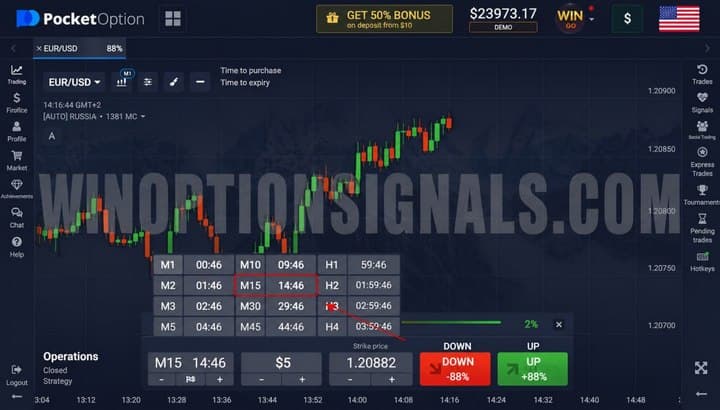
The process of placing a trade is as follows:
- An asset is selected in the broker's trading platform (in this example, the EUR/USD currency pair):
- The expiration time is selected (for example, 15 minutes):
- The direction of price movement is set by clicking either the Call ("Higher") or Put ("Lower") button:
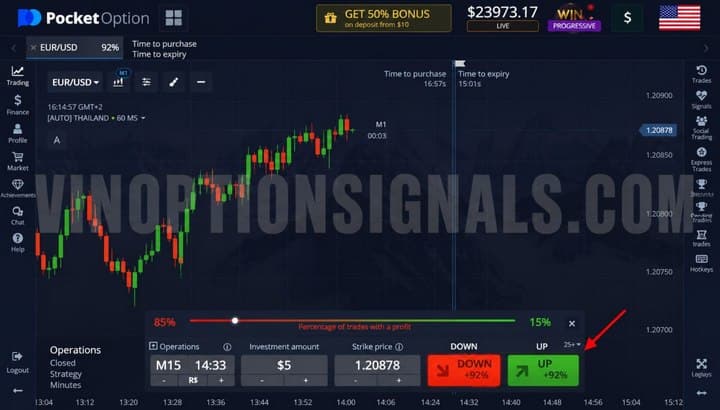
If after 15 minutes the price of the selected currency pair has risen by at least 1 point, the trader receives a profit of up to 92% of the invested amount.
Call options ("Higher"). Suppose a trader concludes from their analysis that Meta Platforms (META) shares are likely to rise in the near future. In this case, they buy a call option.
For example, assume the shares are trading at a certain price before the trade is opened. If the price rises above that level within 10 minutes (the selected expiration), the trader receives the profit percentage set by the broker (for example, 81%). If the price remains below the entry level at expiration, the trader loses the full amount invested.
Put options ("Lower"). If market analysis indicates that the price of a given asset is likely to fall, a put option is purchased. For example, consider the GBP/USD currency pair. Suppose technical analysis suggests the pair will fall below its current value within the next 5 minutes. The trader buys a put option with a 5-minute expiration — if the price drops by 1 point or more from the moment the trade is placed, the trader earns a profit.
How to Predict Prices in Binary Options
Price forecasting in binary options involves applying a combination of technical and fundamental analysis methods. A stock's price, for example, can be influenced by investor expectations about future events, conditions in local or global markets, decisions by the company's board of directors, and other factors.
Suppose Volkswagen announces that it is preparing several new models for the European market that are expected to be in high demand. Following such a news release, the company's share price would almost certainly rise. A trader who opens a call option on that stock at the time of the announcement would, at expiration, very likely receive a profit.
Benefits of Binary Options
 Traders typically highlight several clear advantages of binary options over other instruments:
- Simplicity. As noted earlier, making money from binary options requires predicting the direction of price movement — not the exact exchange rate value, as is the case with stocks, where the size of the price move directly affects returns. Binary options allow traders to make decisions and act on price direction without needing to study the finer details of a particular asset.
- Accessibility. Binary options give investors with relatively modest capital access to financial markets. Trading stocks, bonds, and similar instruments typically requires significantly larger initial investments.
- Return potential. The profit available from binary options trading is not capped. With a well-structured strategy, daily returns can be substantially higher than those achievable through trading securities.
Binary Options Strategies and Indicators
The success of binary options trading depends on the quality of the analysis performed. Traders use dedicated strategies to predict the direction of price movement with a reasonable degree of accuracy. Technical analysis is more commonly used in binary options than fundamental analysis, since positions in digital contracts are typically held for short periods (5, 10, or 30 minutes).
Experienced traders advise beginners to start by focusing on trend-following strategies. As practice shows, if an asset's price has been moving in one direction for, say, 30 minutes, it is likely to continue in that direction for the next 10 minutes.
Even so, using several complementary strategies simultaneously produces more accurate forecasts. For example, a trader might use an indicator based on the Stochastic oscillator to identify entry points. Since the Stochastic frequently generates false signals, its readings can be confirmed using Moving Averages. Signals confirmed by two or more indicators are consistently more reliable.
Conclusion
The history of binary options stretches back to antiquity — even if the transactions of that era were not described in those terms. Since then, the instrument has evolved considerably and is today far more functional and effective than its earliest predecessors.
Once traders understand the mechanics of binary options and the specifics of working with digital contracts, they gain access to an instrument with significant earning potential. It is important to keep in mind, however, that consistent profit from binary options cannot be achieved through intuition or guesswork alone. Returns depend directly on the accuracy of price forecasts, which in turn requires the disciplined application of technical and fundamental analysis.

To leave a comment, you must register or log in to your account.