
For binary options traders, the USD/JPY currency pair offers genuinely unique opportunities. Many traders have come to favour it for its distinctive behaviour: the pair can hold within a narrow range for hours, then suddenly make a strong impulsive move — often ignoring traditional technical indicator signals. Success in trading this asset comes down to three core principles, which you will find in this article.
Contents:
- What makes the USDJPY pair unique for binary options traders?
- Tip #1: Enter a trade after consolidation
- Tip #2: Predict the Japanese Yen Exchange Rate Using the Dow Jones Index
- Tip #3: Use round numbers as support and resistance levels
- Conclusion

What Makes the USDJPY Pair Unique for Binary Options Traders?
Anyone who has traded USD/JPY will have noticed its distinctive behaviour compared to other assets. The reason lies in the pair's dual nature. On one hand, it reflects the interaction between the world's two largest economies — the US and Japan. On the other hand, the yen has historically served as a safe-haven currency during periods of financial stress.
For binary options traders, this means USD/JPY exhibits pronounced directional moves: when panic grips the markets, the yen strengthens, creating a clear bearish trend in the pair and generating signals to buy Put options.
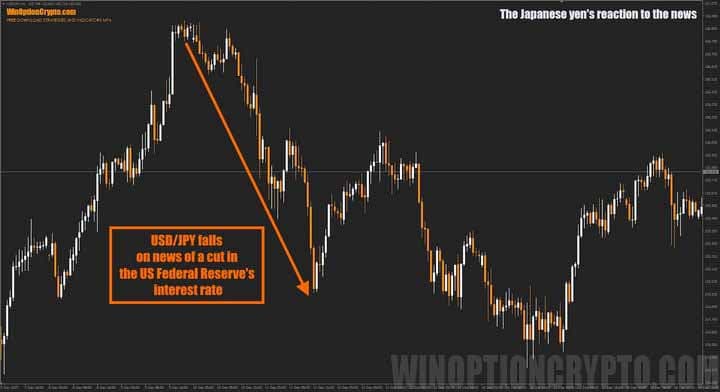
From a technical standpoint, USD/JPY differs from most major pairs. It tends to form extended, sustained one-directional trends — which is especially relevant when trading with a fixed expiration time. While EUR/USD produces numerous false breakouts throughout the day, USD/JPY moves within well-defined price channels. This allows binary options traders to identify entry points with greater confidence, basing decisions on chart patterns that work considerably better on this pair than on most other assets.
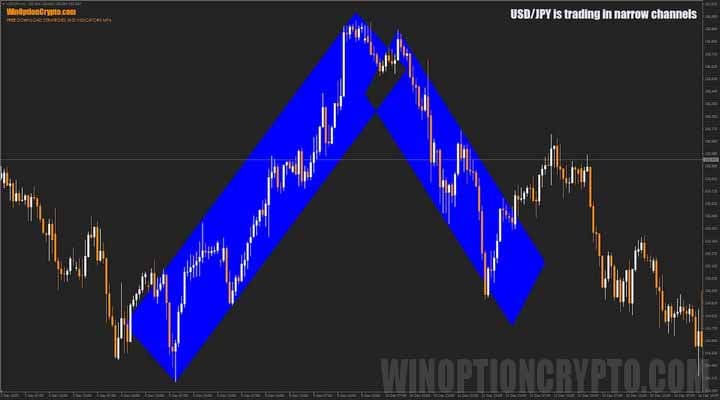
Another feature valued by experienced traders is the pair's predictable intraday activity. Yen quotes follow a consistent pattern during the Asian trading session, often setting the directional bias for the rest of the day. Unlike most European currencies, which are subject to a constant flow of news from multiple EU countries, USD/JPY responds to very specific catalysts: decisions by the Bank of Japan and the US Federal Reserve. This makes the pair more straightforward to analyse and less susceptible to erratic moves.
Tip #1: Enter a Trade After Consolidation
USD/JPY can remain in a tight range for several days before making a sharp move. Consolidation zones like the one shown below appear on various timeframes and can sometimes persist for several months. When the price does break out of the range, however, the move can be substantial. Review higher-timeframe charts to see this pattern in action.
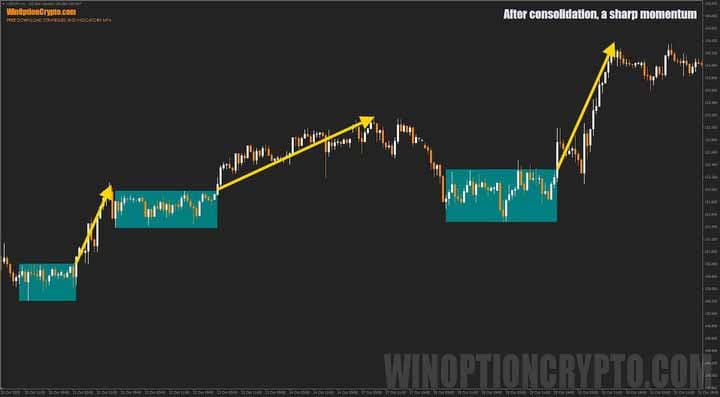
Such powerful breakout moves are ideal for short-term expiration trades on Call or Put contracts. To apply this approach, traders need to learn to identify consolidation zones on the chart — they typically appear as flat, sideways price action. During these periods, large market participants such as banks and hedge funds are building their positions. The trader's role is not to guess the direction of the move within the range, but to wait for the price to break through one of its boundaries.
The key signal for opening a trade is the first candle closing outside the consolidation zone. A close above the upper boundary signals a Call option; a close below the lower boundary signals a Put option. Volume serves as an additional filter — a valid breakout should occur on above-average volume or be accompanied by a significant expansion in the candle's range. Set the expiration time at 3–5 candles of your working timeframe — enough time for the price to travel a meaningful distance from the breakout point before any correction begins.
Tip #2: Predict the Japanese Yen Exchange Rate Using the Dow Jones Index
Pay attention to the relationship between the Dow Jones Industrial Average and USD/JPY. When investors sell US equities, the Japanese yen tends to strengthen against the dollar; when stocks rise, this typically has a positive effect on the pair.
In the chart below, the daily candles represent USD/JPY, and the yellow line shows the closing prices of the Dow Jones Industrial Average.
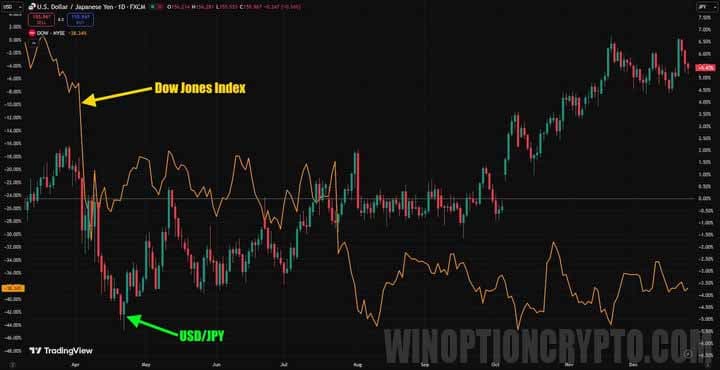
As you can see, the two tend to move in sync. This reflects global risk appetite: when the US economy is performing well and equities are rising, investors favour the dollar and move out of the safe-haven yen. In this context, the stock index acts as a leading indicator, and binary options traders can gain an edge by monitoring the Dow.
For example, if the index breaks a local high and surges upward, this is a strong signal that USD/JPY may rise in the following 5–15 minutes. Traders who open a Call option in this scenario are trading in line with the broader market sentiment.
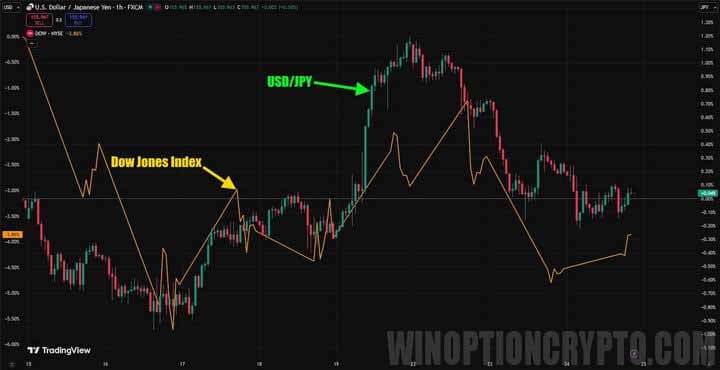
This relationship holds even on lower timeframes. Trades on USD/JPY should therefore be opened in the direction of the US stock index — though keep in mind that the correlation between the two instruments works best during the US Forex trading session.
Also watch for divergences between the Dow and USD/JPY. If the index is rising while the yen is stagnating or falling, this often signals that a powerful move is building in the currency market that will eventually align with the stock market's direction.
Tip #3: Use Round Numbers as Support and Resistance Levels
Most binary options traders are familiar with the importance of round numbers as support and resistance levels. If this concept is new to you, we recommend reading the article "How to Use Support and Resistance Levels in Binary Options." On USD/JPY, these levels play a far more significant role than on most other assets — a result of the trading habits of Japanese market participants and the way the Bank of Japan monitors the national currency's exchange rate.
For USD/JPY, round numbers are price levels ending in one or more zeros: 145.00, 150.00, 152.50, and so on. These levels tend to attract large pending orders from commercial banks and export-oriented companies, turning them into powerful barriers to price movement.
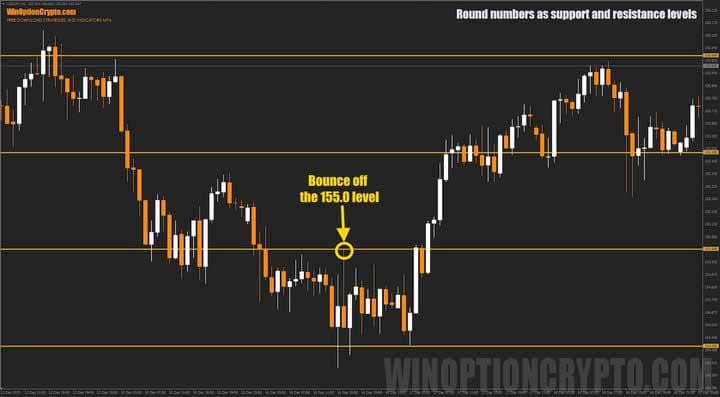
In binary options trading, these levels are effective entry points for reversal trades. For example, when price approaches the 155.00 level from below, it rarely breaks through on the first attempt — more often it tests the level and reverses, as illustrated in the chart above.
The strategy is straightforward: avoid opening trades between round levels. Instead, wait for the price to approach a level ending in two or three zeros — such as 155.00 or 150.00. Look for a reversal pattern in the price action, such as the pin bar discussed in the article "Using Pin Bars in Binary Options Trading," and open a trade on the rebound.
Patience is essential here. The market frequently makes minor false breaks above round levels before reversing. Waiting for the level to be tested and a reaction to form — then opening a trade for 2–3 candles — reduces noise and takes advantage of the interest large players place in these levels as key reference points on the chart.
Conclusion
USD/JPY is well suited to binary options traders who favour a systematic, rules-based approach. By building your strategy around three principles — waiting for breakouts from consolidation, monitoring the Dow Jones Index, and trading reversals at psychologically significant round levels — you lay a solid foundation for consistent results. Above all, remember: the yen rewards patient traders and punishes those who ignore its connection to global financial markets.

To leave a comment, you must register or log in to your account.