
While newer traders chase sharp price surges at the opening of the London and New York sessions, professional binary options traders often prefer the quieter Asian market. The reason is straightforward: in binary options trading, what matters is not the magnitude of the price move but whether the price closes above or below the option's opening price. The Asian session creates ideal conditions for this. This review covers its key features and less obvious advantages.
Contents:
- Why the Pros Choose Night Trading: The Hidden Mechanics of the Asian Market.
- What to Trade While Europe Sleeps?
- Pocket Option and Quotex Trading Strategies for the Asian Session.
- How News from China and Japan Moves Price Charts.
- The Pros and Cons of Night Trading: Is It Worth Changing Your Hours for Profit?
- Conclusion.

Why the Pros Choose Night Trading: The Hidden Mechanics of the Asian Market
The Asian trading session has distinctive characteristics that set it apart from the European and American sessions. The most notable is the prevalence of flat and sideways price movement. This is a consequence of the start of a new trading day, when the market "awakens" and forms the first significant price levels on relatively healthy volumes after an overnight lull.
The Asian session begins around 2:00 a.m. and continues until the European session opens. This is covered in more detail in the article "The Best Time to Trade Binary Options." During this period, trading floors in Tokyo, Hong Kong, and Singapore are active, while major participants from the US and Europe are largely absent. As a result, prices often move in narrow horizontal channels — a pattern that experienced binary options traders actively exploit through rebound strategies.
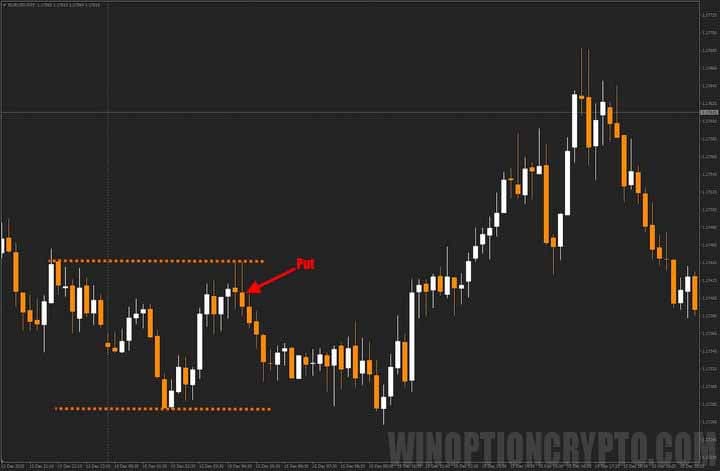
Another characteristic of the Asian session is the relative absence of significant news from major global economies. For this reason, quotes on many currency pairs can move erratically during daytime hours. Liquidity is lower overnight, but this is not a critical factor for binary options traders. Far more important is that prices tend to move more smoothly during this period, with significantly fewer sudden spikes. This allows traders on Pocket Option and Quotex to use one-minute and five-minute expirations with a lower risk of random price spikes.
This does not apply to currency pairs involving the Japanese yen, Australian dollar, or New Zealand dollar, since macroeconomic data releases from Japan, Australia, and New Zealand can trigger sharp moves in these currencies against the US dollar.
It is also worth noting that the Asian session is when the Bank of Japan and the Reserve Bank of Australia are most active. These central banks often establish a clear trend direction for the entire session. Unlike the European session, where direction can shift several times within an hour, Asian trends tend to develop more slowly but remain more stable. This allows binary options traders to close entire series of trades profitably in one direction.
What to Trade While Europe Sleeps?
 When European financial centres are closed, volatility in major currency pairs falls significantly, creating conditions that favour binary options trading. During this period, the market typically moves in narrow ranges, making rebound strategies more effective than breakout strategies.
Japan is Asia's main financial centre, so economic news from the country can trigger short-term price movements. The USD/JPY pair is particularly active during the Asian session, often moving within predictable ranges in the absence of significant Bank of Japan announcements. 
In addition to USD/JPY, the EUR/JPY and GBP/JPY cross rates are actively traded during this period. These pairs often experience more pronounced moves, though caution is warranted given the potential for sharp price swings.
Trading in the Pacific currency pairs AUD/USD and NZD/USD also intensifies during the Asian session. These pairs are sensitive to inflation, labour market, and interest rate data from Australia and New Zealand, and are also influenced by macroeconomic data from China. Typically, if weak data is released from Beijing between 3:00 and 4:00 a.m. (GMT+2), AUD/USD and NZD/USD tend to decline.
Pocket Option and Quotex Trading Strategies for the Asian Session
When trading on Pocket Option and Quotex, binary options traders should account for the specific conditions of the Asian session. Classic trend indicators and standard market analysis methods often produce false signals during this period. The focus should therefore be on counter-trend strategies and range-bound trading within horizontal channels.
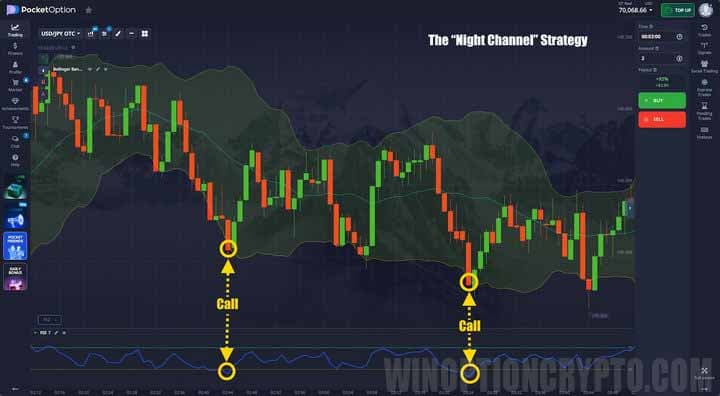
For example, traders on Pocket Option and Quotex can apply a simple "Night Channel" strategy using two indicators: Bollinger Bands with a period of 20 and a deviation of 2, and RSI with a period of 7 and levels at 30 and 70.
To enter a Call option, wait for a candle to close below the lower Bollinger Band with the RSI in oversold territory — below 30. For a Put option, the logic is reversed: wait for a candle to close above the upper band with the RSI above 70.
On the M1 timeframe, an expiration of 3–5 candles (3–5 minutes) is recommended. EUR/USD is the best-suited pair for this strategy, as it most frequently trades in a range during this period.
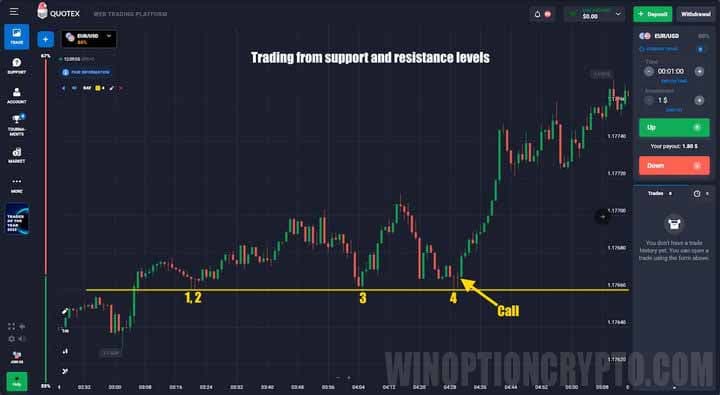
Another approach is to trade from support and resistance levels. Levels formed during the Asian session tend to hold fairly reliably and can be used as entry points. On the Quotex platform, for example, the "Horizontal Line" drawing tool makes it easy to mark these levels on the chart.
To use this approach, wait for three touches of the level and enter on the fourth. However, if price lingers near a level for an extended period, the probability of a breakout rises considerably — making entries riskier under such conditions.
How News from China and Japan Moves Price Charts
To trade successfully during the Asian session, every binary options trader needs to understand the economic influence of China and Japan on the market. While European trading floors are closed, data from Tokyo and Beijing become the primary drivers of price movement. China is the world's largest consumer of raw materials, so its economic data has a significant impact on so-called commodity currencies — the Australian and New Zealand dollars in particular.
For example, if China's business activity index or GDP figures beat expectations, demand for raw materials rises and tends to push AUD/USD and NZD/USD higher. Conversely, weak data from China often weighs on these pairs, creating favourable conditions for Put option entries.
The Bank of Japan's active role and the yen's status as a safe-haven currency also drive increased volatility in USD/JPY during the Asian session. If the Bank of Japan signals a tightening of monetary policy, the yen tends to strengthen quickly, pushing USD/JPY lower.
Rather than relying solely on indicators, Pocket Option and Quotex traders should monitor scheduled economic data releases and analyse the market's initial reaction. When news from both China and Japan points in the same direction — for example, both indicating economic growth — a short-term trend can develop for 30–60 minutes following the release. During such periods, trading in the direction of price momentum with a 10–15-minute expiration tends to be most effective, as fundamental factors take precedence over technical signals.
The Pros and Cons of Night Trading: Is It Worth Changing Your Hours for Profit?
The main advantage of night trading is the highly predictable behaviour of European currency pairs during this period. With major participants from London and New York absent, significant price moves are infrequent. The Asian session suits technical analysis practitioners well: support and resistance levels are broken far less often, and the RSI and Stochastic oscillators generate cleaner signals. Night trading can also be a practical option for those looking to combine trading with a full-time job.
The primary disadvantage relates to broker-specific conditions. The most common issue is reduced payouts on major currency pairs — returns on EUR/USD can fall to around 60% during this period, making trading less profitable. From a health perspective, consistently disrupting sleep patterns takes a toll on a trader's wellbeing, increasing fatigue and stress. This raises the risk of straying from a trading plan: traders may start chasing the market and increasing trade sizes in violation of money management rules, which can ultimately result in significant losses.
Conclusion
The Asian session offers a distinctive environment for binary options traders who value discipline and systematic approaches over volatile, fast-moving market conditions. While European and American financial centres are closed, the market provides an opportunity to trade in calm, predictable conditions. Apply rebound strategies, monitor economic news from China and Japan, and choose assets carefully on the Pocket Option and Quotex platforms. A considered approach can turn the quietest hours of the trading day into a consistent source of income.

To leave a comment, you must register or log in to your account.