
Trend-following trading systems are growing in popularity among traders. The Triple EMA binary options strategy is built on this principle and comes equipped with all the tools needed to identify trend direction and determine when a correction has ended.
The developers included a dedicated signal filter to reduce false entries — we cover it in detail in this review. If you prefer to trade comfortably in the direction of the main trend without the constant concern that the market will reverse against you, this review will walk you through an effective method for applying Triple EMA in practice.
Contents:
- Key Features
- Installation
- Triple EMA: Overview and Settings
- Trading Rules
- Application Notes
- Conclusion
- Download Triple EMA
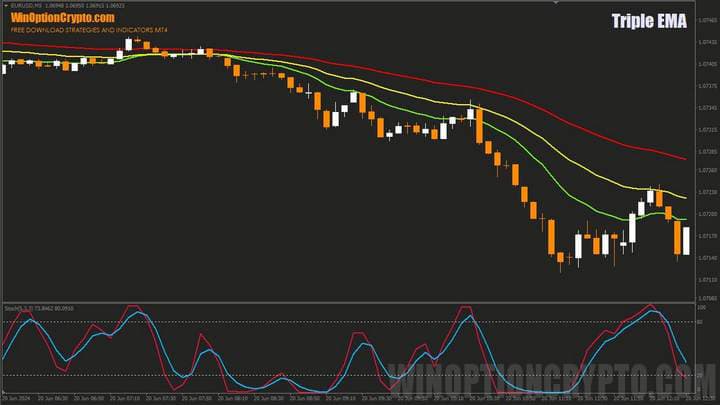
Key Features of the Triple EMA Strategy
- Terminal: MetaTrader 4
- Timeframe: M5
- Expiration: 3 candles
- Option types: Call / Put
- Indicators: built into the platform
- Trading instruments: currency pairs, commodities, cryptocurrencies, stocks
- Trading hours: 08:00–21:00 UTC
- Recommended brokers: Quotex, Pocket Option, Binarium
Installing the Triple EMA Binary Options Strategy
Triple EMA templates are installed using the standard MetaTrader 4 procedure. Open MT4, select "File," then "Open Data Folder." In the directory that opens, navigate to the "templates" folder and move the template file there. For a full walkthrough, see our installation video:
Triple EMA Indicators: Overview and Settings
Currency pairs are known for their clearly defined price trends, and one effective way to trade them is to capture short-term corrections within a broader trend. This is precisely the approach at the heart of Triple EMA. Despite its apparent simplicity, the strategy is grounded in a fundamental principle of price behaviour: markets do not move in a straight line, and every trend is periodically interrupted by a correction.
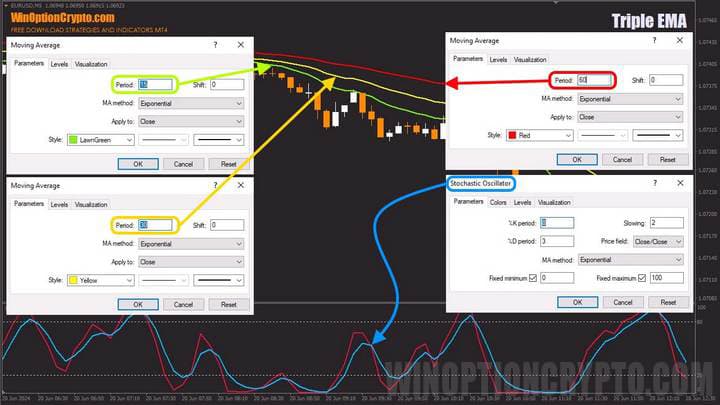
Trend direction is determined using three exponential moving averages with periods of 15, 30, and 60 candles. Their position relative to each other tells the trader whether a trend is present. The Stochastic Oscillator is used as a signal filter. The optimal Stochastic settings depend on the asset and timeframe — for EUR/USD on M5, the following values have proven effective: %K period = 2, %D period = 3, Slowing = 3.

All four indicators are included in MetaTrader 4's standard technical analysis toolkit and have straightforward settings. Keep in mind that the parameters above are optimised for EUR/USD and may not perform as well on other instruments. We recommend testing and adjusting the values for each asset individually.
Trading Rules
In the Triple EMA strategy, the moving averages act as dynamic support and resistance levels from which price periodically bounces. The trader's objective is to recognise when a counter-trend correction has ended and price is resuming in the direction of the main trend. Entering at this point gives a more favourable risk/reward ratio on Forex and a higher probability of the option expiring in the money when trading binary options.
If you are not yet familiar with support and resistance trading, we recommend reading "How to Use Support and Resistance Levels in Binary Options", which covers how to apply them correctly and how to build profitable strategies around them. For those just starting out who are unfamiliar with the concept of a trend, the following articles on our website are a useful starting point:
- How does a trend work in the markets?
- Identifying and using bullish and bearish trends
- Market phase transitions
- How to identify a ranging (flat) market
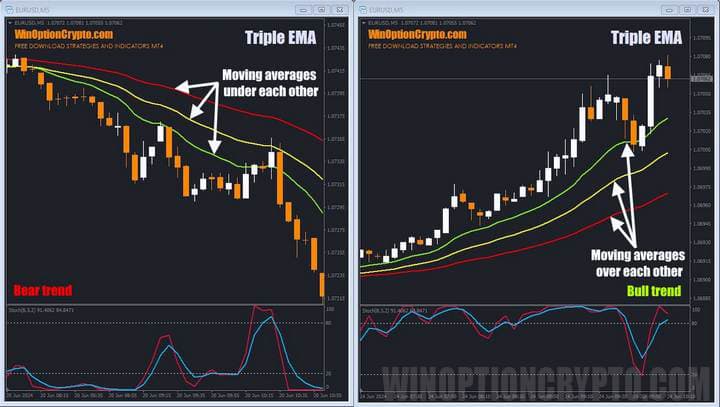
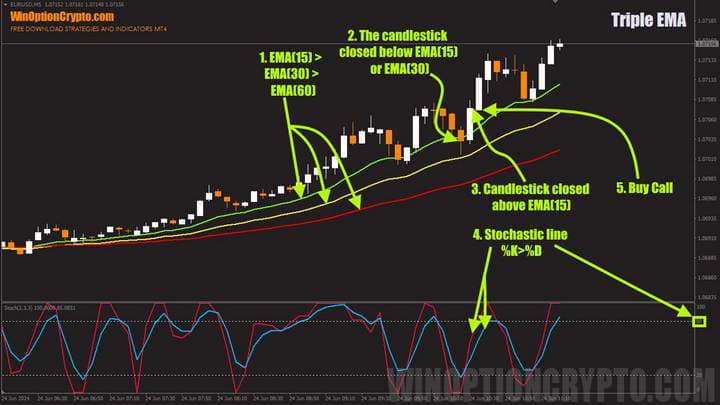
Trend direction in Triple EMA is determined by the position of the moving averages relative to one another: when EMA(15) > EMA(30) > EMA(60), the trend is upward; when they are in the opposite order, the trend is downward.
A correction is identified when a candle closes on the far side of EMA(15) or EMA(30) — but remains on the trend side of EMA(60). If a candle closes beyond EMA(60), the current trend is called into question and may be reversing. In that case, even if price subsequently closes back above EMA(15), the signal should not be trusted — wait for a clearer, more unambiguous setup.

Once a correction has been identified, wait for price to return in the direction of the main trend — confirmed by a candle closing back on the trend side of EMA(15) — before opening a position.
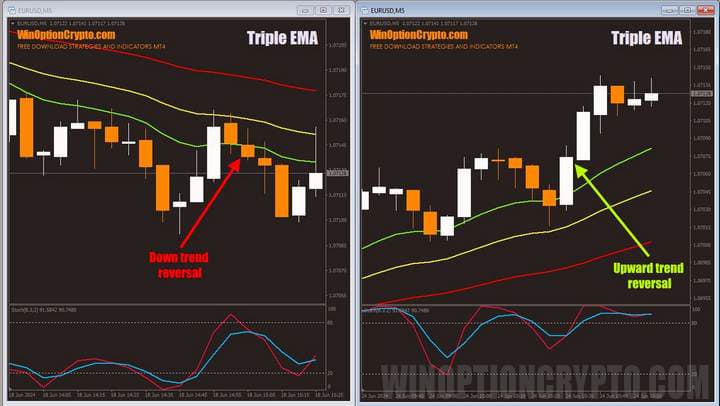
The Stochastic Oscillator acts as the final filter, confirming that price has resumed its trend move and that there is room for further development. Call options are only opened when the fast %K line is above the slow %D line and has not yet reached the overbought zone (value below 80). Put options are only opened when %K is below %D and has not yet reached the oversold zone (value above 20).
Opening a Call Option
- Uptrend confirmed: EMA(15) > EMA(30) > EMA(60)
- Correction: the previous candle closed below EMA(15) or EMA(30), but above EMA(60)
- Trend resumption: the last candle closed above EMA(15)
- Filter: Stochastic %K is above %D and below 80
- Open a Call at the start of the next candle
Opening a Put Option
- Downtrend confirmed: EMA(15) < EMA(30) < EMA(60)
- Correction: the previous candle closed above EMA(15) or EMA(30), but below EMA(60)
- Trend resumption: the last candle closed below EMA(15)
- Filter: Stochastic %K is below %D and above 20
- Open a Put at the start of the next candle

The recommended expiration is 3 candles. Fine-tune the holding period based on your chosen asset and the results of backtesting on historical data.
Application Notes
Triple EMA performs best on trending instruments — indices, stocks, and major currency pairs. Pay attention to the trading session and be aware of scheduled economic data releases, which you can track using the economic calendar on our website.
Since Triple EMA is a trend-following strategy, avoid trading during flat (ranging) market conditions — the system is prone to false signals when price is moving sideways.
Advantages of the Triple EMA Strategy
The strategy's primary strength is its ability to capture significant profits during sustained directional price moves. Currency pairs and cryptocurrencies are known for their tendency to trend for extended periods — and it is precisely this characteristic that trend-following systems like Triple EMA are designed to exploit.
Limitations of the Triple EMA Strategy
The focus on trending conditions is both the strategy's strength and its weakness. Once the market enters a sideways range, Triple EMA will generate false signals. The Stochastic Oscillator is included specifically to mitigate this — acting as a filter to screen out counter-trend noise. We encourage you to experiment with the Stochastic parameters for your preferred instruments and share your findings in the comments.
Another limitation is the absence of alerts or an arrow indicator to notify the trader when entry conditions are met. Without automated alerts, the trader must monitor the chart continuously to avoid missing setups — which can reduce overall trading efficiency.
Conclusion
Triple EMA uses only standard MetaTrader 4 indicators, yet its apparent simplicity conceals genuine effectiveness. The strategy is built on a sound trend-trading principle: enter in the direction of the trend after a correction. The Stochastic Oscillator adds a final confirmation layer, acting as the last check before committing to a trade.
Before going live with this strategy, practise on a demo account with a reliable broker, and apply disciplined risk management and money management principles throughout. Switch to a live account only once you are consistently comfortable with the rules. We wish you strong, sustained trends!
Download the Triple EMA Binary Options Strategy

To leave a comment, you must register or log in to your account.