
The LUNA binary options strategy combines two elements: candlestick colour-coding to reflect trend direction, and a chart marker that indicates entry points. Together they form a complete trading system — the built-in indicator handles trend identification automatically, removing the need for guesswork. This analytical approach is engineered to maximize trade execution accuracy when monitoring high-probability setups. The integration of distinct visual filters allows traders to recognize momentum shifts early and open positions in alignment with dominant market volume, significantly reducing exposure to price noise
This review also covers one straightforward addition that can meaningfully improve signal quality.
Contents:
- Characteristics
- Installation
- Overview and settings
- Trading rules
- Practical notes
- Conclusion
- Download LUNA
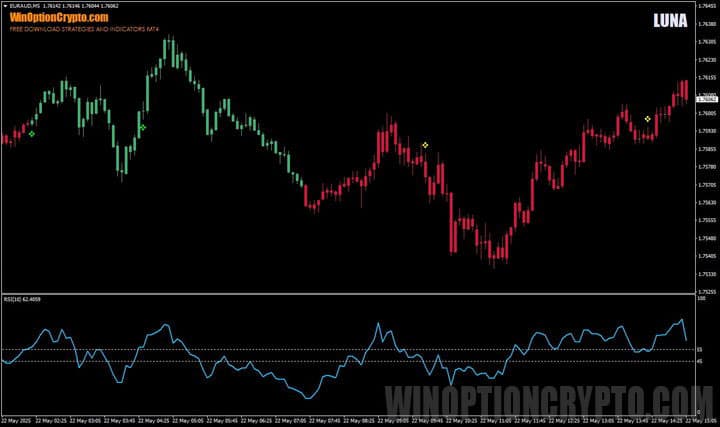
Key Features of the LUNA Strategy
- Terminal: MetaTrader 4
- Timeframe: M5
- Expiration: 3 candles
- Option types: Call / Put
- Built-in indicator: LunaM3.ex4
- Instruments: currency pairs, commodities, cryptocurrencies, stocks
- Trading hours: 08:00–21:00 UTC
- Recommended brokers: Quotex, Pocket Option, Binarium
Installation
LUNA indicators are installed in MetaTrader 4 in the standard way. Open the terminal and go to "File" → "Open Data Folder". In the window that opens, navigate to MQL4 → Indicators and copy all indicator files there.
If the package includes a template, move it to the Templates folder in the terminal's root directory.
Restart the platform for the new indicators and template to appear in the list. A detailed walkthrough is available in the video below:
Overview and Settings
LUNA is built on a custom indicator that identifies whether the market is in a bullish or bearish phase. It analyses price automatically and colours the candles accordingly: green signals buyer dominance; red signals seller dominance. This visual approach makes trend reading fast and straightforward.
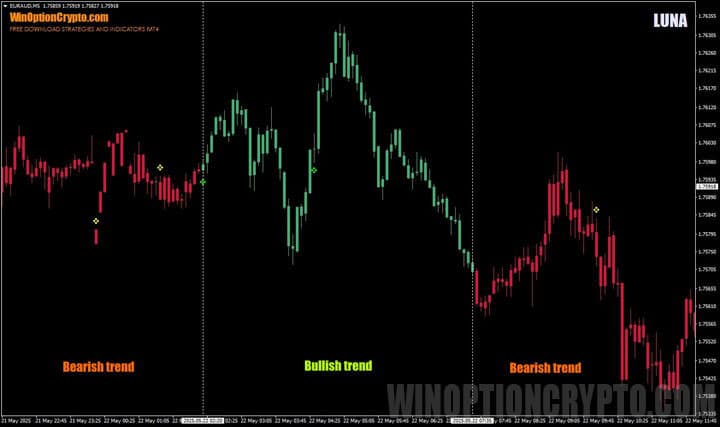
This alone makes the strategy worth considering. Experienced traders widely regard the ability to identify trend direction as a foundational skill — and LUNA builds that skill into the system itself.
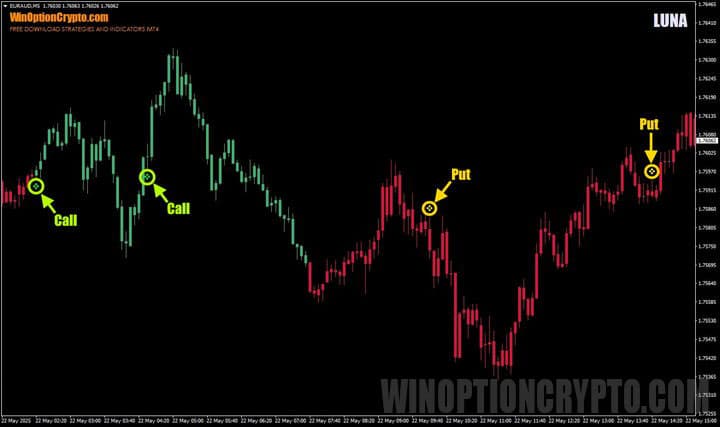
Beyond trend identification, the LunaM3 indicator also marks optimal entry points directly on the chart — displayed as diamonds. Each signal aligns with the prevailing market direction, meaning the strategy trades with the trend rather than against it, which improves signal reliability.
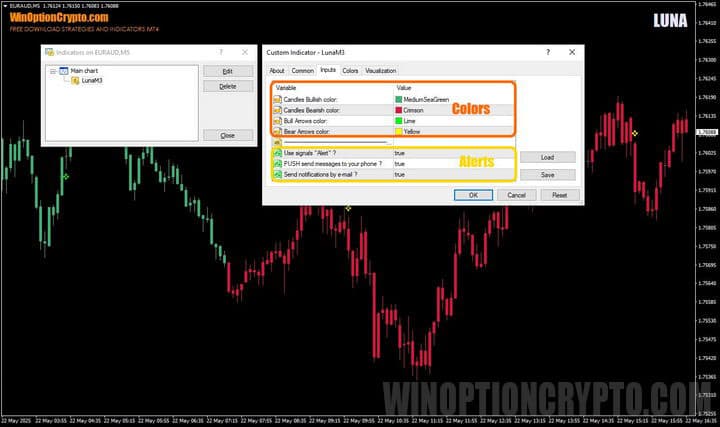
On the settings side, there is very little to adjust. The developer has locked the parameters that govern trend detection and signal generation. Only candle colours, signal diamond appearance, and sound alerts can be changed by the user.
This limited flexibility is a drawback. Different assets and timeframes have their own characteristics that a more configurable system could account for. To address this, we added a supplementary indicator that helps filter false signals and improves overall reliability.
The strategy can also be strengthened by incorporating candlestick patterns and chart formations. Further reading:
- Candlestick analysis and binary options
- Japanese candlesticks for beginners — how to read them
- Japanese candlesticks — chart analysis
- Using pin bars in binary options trading
Trading Rules
The majority of false entries occur during weak price momentum and periods of low activity — particularly during the Asian session, when the market is largely directionless and signals lose reliability.
Our article "The Best Time to Trade Binary Options" covers global session hours and their effect on market activity in detail — useful for avoiding low-quality trading windows.
For filtering signals, the Relative Strength Index (RSI) works well. It measures the strength of the current price impulse and indicates who is in control of the market. When the RSI is above 50, buyers are dominant; below 50, sellers are in control.
We recommend using the RSI's position relative to this midline as a filter. In practice, slightly adjusted thresholds tend to produce better results — in our testing, levels of 55 and 45 worked well. Call trades were only taken when the LUNA signal coincided with the RSI above 55; Put trades only when the RSI was below 45.
This filters out weaker signals and concentrates trading on the highest-quality entry points.
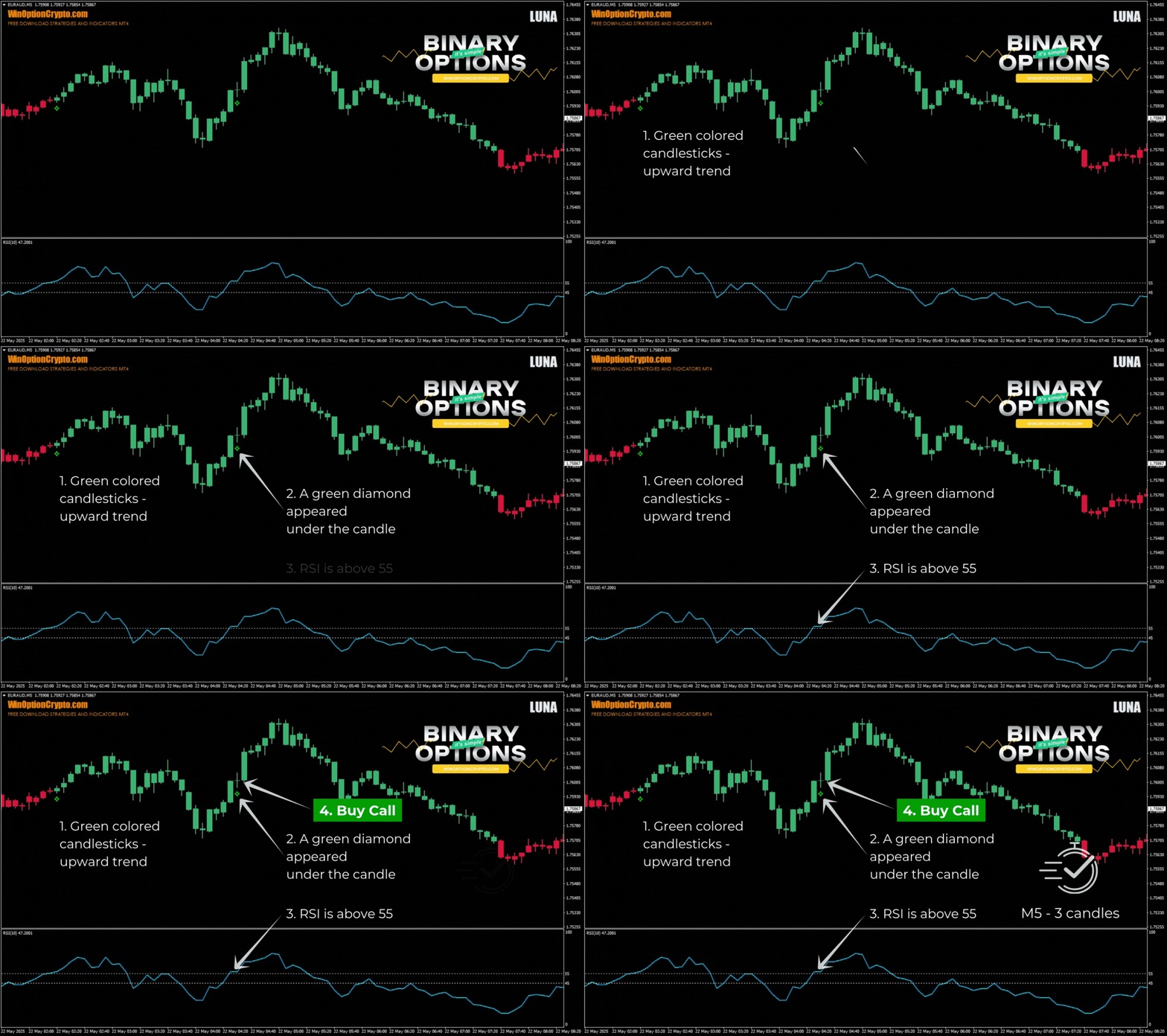
Call Option Entry
- Trend is upward — candles are green.
- A green diamond appears below the candle.
- RSI is above 55.
- Buy a Call at the open of the next candle.
Put Option Entry
- Trend is downward — candles are red.
- A yellow diamond appears above the candle.
- RSI is below 45.
- Buy a Put at the open of the next candle.
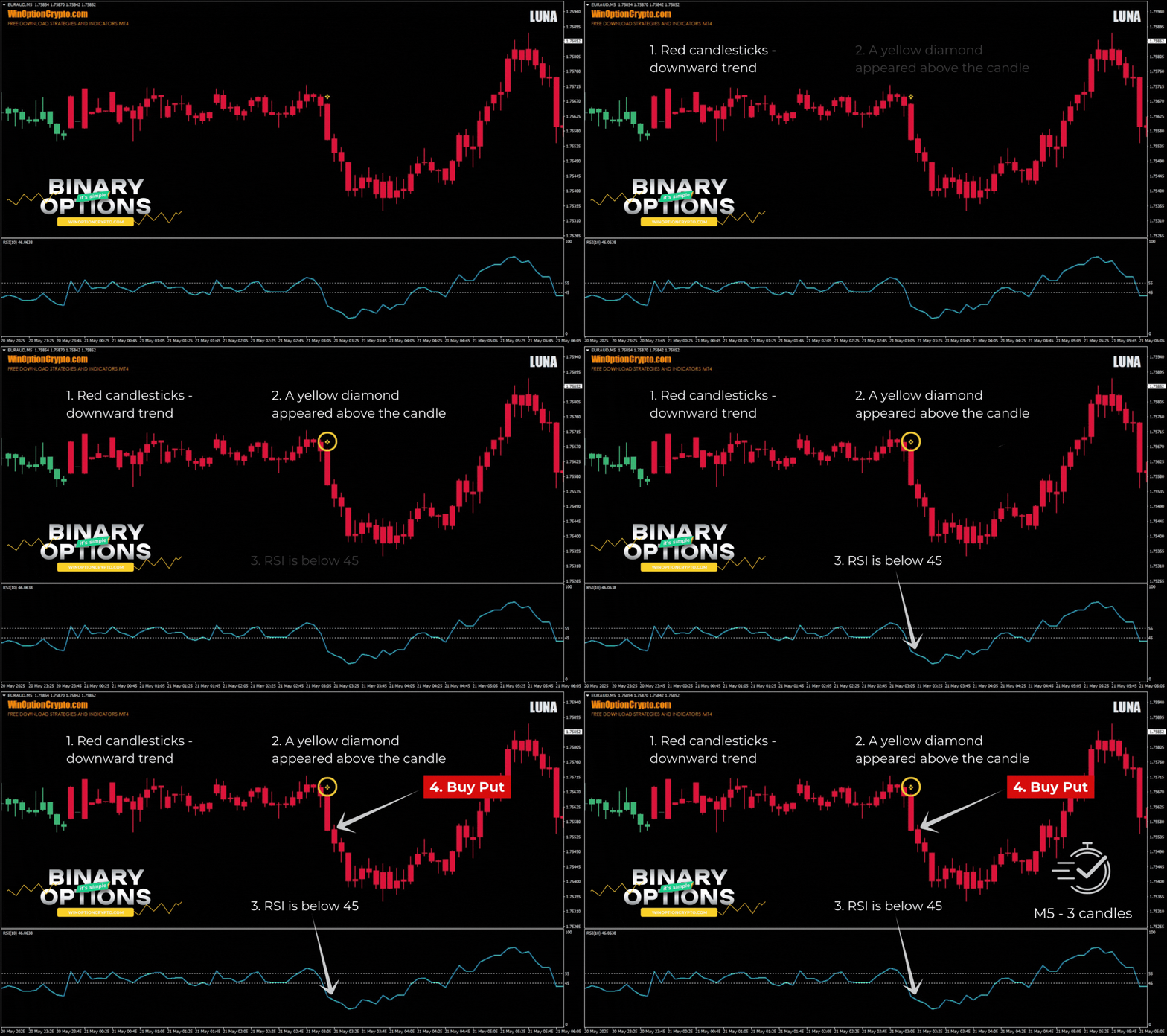
The recommended expiration time is 3 candles, though the optimal period depends on the specific asset and should be confirmed through testing on historical data.
Practical Notes
LUNA performs best during active market hours, when price impulses are strong and directional. Avoid lower timeframes where market noise and false signals are more prevalent. Even with the RSI filter in place, periods of consolidation or low volatility should be avoided — the strategy is sensitive to market phase and loses accuracy in sideways conditions.
Pros
- Pop-up notifications, sound alerts, and push signals make it easy to catch entries in real time.
- The built-in trend filter ensures signals are generated in the direction of the current market move, reducing the proportion of losing trades.
- Colour-coded candles simplify analysis, particularly for those new to trading.
- Signals do not repaint — what you see is what was there.
Cons
- The trend filter does not always respond quickly to significant corrections. It is possible to see red candles while price is still making higher highs, or green candles while price is setting lower lows — a trend change the system can be slow to register.
- Signal filtering is relatively loose. Additional analytical tools are often needed to reduce weak entry points and improve overall reliability.
Conclusion
LUNA is a signal indicator with a useful built-in trend filter. By ensuring trades are taken in the direction of the current market move, it improves entry accuracy and the overall proportion of profitable trades.
Adding the RSI as a filter — as described in this review — reduces false signals further and produces more confident entries. Experiment with RSI thresholds to find what works best for your preferred asset and timeframe.
Test the strategy on a demo account with a reliable broker before trading live. When trading with real funds, always apply risk management and money management rules consistently.
Download LUNA

To leave a comment, you must register or log in to your account.