
The internet offers an enormous number of indicators and binary options strategies created by traders of all backgrounds. Not all of them work. In this article we look at how to build an effective binary options strategy from scratch — and what you need to do it.
Contents:
- What you need to create a binary options strategy
- Stage 1: choose a strategy style
- Stage 2: select your indicators
- Indicator settings
- Understanding how indicators work
- Stage 3: select the technical components
- Asset selection
- Timeframe selection
- Expiration selection
- Signal correlation
- Stage 4: test the strategy
- Conclusion

What You Need to Create a Binary Options Strategy
Building a strategy involves research and data gathering — understanding what your system should include before you start assembling it. The first decision is what type of strategy you want to create. The main types are:
- signal-based;
- trend-following;
- level-based;
- mixed;
- indicator-free.
During the research phase, pay attention to the following sources:
- Indicators. The more indicator types you review, the better your chances of finding ones that suit your approach. Strategies can be built around trend indicators or support and resistance level indicators;
- Existing strategies. Reviewing ready-made strategies can give you ideas or introduce you to indicators not easily found elsewhere;
- Trading methods. Studying different approaches to trading can suggest techniques worth incorporating into your system;
- Trader screenshots. Seeing how other traders set up their charts can spark ideas for your own implementation.
You will also need to determine which instruments suit your trading style — specifically, what kinds of signals will work best for the timeframe you intend to trade.
Stage 1: Choosing a Strategy Style
As outlined above, the main strategy types are:
- signal-based;
- trend-following;
- level-based;
- mixed;
- indicator-free.
Beginners can generally set aside indicator-free and level-based strategies for now — both require trading experience and can be difficult to apply without it. Signal-based, trend-following, and mixed strategies can be kept simple and are accessible to traders at any level. In practice, most strategies are mixed, with certain indicator types predominating over others.
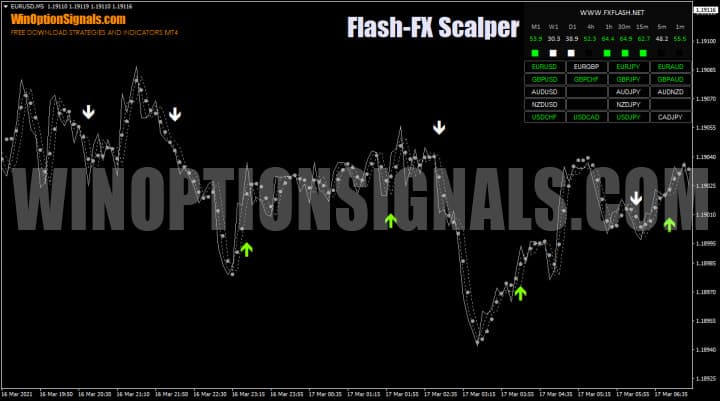
Signal-based strategies rely primarily on signal indicators — tools that produce arrows, dots, or similar markers on the chart. An example is Flash-FX Scalper:
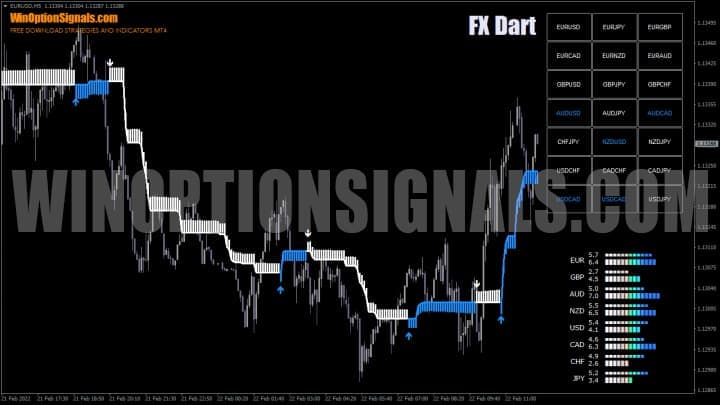
Trend-following strategies are built around trend direction, with trades taken only when there is a clear directional move. During ranging (flat) conditions, these systems produce few useful signals. An example is FX Dart:
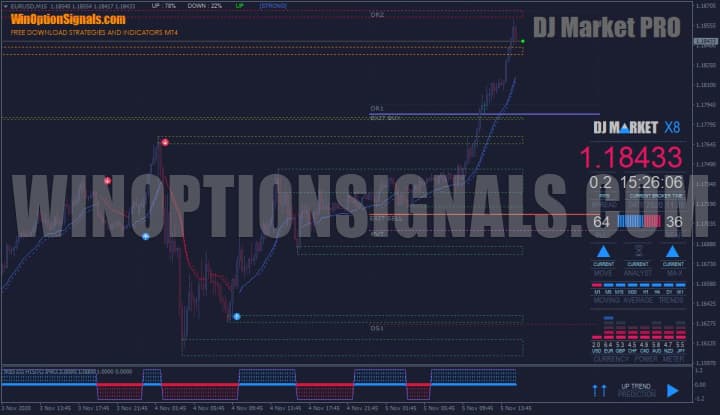
Mixed strategies combine trend, informational, and signal indicators, and may also incorporate levels. An example is DJ Market PRO:
Indicator-free systems may involve trading on a clean chart, trading from manually drawn levels, or applying Price Action, chart pattern analysis, or candlestick analysis. Pattern-based trading can be effective, but each pattern requires study — which takes time and experience. Beginners are better off starting with simpler, indicator-based approaches.
Stage 2: Selecting Indicators
Finding effective indicators requires reviewing a broad selection of them. For each candidate, study its settings and, where possible, understand the logic behind how it generates signals.
Indicator Settings
Using the Stochastic Oscillator as an example: its key parameters are %K period, %D period, and slowing. Consider how different settings affect signal behaviour. Comparing the default settings (5-3-3) with custom settings (15-3-9) shows the difference clearly — the default settings are more sensitive to price fluctuations, while the custom settings lag more and produce fewer but potentially more selective signals. Below, both are compared using standard overbought/oversold crossovers as the signal:
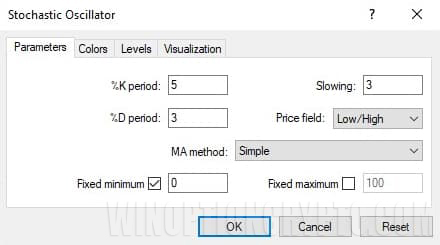
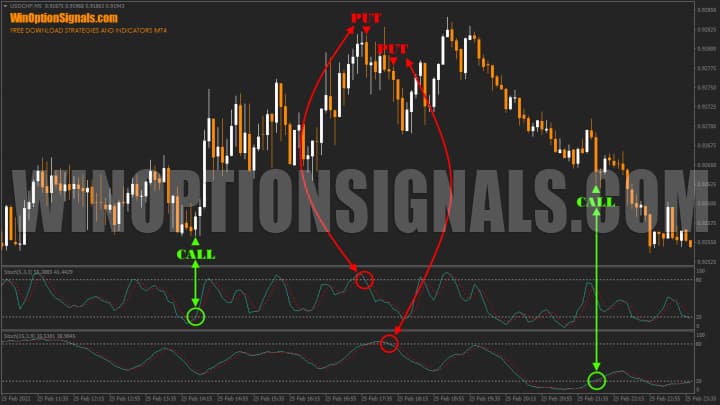
Apply the same evaluation process to every indicator you consider. The only exception would be indicators where settings cannot be adjusted.
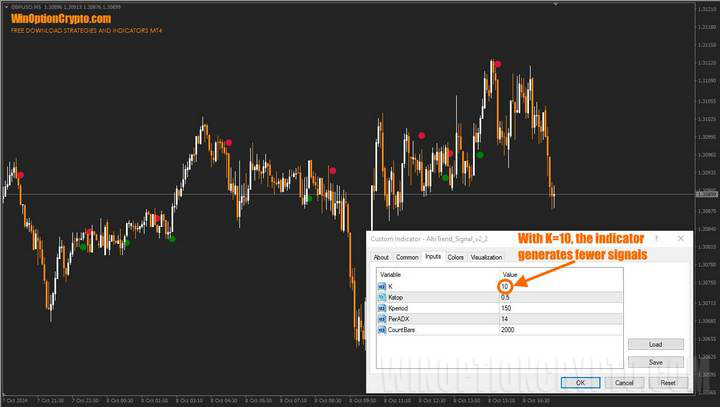
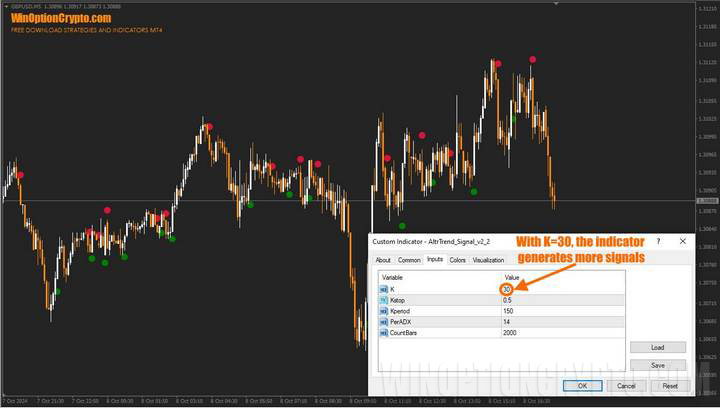
The same comparison applies to signal indicators. In the images below, the first uses a parameter of 10 and the second uses 30. The difference in the number and quality of signals is immediately visible — another illustration of why studying each tool carefully before including it in a system is worthwhile:
 |
 |
Understanding How Indicators Work
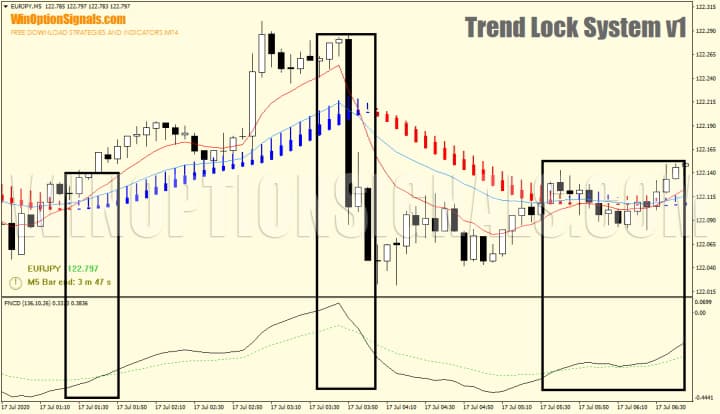
It is also worth understanding the underlying logic of any indicator you plan to use. Many indicators that appear unique are built on familiar foundations. Trend Lock System v1 is a good example — it presents a standard SMA in a visual format that makes it look like a dedicated signal tool:
Stage 3: Selecting the Technical Components
Once you have studied the available tools and selected those you want to use, the next step is to define the technical parameters of your strategy. Regardless of what indicators it uses, every strategy requires you to:
- select an asset to trade;
- choose a timeframe;
- set expiration;
- verify that indicator signals correlate with each other.
Asset Selection
Trade a small number of assets rather than spreading attention across many. Focus narrows risk and deepens understanding. Trading one or two assets thoroughly is more effective than monitoring many superficially.
Reliable binary options brokers offer a variety of financial instruments. Some assets are more volatile; others move more slowly. With the right approach, profit is achievable in either case. The key advantage of limiting the number of assets is that over time you begin to understand how their quotes form and what drives price — which makes forecasting progressively easier.
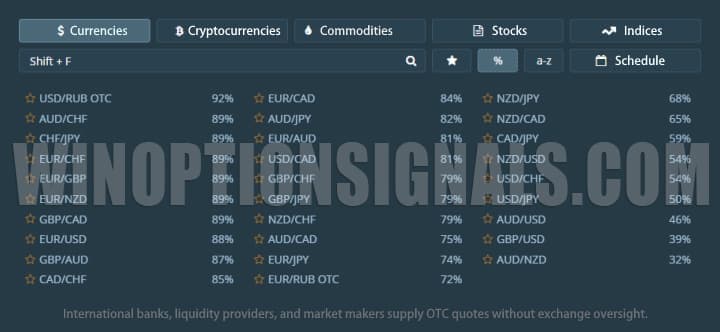
Beginners should start with currency pairs. Their behaviour tends to be the most predictable, and there is a wide enough range to find a pair that suits your style:
Timeframe Selection
Before choosing a timeframe, answer two questions:
- Do you prefer short-, medium-, or long-term trading?
- How much time are you willing to wait for a signal? (The higher the timeframe, the fewer signals.)
For short-term trading, M5 and M15 charts are standard — but be aware that market noise is more pronounced on these timeframes.
For medium-term trading, M30 or H1 are appropriate. Indicators tend to produce more reliable signals at these intervals.
Long-term binary options trading uses H4 and above — but not all brokers support expirations of more than four hours. This style is also more challenging to forecast accurately and is not recommended for beginners.
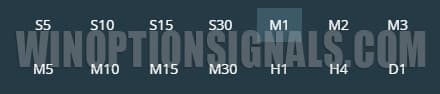
The most commonly available timeframes at binary options brokers are:
Expiration Selection
Expiration is determined based on:
- volatility;
- current market behaviour;
- the presence or absence of high-impact news and other events;
- the timeframe in use.
Expiration should be selected for each trade individually. Applying the same expiration every day regardless of market conditions is not a sound approach.
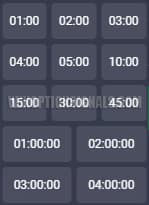
The most commonly available expiration types at brokers are:
Signal Correlation
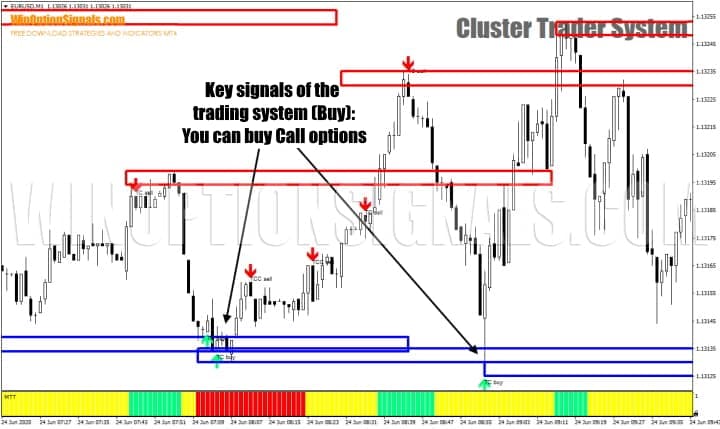
Once your indicators are selected, check how well their signals align with each other. Using Cluster Trader System as an example, the entry rules are:
Call options:
- (Optional) The MTT indicator is green, indicating an uptrend.
- The level price is approaching should be blue (support/demand).
- A green arrow with the label "TC Buy" appears.
Put options:
- (Optional) The MTT indicator is red, indicating a downtrend.
- The level price is approaching should be red (resistance/supply).
- A red arrow with the label "TC Sell" appears.
The chart below shows a Call setup where the signal arrow appears precisely at the level — strong evidence that the indicator signals are well correlated:
The Stochastic comparison shown earlier is the opposite example — different settings produced completely different signals with no meaningful correlation between them.
Stage 4: Testing the Strategy
The only way to truly evaluate a strategy is to test it on a demo account. This also builds the trading experience that will help you refine the system over time. Through demo testing you will be able to:
- assess how much profit the strategy can realistically produce;
- deepen your understanding of the entry rules;
- develop a feel for how your signals behave under different conditions;
- identify weaknesses in the system;
- make targeted improvements.
Test on a demo account first before committing any real capital.
Conclusion
Working through all four stages will give you a functional binary options strategy that can be used on a live account. It will almost certainly evolve over time as you gain experience, but the core framework tends to remain stable.
Follow the recommendations above to build an effective approach. Then test it on a demo account, followed by a small live account with minimal trade sizes. This lets you measure the strategy's real-world performance — profit potential and drawdown characteristics — with limited financial exposure.

See Also:
- How to choose a binary options broker
- Rating of binary options brokers
- Live Chart for Binary Options Online
- Technical analysis in binary options trading
To leave a comment, you must register or log in to your account.