
The AMA binary options indicator is one of the most advanced tools developed by the well-known financial expert Perry Kaufman. Its full name is Adaptive Moving Average. This technical analysis tool represents a genuine breakthrough in price analysis for financial markets.
Traders around the world first took notice of this tool following the publication of Kaufman's book Smarter Trading. In it, the author introduced the concept of an adaptive moving average, which has significantly less lag than a classic moving average. This characteristic allows the AMA to identify market trends with high accuracy and respond to signals of trend exhaustion (flat) or reversal — substantially reducing risk and improving trading efficiency.
In this review, we will cover the operating principles of the Adaptive Moving Average and its signals, which are accessible enough for even a complete beginner to work with in the Forex market or in binary options trading. You can download the AMA from our website free of charge for evaluation purposes.
Contents:
- Key Features
- Installation
- Overview and Settings
- AMA Trading Rules
- Buying a Call Option
- Buying a Put Option
- Conclusion
- Download AMA
Key Features of the AMA Indicator
- Terminal: MetaTrader 4
- Timeframe: M15
- Expiration: 3 candles
- Option types: Call/Put
- Indicators: AMA.ex4
- Trading instruments: currency pairs, commodities, cryptocurrencies, stocks
- Trading hours: active market hours
- Recommended brokers: Quotex, Pocket Option, Binarium
Installing the AMA Indicator
The AMA indicator is installed using the standard MetaTrader 4 method. Open the platform, select "File", then "Open Data Folder". In the directory that opens, navigate to the "MQL4" folder, then "Indicators", and copy all the files there. Templates are installed in the same way but should be placed in the "Templates" folder. For detailed installation instructions, see our video:
Overview and Settings of the AMA Indicator
The AMA indicator was developed with two key challenges in mind that traders commonly encounter with price-smoothing algorithms. First, it is resistant to noise in price data. This prevents false trend-change signals from appearing during periods of elevated volatility, which significantly improves the accuracy of analysis and decision-making.
Second, the adaptive moving average has minimal lag, allowing traders to identify trends quickly and respond to signs of trend exhaustion or reversal. This further reduces risk and improves overall trading efficiency.
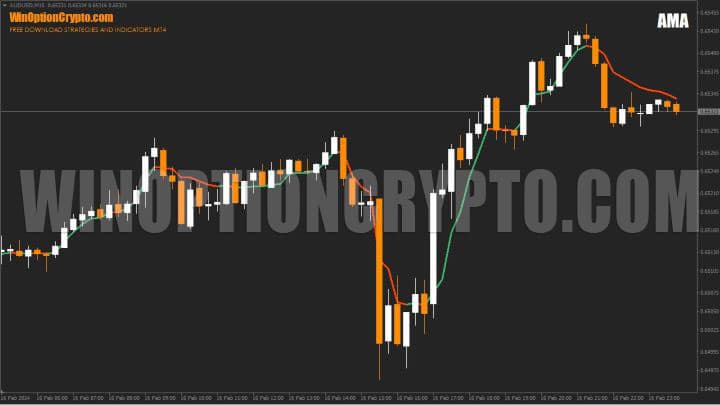
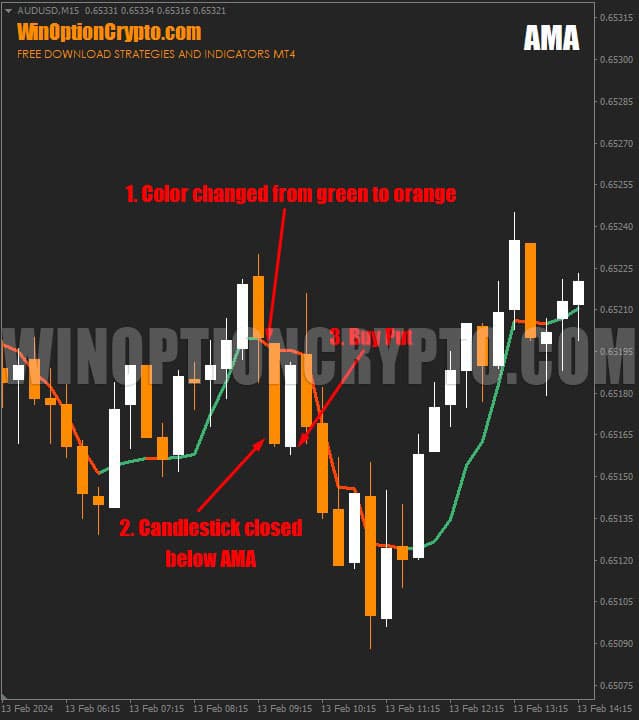
The indicator is displayed on the main chart as a two-colour moving average. Green indicates upward price momentum; orange indicates downward price momentum. A colour change signals a potential trade entry. It is worth noting that this moving average does not repaint its signals, so they can be relied upon.
The AMA indicator has only a few adjustable parameters, which can be tuned to suit your trading objectives and the characteristics of the currency pair or asset being traded. Feel free to experiment with the settings and share your preferred values for different instruments in the comments.
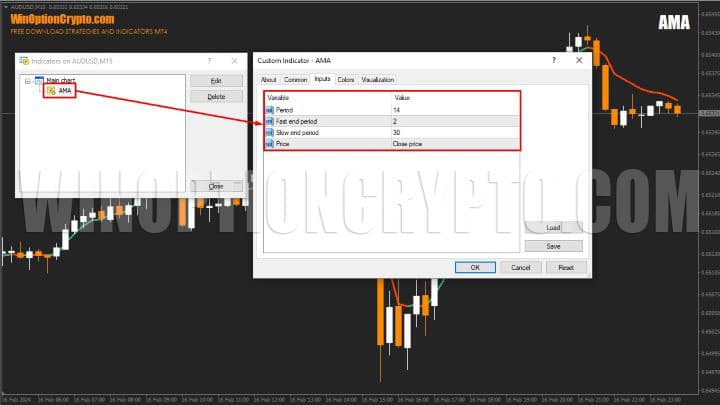
The indicator has 4 parameters:
- Period — number of candles used in the calculation;
- Fast End Period, Slow End Period — sensitivity coefficients;
- Price — the price type (Open, High, Low, Close) used in the calculation.
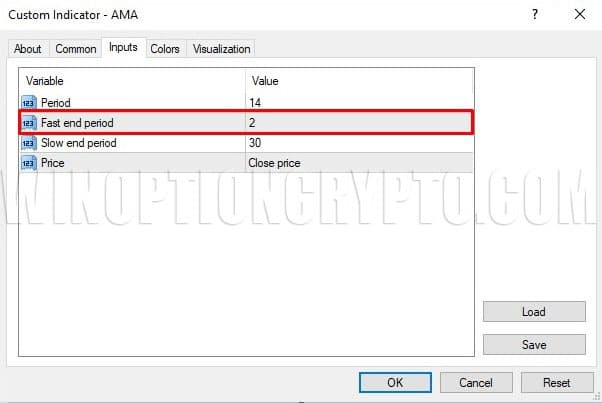
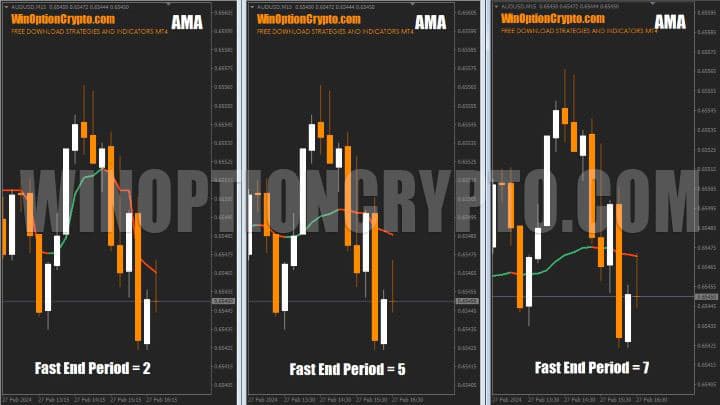
The "Fast End Period" parameter has the greatest influence on how frequently the adaptive moving average signals a trend change. The higher the value, the less frequently signals are generated. This makes it easy to adapt the indicator to your trading style. If you prefer turbo options and scalping, a "Fast End Period" value between 2 and 5 is recommended. For swing trading or binary options with longer expiration times, set this parameter to 7 or higher.
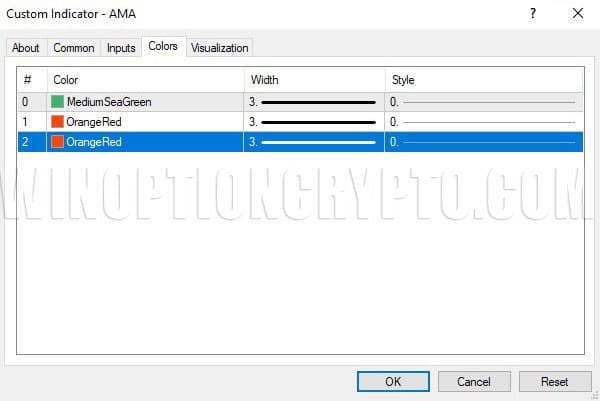
In addition to the calculation parameters, you can customise the indicator's appearance by selecting your preferred display colours.
Trading Rules for the AMA Indicator
The AMA indicator works correctly on any instrument — no matter how exotic — and on any timeframe. Most importantly, it is well suited to trend trading: an approach based on the principle that prices tend to move in a sustained direction over a period of time.
To better understand the principles of trend trading, we recommend reading the following articles:
- How does a trend work in markets?
- Identifying and using bullish and bearish trends.
- Market phase changes.
- How to identify a flat market.
No additional tools are needed to trade AMA signals for binary options — everything required is built into the indicator. According to the developers, a colour change in the moving average signals a change in trend, and it is sufficient to trade during active market hours when there is adequate volatility.
Positions are opened when the closing prices of candles shift relative to the adaptive moving average: if closing prices move above the AMA, open a Call; if below, open a Put. To increase the percentage of profitable trades, a second AMA instance is added with a longer "Fast End Period". The condition is that at the time of entry, the colour of the short-term AMA must match the colour of the long-term one.
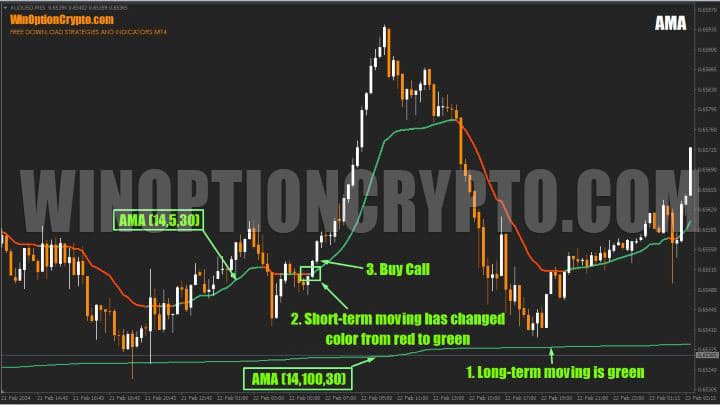
Trading rules for a Call using the AMA indicator:
- Confirm an upward trend: the long-term adaptive moving average with "Fast End Period" = 100 is green.
- The short-term moving average with "Fast End Period" = 5 has changed colour from red to green.
- At the opening of the next candle, buy Call.
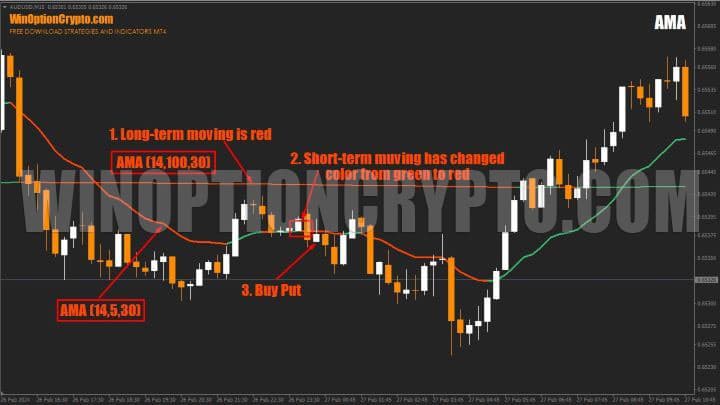
Trading rules for a Put:
- Confirm a downward trend: the long-term adaptive moving average with "Fast End Period" = 100 is red.
- The short-term moving average with "Fast End Period" = 5 has changed colour from green to red.
- At the opening of the next candle, buy Put.
The recommended expiration time is 3 candles. However, the optimal holding period for a specific instrument should be determined through backtesting and based on the timeframe used.
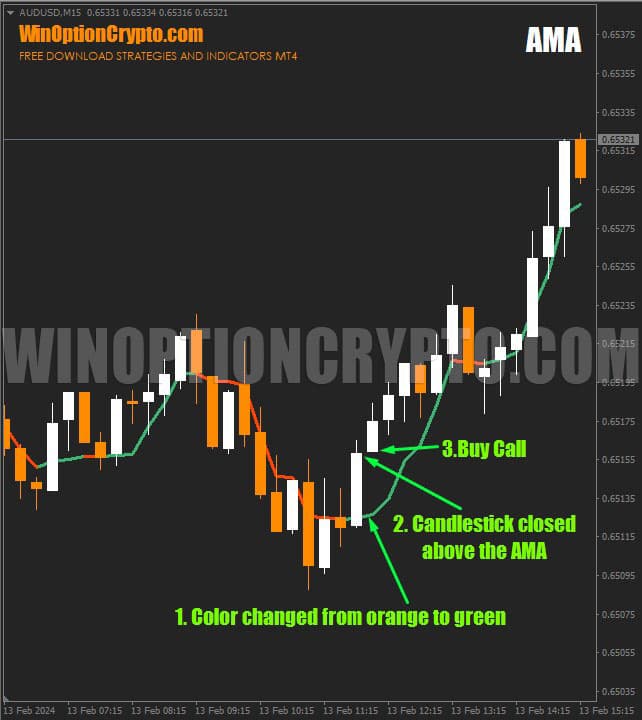
Buying a Call Option
- Confirm an upward trend: the long-term moving average is green.
- The short-term moving average has changed colour from red to green.
- The previous candle closed above the moving average.
- At the opening of the next candle, buy Call.
Buying a Put Option
- Confirm a downward trend: the long-term moving average is red.
- The short-term moving average has changed colour from green to red.
- The previous candle closed below the moving average.
- At the opening of the next candle, buy Put.
Conclusion
It is important to maintain realistic expectations. Like any technical analysis tool, the adaptive moving average does not guarantee accurate signals in every situation. It can produce false signals, particularly in volatile market conditions, and its effectiveness will always depend on the current market environment. That said, we encourage traders to explore the AMA indicator when developing their own strategies, keeping both its strengths and limitations in mind.
As a general recommendation, try to avoid trading during price consolidations and flat market conditions. Start with a demo account with a reliable broker, applying sound principles of risk management and money management. Only after achieving consistent positive results on a demo account should you move to live trading. We wish you a favourable trend!
Download the AMA Binary Options Indicator

To leave a comment, you must register or log in to your account.