
Trading binary options, despite its apparent simplicity, requires care and the ability to accurately predict price movements in the market. Traders who are unfamiliar with the rules of binary options trading often make mistakes that lead to losses. Even those who use their own binary options strategies are not immune to losses. In this article, we will cover the trading rules that can help both beginners and experienced traders achieve more consistent profits.
Contents:
- Rule No. 1: Choose the Right Deposit for Trading;
- Rule No. 2: Keep a Trading Diary;
- Rule No. 3: Do Not Use the Martingale System at the Initial Stage;
- Rule No. 4: Know When to Stop;
- Rule No. 5: Analyze the Market First;
- Rule No. 6: Trade Only with the Trend;
- Rule No. 7: Open No More than Two Trades at a Time;
- Rule No. 8: Follow the Rules of Money Management and Risk Management;
- Conclusion.

Rule No. 1: Choose the Right Deposit for Trading
One of the first rules that new traders tend to overlook is using the minimum deposit too frequently. This approach will not generate significant income, and a series of losing trades can push you out of the market entirely. To avoid this, it is recommended to fund your account with an amount that allows you to withstand several losing trades in a row. This is especially important when testing new strategies, indicators, or any other trading methods.
Ideally, your deposit should be enough to cover at least ten losing trades — and the more, the better. If you can only afford fewer than ten trades, your options are severely limited. In such conditions, just two or three incorrect forecasts can result in roughly 50% of your trading account being lost. This creates additional emotional pressure and a desire to chase losses, which most often leads to even greater losses. As a general rule, base your deposit on the amount you invest per trade: if that amount is $10, your deposit should be at least $100 — and ideally $200 or more.
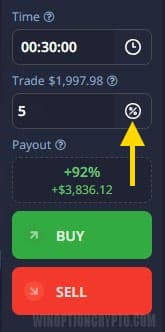
You can also calculate the minimum trade size as a percentage of your deposit, which is more convenient. Pocket Option and Quotex both allow you to do this automatically. For example, if you decide to allocate 5% of your deposit to each trade, you do not need to manually calculate how much that is from, say, $157. To use this feature, switch the trade amount setting from a fixed value to a percentage on the trading panel. In Pocket Option, this button looks like this:
In Quotex, this feature is enabled here:
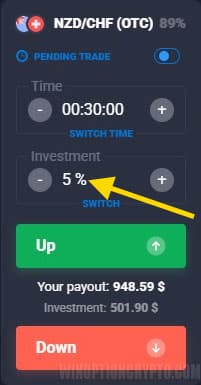
Once set, the system will automatically calculate the trade amount based on the percentage you have entered.
Rule No. 2: Keep a Trading Diary
A trading diary is a tool that helps you identify and correct mistakes in your binary options trading. It is recommended to log every trade you make, including all relevant details, such as:
- price data;
- analysis details;
- outcome of the trade (profit or loss);
- the reason the trade was opened;
- (required) a post-trade review where all errors — or, conversely, correct decisions — are recorded.
After logging at least a few trades, you will be able to build charts and graphs showing trading account performance and much more. Below is an example of such charts:
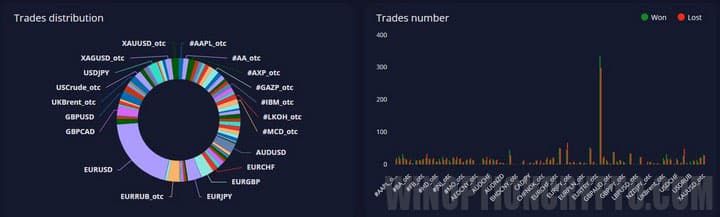
If you trade through Pocket Option or Quotex, this information is available in your personal account under the analytics section. In addition to charts, you will find data on individual trades, timing, assets, amounts, and much more. This information helps you identify what you are doing right and wrong, and highlights areas of your binary options trading that need improvement.
Rule No. 3: Do Not Use the Martingale System at the Initial Stage
The principle of the Martingale system is straightforward: after a loss, the trader opens the next trade with double the investment amount. For convenience, some traders use a calculator:
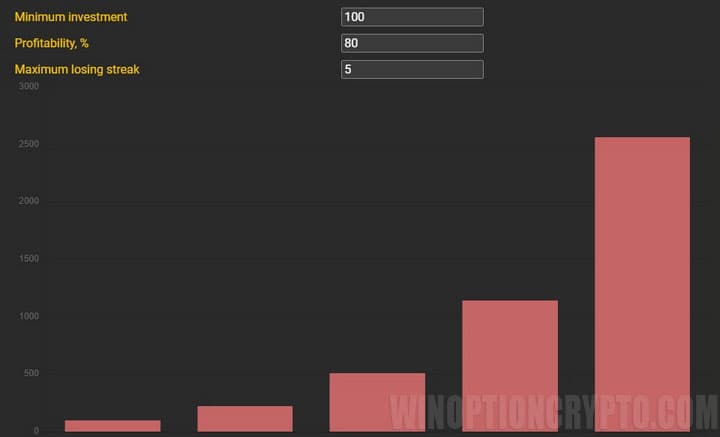
It is important to understand that while this approach can allow total profits to offset losses, it requires a large deposit and consistently accurate direction calls. If you lack sufficient capital or misjudge the trend, you can lose your deposit very quickly. Beginners are particularly vulnerable to this outcome due to their limited experience with the nuances of such an approach.
To avoid these consequences, it is recommended to avoid using this system at the initial stage. While it can be profitable in some cases, failing to stop in time can result in losing your entire deposit.
Rule No. 4: Know When to Stop
For some traders, trading binary options triggers the same emotions as gambling. As a result, they struggle to stop at the right moment — whether they are on a winning streak or taking losses. After two or three profitable trades, a trader may feel they have read the market correctly and expect the next trade to be profitable as well. However, if that next position closes at a loss, the desire to recover will kick in. If another loss follows, emotions begin to override rational thinking. Rather than waiting for a clear signal or the right setup, trades get placed one after another in an attempt to recover what was lost.
It is essential to understand that trading cannot be profitable every single day. Not only individual trades, but entire trading sessions can be unprofitable when market conditions become difficult to read. This applies to beginners and professional traders alike. To protect your capital, it is recommended to stop trading after three consecutive losing trades. At that point, you should step back, review your decisions and the market, and try to understand what went wrong. The best course of action is to take a temporary break from trading.
To better prepare yourself psychologically for trading, read our article on trading psychology.
Rule No. 5: Analyze the Market First
Financial markets have no tolerance for traders who act on intuition or emotions. Success depends directly on discipline. If you rely on gut feeling rather than analysis, any strategy will become unprofitable over time. Discipline is one of the most important tools for achieving consistent results.
Trading success is shaped by several factors, and right after sound judgment comes the ability to analyze the market and follow your forecasts. To improve the effectiveness of your trading, draw up a trading plan each day before you start. Developing discipline requires significant effort, but it will ultimately produce a positive effect.
As an example, consider the Master Entry indicator and its signals. After a simple analysis, it becomes clear that the trend at that moment was downward — meaning only Put option signals should be used. Once the red arrow appears, a Put trade can be entered. Without that analysis, and relying only on intuition, a trader would most likely open a trade on the Call signal — resulting in a loss:
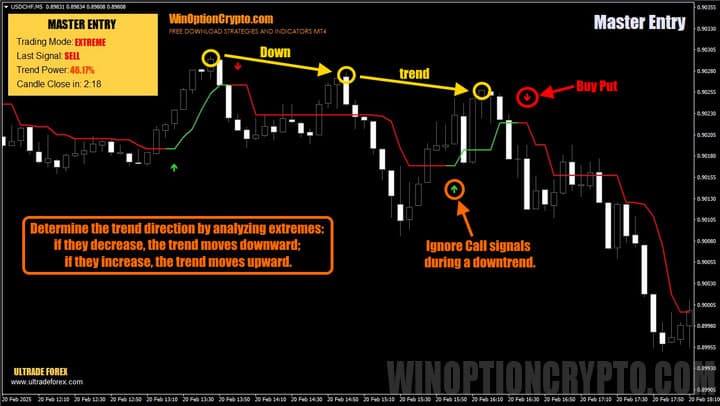
To avoid unnecessary losses, trade according to a clear plan and let analysis — not intuition — guide your decisions.
Rule No. 6: Trade Only with the Trend
There are plenty of indicators and strategies online that are designed for ranging markets, but beginners are better off focusing on trend-following methods. We already covered an example of trading with the trend in the previous rule. However, a trend is more than just a price moving up or down. Inexperienced traders — as well as more seasoned traders who may have gaps in their knowledge — should study the following topics:
- How trends work in the market;
- Identifying and using bullish and bearish trends;
- Market phase changes;
- How to identify a ranging market.
It is important to understand that 90% of trading systems can be profitable if you filter signals to those that align with the trend. Even trading with moving averages follows this principle:
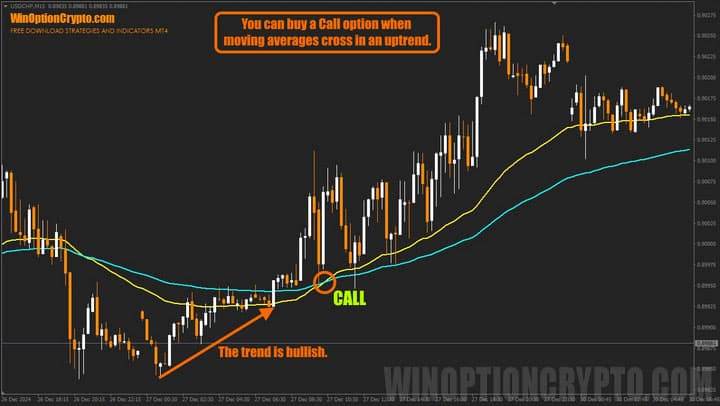
The chart above shows two simple moving averages with parameters "14" and "30". Trading every crossover of these lines during a ranging market can wipe out your entire deposit. But using crossovers only during a trend — and only in the direction of that trend — is far more likely to produce profitable results. The same principle applies to any indicator whose signals can be filtered by trend direction.
Rule No. 7: Open No More than Two Trades at a Time
Analysis and decision-making generate stress, which negatively affects your mental state. The more data you have to process simultaneously, the higher the likelihood of making mistakes. For this reason, you should not open more than two trades at the same time. Ideally, limit yourself to one asset and one trade at a time. When a beginner ignores this rule and opens three trades simultaneously, it not only increases the analytical burden but also multiplies risk, since any or all of those trades can close at a loss. This, in turn, fuels the urge to chase losses — as discussed earlier — and can result in losing the entire deposit or a significant portion of it. As a beginner, you should also avoid placing more than 10 trades per day. Over time, as your experience grows, you can gradually increase that number to 20–30 trades per session.
If you find it difficult to stick to this rule, it can help to take regular breaks from trading during the day and devote that time to other activities — whether that is resting, going for a walk, hitting the gym, or anything else that helps you reset.
Rule No. 8: Follow the Rules of Money Management and Risk Management
We have already touched briefly on money management and risk management. MM and RM in binary options allow a trader to limit unnecessary losses even during a long series of losing trades. The core idea of trading is built on this principle: your total profit should cover your total losses. It is therefore vital to stay in the game for as long as possible. If your deposit is divided into many portions and you can still place trades after ten losing trades in a row, you have a real chance to recover your losses and turn a profit. If your deposit only allows for a few losing trades, the chances of recovering are minimal.
In more detail, money management governs how you handle your capital and work with your deposit. It helps you determine:
- how much loss you can afford in a single day;
- what percentage of your deposit to allocate to each trade;
- what percentage or dollar loss limit you can afford per week.
Risk management helps you reduce exposure by applying the following rules:
- setting a maximum number of losing trades per day;
- limiting the number of assets you trade at any one time;
- avoiding the Martingale system;
- avoiding assets with low payout rates;
- avoiding handing over capital to third-party management;
- avoiding trades based on unverified signals.
Each trader can adapt these rules and apply only those they consider relevant. What matters is that you follow them consistently — doing so will help protect your trading account from unnecessary losses and keep you active in the market over the long term.
Conclusion
The binary options trading rules outlined above can help traders improve the efficiency of their trading systems and increase their profits. These are by no means all the rules that apply to binary options trading, but following even these basic recommendations can take your trading to a more professional level.
To leave a comment, you must register or log in to your account.