
A demo account can be both a binary options trader's best friend and their worst enemy. It all depends on how you use it. For beginners, it often creates the illusion of easy money, encourages complacency, and builds bad habits that almost certainly lead to losing a real deposit.

If you want your first real binary options trades to be profitable rather than disappointing, you need to understand the rules of the game. In this article, we explain why demo trading can be deceptive and provide a step-by-step plan to help you avoid the common pitfalls and protect your first deposit.
Contents:
- How a demo account distorts your perception of risk
- What brokers don't show you on a demo account
- A step-by-step guide to transitioning safely from demo to live trading
- Conclusion

How a Demo Account Distorts Your Perception of Risk
The core problem with a demo account lies not in the charts and buttons of the trading platform, but in the trader's mind. It creates a dangerous illusion that shatters the moment real money is involved. This distorted perception of risk arises for several interconnected reasons.
First, demo trading carries virtually no emotional pressure, because there is no real financial risk. On a live account, every trade triggers a range of emotions: fear of losing, greed that pushes toward unnecessary risks, and stress that makes clear thinking difficult. On a demo account, none of these are present. A trader can follow a strategy calmly, knowing there is nothing to lose. This produces a false sense of control and discipline that disappears the moment real money is at stake. 
Second, a demo account creates the illusion of consequence-free mistakes. If the virtual deposit is lost, no problem — just click "Top Up" and continue. This encourages destructive habits. Traders begin taking aggressive risks, ignoring the fundamentals of risk management and money management, and opening trades out of boredom or impulse.
These patterns become ingrained, and when the trader switches to a live account, the same behaviour continues — quickly leading to a blown deposit.
Finally, consistent demo profits often lead to an inflated sense of skill and unrealistic expectations. The trader concludes they have found a strategy that always works. Seeing a positive balance, they reason: if they made 50% in a month on the demo, the same will happen on a real account. But the first real drawdown often triggers panic. Instead of continuing to follow the strategy, the trader tries to chase losses, takes on greater risk, and loses the deposit rapidly. The psychological weight of losing real money is something a demo account simply cannot prepare you for.
In short, while a demo account is a useful training tool, it creates a distorted psychological environment — one that fosters trading without genuine fear or respect for risk, and inflates expectations. This is the primary cause of failure when switching to a live account.
What Brokers Don't Show You on a Demo Account
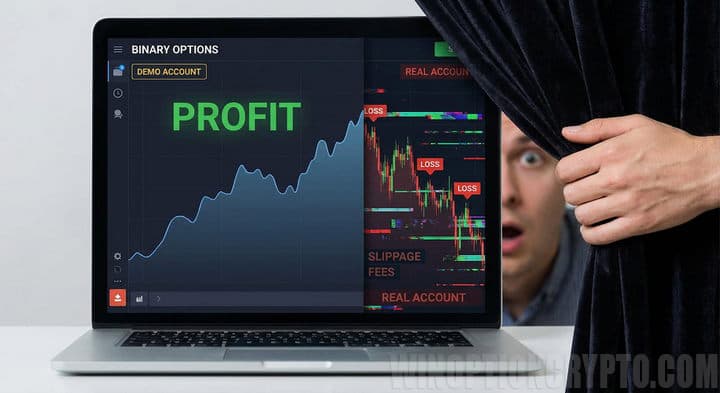
In traditional trading, technical nuances typically reduce profits at the margins. In binary options, where the outcome of a trade can be decided by a single point, they can be the difference between winning and losing. For most binary options brokers, the demo account is a polished marketing tool that conceals what the real market actually looks like.
Idealised Quotes
 Many binary options brokers present a smoother, more predictable chart on the demo. Signals look clean, trades are entered easily, and price moves obligingly in the expected direction.
On a live account, quotes are subject to market noise — microscopic price fluctuations that are particularly pronounced on short timeframes of 1 and 5 minutes. The greatest risk arises around expiration and is associated with potential quote manipulation. An unscrupulous broker can "paint" a candlestick wick in the final fraction of a second before expiration, turning a winning trade into a loss. This does not happen on a demo account — but in live trading, there may be moments when the broker's quotes briefly diverge from an independent source such as TradingView.
Instant Execution Without Delays
 On a demo account, pressing Call or Put opens the trade instantly at the price shown on screen. In real trading, there is a delay — known as latency — between the moment you click and the moment the trade actually opens on the broker's server.
In those split seconds, price can move several pips — especially on volatile assets. You spot a clean bounce from a support level and click "Higher," but due to the execution delay, the trade opens mid-candle at a significantly less favourable price. Even a minor subsequent pullback is enough to push the option out of the money.
This problem does not exist on a demo account.
Inflated and Stable Payout Percentages
 For promotional purposes, many brokers display their most attractive payout rates on demo accounts — 85%, 90%, even 95% — consistently across all assets and at all times.
In reality, payout percentages are variable. They can be higher during flat, low-volatility conditions where forecasting is difficult. As soon as the market begins to trend and clear entry signals appear, brokers often cut payouts on that asset to 55–65%.
A strategy that was profitable at 85% payouts — where 54% winning trades was sufficient to break even — immediately becomes loss-making at 70%, where the break-even rate rises to 59%.
No Rejected Trades
 On a demo account, the platform works flawlessly at any moment. In the real market — particularly during major news releases — the platform may simply not allow a trade to be placed. Buttons go inactive, or a message appears: "Trading for this asset is currently unavailable. Please try again later."
This allows the broker to limit payouts in situations where the market direction is obvious. The most reliable trade of the day gets blocked — because, unlike on a demo account, a real broker is effectively playing against you.
A trader accustomed to the clean, predictable conditions of a demo account is completely unprepared for this.
A Step-by-Step Guide to Transitioning Safely From Demo to Live Trading
After reading this, it might seem that demo accounts are useless and should be abandoned. They are not. A demo account is a powerful tool — the problem is that the vast majority of beginners treat it as a video game rather than a professional training environment.
Before you drive a car on public roads, you practise on a learner vehicle — and you don't start by racing into oncoming traffic. You master parking, smooth starts, and junction navigation first. The same principle applies to demo trading.
Your goal is to turn the game into genuine practice. Follow this step-by-step plan:
- Simulate real conditions from the start. Stop treating the demo deposit as play money. Fund your demo account not with $10,000, but with the amount you actually intend to start trading with — $100 or $200. This immediately changes your relationship with the capital.
- Forget the "Top Up" button. Set a firm rule: if you lose on the demo, you do not refill — instead, take at least a week off to analyse what went wrong. This develops respect for capital and personal accountability.
- Trade only according to a clearly defined strategy. Specify your entry and exit rules in advance. For example: when two moving averages cross and RSI exits the oversold zone, open a Call option. Define the expiration time and the conditions under which you will not trade, such as during specific high-impact news events. Your objective at this stage is not to maximise virtual profits — it is to collect statistics on winning and losing trades across a range of market conditions.
- Apply strict risk management. Risk management is what separates consistent traders from those who constantly lose. Set a maximum loss per trade — for example, 1–2% of your account. On a $100 account, that means no more than $1–2 per trade. Also set a daily loss limit — for example, 5%. If you lose $5, stop for the day.
- Keep a trading journal and log every trade. This is one of the most effective learning tools available. Record the date, asset, reason for entry, result, and your emotional state at the time. Review your entries at the end of each week. This will help you identify recurring mistakes, pinpoint the conditions where your strategy works best, and recognise which emotions most often undermine your decisions.
- Set clear, measurable criteria for switching to a live account. Do not stay on a demo account indefinitely — this leads to a cycle of perpetual learning and a fear of real trading that is hard to break. Set a concrete target. For example: move to a live account after two consecutive months of at least 20% profit on your demo deposit, or once your statistics show at least 60% winning trades over 100 trades.
Following this plan allows you to treat virtual money as real money — and genuinely prepares you to replicate those results when it counts.
Conclusion
A demo account should not be treated as a complete training tool in itself. It is, in important ways, a deceptive environment — one that deprives beginners of the most valuable experience (truly confronting fear and greed) while concealing the technical realities of live trading: execution delays, variable payouts, and trade rejections. A trader who switches to a live account after this kind of "sterile" training is not simply inexperienced — they carry dangerous overconfidence and entrenched bad habits. It is this combination, more than any lack of knowledge, that most often destroys a first real deposit.
Treat a demo account as a testing ground for discipline, risk management, and capital management — not as a game. Your goal is not to earn virtual millions, but to develop the psychological resilience and technical awareness needed for live trading. This is the path that turns a first real deposit into the foundation of long-term success. To make that transition easier, we recommend starting with a broker that offers a minimum deposit.

To leave a comment, you must register or log in to your account.