
Trading binary options is not for everyone, and most traders lose money in this market. As a result, some turn their attention to paid and free trading signals, since they eliminate the need to conduct analysis independently. The main question is whether to buy paid signals or use free ones. In this article we will try to answer it.

Contents:
- Is It Worth Buying Trading Signals?
- Who Sends Out and Sells Signals?
- How Good Are the Trading Signals?
- What Does the Subscriber Buy?
- How Legal Is This?
- Which Trading Signals to Choose?
- Results: Is It Worth Buying Paid Signals?
Is It Worth Buying Trading Signals?
A trading signal is a clear indication of when and which option to buy. Most signals are provided with the required expiration time already specified, so the trader simply needs to place the trade. If you have a strong desire to trade binary options but lack the ability to conduct technical analysis — or have not yet learned how — signals can be a useful tool. That said, beginners are always better off starting with free signals to understand how signal-based trading works before committing any money.
Experienced traders can consider paid signals, as they have the skills to test them and evaluate whether they are likely to be profitable. Experienced traders can also adapt signals to their own strategy, and if a signal conflicts with their rules, they risk only a small portion of their deposit. Beginners, on the other hand, tend to act on every signal they receive and often lose their entire deposit as a result.
Who Sends Out and Sells Signals?
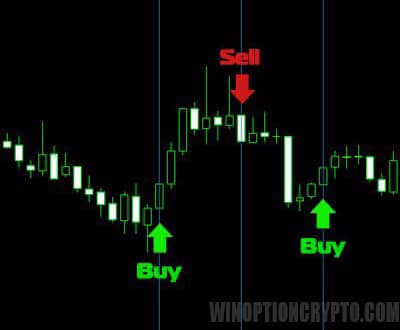 Trading signal developers are often professional traders who form groups and distribute this information to other market participants on a paid basis. For example, traders may share binary options signals through Telegram channels. There are also websites that broadcast similar "tips" in the form of a ticker, though this format is less convenient to use.
Every newsletter or advertisement claims that only successful traders are behind the signals. In reality, however, market professionals rarely engage in this kind of activity. The reasons are straightforward:
Earnings from selling signals are typically lower than earnings from actual trading. Successful traders can generate up to 1% of their deposit daily. For example, a professional with $10,000 in their account could grow it to $22,000 in a year by trading every working day. By comparison, with an average signal subscription price of $50, a trader would need at least 440 paying subscribers to match those earnings — a following that only traders with a large social media presence can realistically attract.
Successful traders also value their time. Building and maintaining a signal service requires significant effort — promoting it, growing an audience, and providing consistent analysis. Most professionals would rather spend that time on market research or developing new strategies. That said, the opposite scenario is also possible.
Who Sends Trading Signals?
-
Brokers. Brokers are interested in growing their client base and increasing revenue. Distributing trading signals helps attract new users. However, since brokers benefit when traders lose, the signals they send are often not designed to generate profit.
-
Traders who fail to profit from the market. Selling signals allows these participants to earn money without actually trading. However, "tips" from people who cannot trade profitably themselves rarely produce good results for their subscribers.
-
Owners of trading websites. Such platforms earn revenue from visitor traffic and engagement. They are therefore motivated to provide consistent, relevant content to a broad audience. In these cases, signal quality tends to be relatively higher, as site owners have a direct interest in maintaining a good track record — audience retention depends on it.
-
Fraudsters. A category of operators who, under the cover of attractive advertising, build audiences of users willing to pay for a non-existent or entirely ineffective product.
How Good Are the Trading Signals?
Verifying the quality of trading signals is genuinely difficult. Some providers are not even confident in the effectiveness of their own "tips." A well-known example from the industry illustrates this clearly.
A company once launched a free signal distribution campaign. They advised some users to open long positions and others to open short ones — directly opposite signals sent to different groups. After reviewing the results, they removed the clients whose signals had led to losses, then repeated the process: again splitting the remaining audience and sending opposite signals to each group.
As a result, the company eventually retained a small group of users who had been consistently "profitable." These clients, now convinced of the signals' effectiveness, began paying for subscriptions — even though the actual probability of profit had never exceeded 50%.
This example illustrates what market professionals consistently warn about: all such "tips" must be tested before you trade with real money. You can evaluate their reliability using the following methods:
-
Check the provider's data sources. Ask the company or provider what historical data was used to develop the signals. Request a transaction history so you can verify the results independently.
-
Look for a free trial period. To accurately assess the effectiveness of trading signals, you should execute at least 100 trades before drawing any conclusions.
-
Review transparency and feedback. Most trading signal providers refuse to disclose performance data. The signals from WinOptionCrypto on our website are fully transparent, with publicly available statistics covering an extended period.
We always encourage traders to test any signals — no matter how reliable or accurate they appear — on a demo account or with a minimal deposit before moving to real-money trading.
What Does the Subscriber Buy?
Trading signals are generated through market analysis — which means any trader has access to the same underlying information. With sufficient experience and knowledge, anyone can develop their own signals, identifying optimal entry points, position sizes, contract durations, and other key parameters.
At the same time, as noted earlier, the quality of many trading signals is often very low, while subscription prices tend to be high. In many cases, it is cheaper and more beneficial to learn binary options trading and conduct your own market analysis rather than pay for signals of questionable value.
How Legal Is This?
The legal status of trading signal providers varies by country. In most regulated markets, anyone offering trading signals commercially is required to hold the appropriate authorization. In the United States, signal providers may need to register as Commodity Trading Advisors (CTAs) with the CFTC and NFA. In the United Kingdom, the FCA requires signal providers to comply with financial promotion rules if their activity falls within the scope of regulated investment advice. In the European Union, harmonized rules under ESMA apply across member states.
In practice, many signal providers — particularly those operating through Telegram channels or social media — function outside any regulatory framework. This creates significant risk for subscribers: there is no oversight, no accountability, and no legal recourse if the signals prove worthless or the provider disappears with subscription fees. When evaluating any signal service, always check whether the provider is registered with a recognized financial regulator in their jurisdiction.
Which Trading Signals to Choose?
As mentioned above, beginners should start with free binary options signals. You can find such signals on our website in the signals section. Both classic free online signals and signals based on candlestick patterns are available.
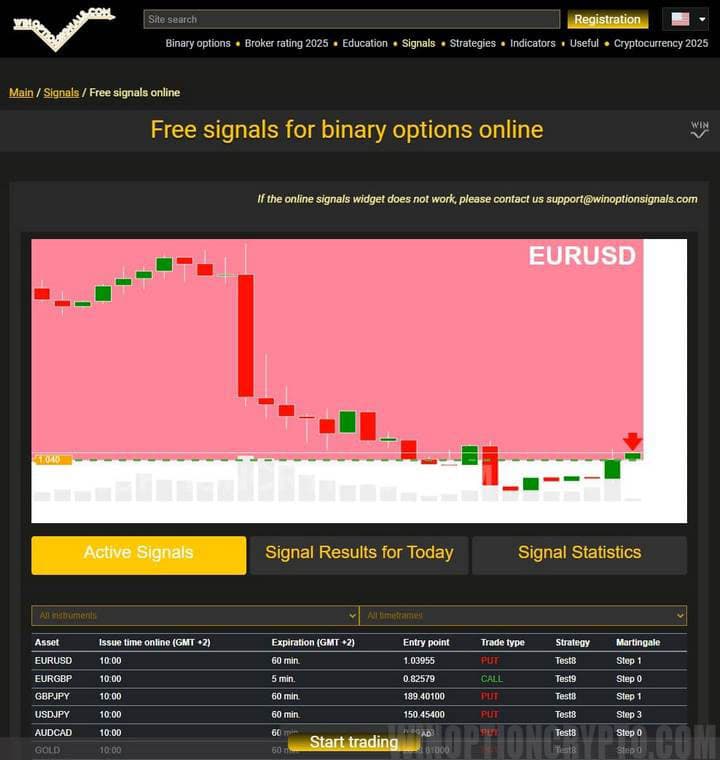
The free online signals are based on nine different strategies and deliver an average profitability of 71%. This result is achieved through the use of the Martingale system. They can be applied to major currency pairs (EUR/USD, GBP/USD, USD/JPY, and others), as well as precious metals and Bitcoin:
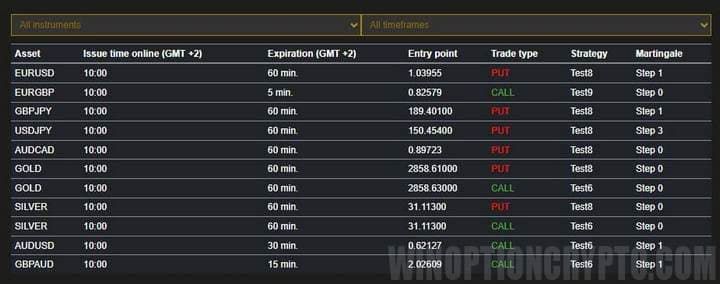
Alongside the signals themselves, a statistics panel is available showing all recommendations for the day, with full history you can review and verify independently:
The section with free signals based on graphical analysis can be used alongside the previous ones, either combined or used separately. These signals draw on more than 50 graphic patterns, including pin bars, engulfing candles, dojis, and other proven setups. This section also includes the same statistics panel as the one described above.
Results: Is It Worth Buying Paid Signals?
Based on the above, buying paid binary options signals is possible — but only if certain conditions are met:
-
Always verify the provider's historical performance before purchasing.
-
If possible, request demo access and test the paid signals on a demo account before committing real funds.
-
Read reviews from other traders who have used the service.
Even if you are confident in the signals you have purchased, always apply money management and risk management rules, and only trade with funds you can afford to lose — no Holy Grail exists in trading. There is always a real risk of losing your deposit.

To leave a comment, you must register or log in to your account.