
Every binary options trader focuses on making profits. But the ability to avoid losses is just as important as the ability to generate them. Regardless of experience level, knowing when to stay out of the market is a critical skill — one that affects capital preservation and long-term growth just as much as identifying the right moment to enter a trade. In this article, we cover the five market periods that carry the greatest risk.
Contents:
- Major economic news releases
- Session opens and closes
- The thin market — nights and public holidays
- Session overlaps and excess volatility
- Friday afternoon trading
- Conclusion

Major Economic News Releases
The first and most dangerous period for binary options trading is during major macroeconomic data releases, when the market becomes effectively unpredictable. Some beginners believe they can profit from sharp price movements at these times, but experience consistently shows otherwise. Trading around news often reduces the process to a lottery. 
When key indicators such as GDP figures, unemployment data, or central bank interest rate decisions are released, technical analysis loses its effectiveness. Indicators become unreliable, and support and resistance levels break down quickly as the market responds to fundamental forces rather than chart patterns.
The core problem is abnormal volatility. Price can surge dozens of points in one direction, then reverse within seconds, completely erasing the initial move. Since entry point and expiration time are decisive in binary options, such erratic movement makes trade outcomes essentially random. Even a correctly identified trend can be invalidated by a sharp counter-move in the final seconds before expiration.
Beyond market risk, there are technical risks to consider. During news releases, trading platforms may freeze or return errors when attempting to open a position, making it impossible to manage trades effectively.
To manage these risks, use an economic calendar. Ideally, stop trading 30 minutes before any high-impact release and wait at least 30 minutes after the announcement before opening new positions. This gives the market time to absorb the new information and return to a more stable state.
Session Opens and Closes
Another period of elevated risk is the opening and closing of Forex trading sessions, when large numbers of participants enter or exit the market simultaneously. In the first 15 to 30 minutes after major financial centres such as Frankfurt, London, or New York open, an intense battle for daily trend direction plays out.
Large institutional players, investment banks, and hedge funds place orders accumulated during off-hours, creating chaotic price action. For binary options traders, these conditions are particularly dangerous: price frequently forms false moves and false breakouts, reversing sharply without warning.
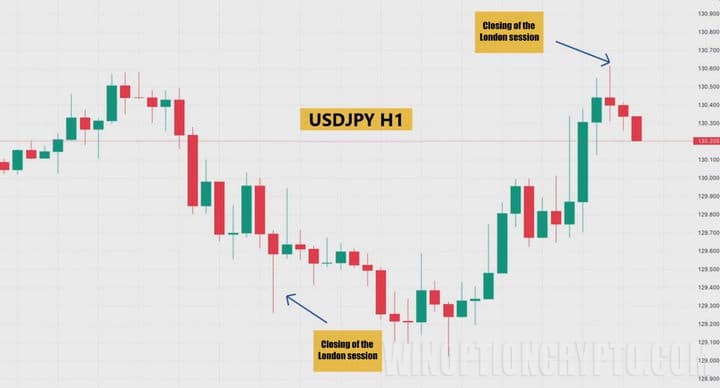
Session closes are no less hazardous. As commercial banks and investment funds close their books, sharp reversals against the underlying trend are common. For binary options traders, this can mean an unexpected turn against an open position right before expiration.
The recommended approach is to avoid entering the market for the first 20 minutes after a session opens, and to refrain from opening new trades at least 30 minutes before a session closes. Trading within these boundaries means working on "clean" charts — where price movements are driven by genuine market dynamics rather than the coordinated actions of large institutional players.
The Thin Market — Nights and Public Holidays
Trading at night and on public holidays is also best avoided. These periods produce what is known as a "thin market" — trading volumes drop sharply as the world's leading financial centres are closed. Low liquidity generates erratic price action: choppy, directionless candlesticks with long wicks that standard trading strategies cannot reliably interpret. 
During these periods, even a mid-sized trade can move prices noticeably, creating noise that is impossible to predict. Many traders gravitate toward range-bound strategies during thin markets, expecting price to bounce predictably within a flat. In reality, it is precisely during these periods that sudden, logic-defying price spikes occur most often — closing options out of the money in the final seconds before expiration. Additionally, many brokers reduce payout percentages on digital contracts at these times, making trading even less favourable.
National holidays and weekends in major economies produce the same effect, stretched across an entire trading day. When banks in these countries are closed, activity in leading currency pairs slows dramatically — prices can stagnate for hours, then spike without any apparent catalyst. Technical analysis loses its value in these conditions, as market behaviour becomes structureless.
Unless a trading strategy has been specifically designed for the Asian session, binary options traders are advised to avoid trading between midnight and 00:00 UTC.
Session Overlaps and Excess Volatility
The overlap of two trading sessions — known in the trading community as the "overlap" — is a period of characteristically high volatility that has caught out more than a few experienced binary options traders.
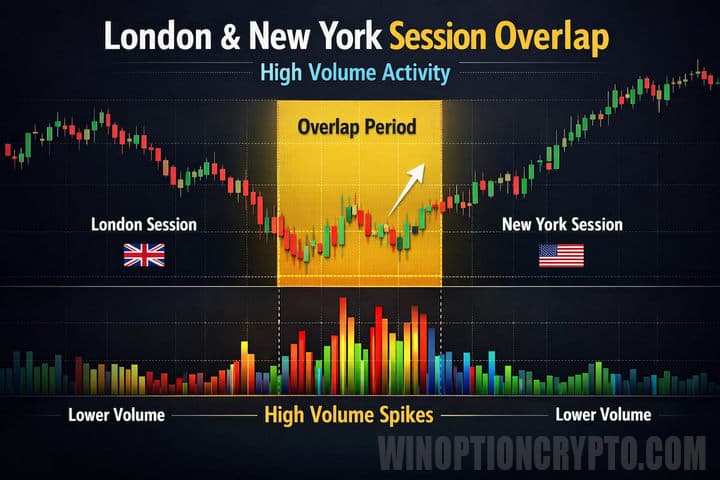
The most intense overlap is between the European and American sessions, when trading volumes reach their daily peak and the largest banks on both sides of the Atlantic are simultaneously active in the market. This creates significant directional pressure and typically drives the formation of the daily trend.
High volatility in these conditions fuels emotional errors. Watching large candles form, traders often give in to the fear of missing out and enter a position at the peak of momentum — precisely when the market is about to stall and reverse sharply.
For safer trading during overlap periods, switch to higher timeframes to filter out the noise, or wait until the initial burst of combined session activity has fully subsided and a clear trend has been established before entering.
Friday Afternoon Trading
Market liquidity typically begins to decline through Friday afternoon. At this point, even minor news or comments from officials can trigger disproportionate price reactions. Prices start moving unpredictably — oscillating within narrow ranges or spiking suddenly. Technical analysis loses its reliability in these conditions, and the fatigue accumulated over the week leads traders to make avoidable mistakes.
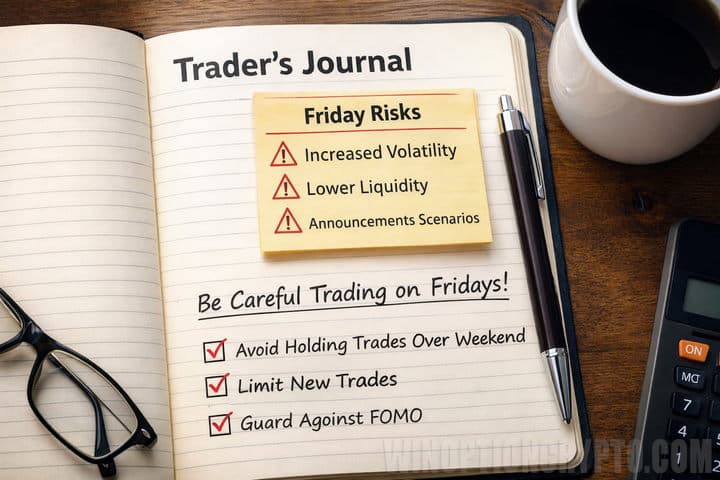
Professional traders recommend concluding Friday trading no later than 16:00 –17:00 UTC. After this point, the market becomes too erratic. The better approach is to record your results, review the week in a trading journal, and rest before Monday. This preserves both capital and the mental freshness needed for a strong start to the new week.
Conclusion
Success in binary options trading depends less on the number of trades executed and more on a trader's ability to choose the right moments to enter them. The market is not always favourable for trading — knowing when risk is elevated is one of the most important skills a binary options trader can develop.

To leave a comment, you must register or log in to your account.