

Timeframes are a key tool in binary options market analysis. They play a crucial role in developing trading strategies, making it possible to visually identify trend direction over a given period, pinpoint key support and resistance levels, and recognise chart patterns.
Simply put, a timeframe is the time interval over which a single candlestick forms on a chart. Beginner traders often struggle to determine which timeframe to choose and what factors should guide that decision. In this article, Binarium experts share their own analysis and conclusions on trading binary options across different timeframes.
Contents:
- Types of Timeframes in Trading: How to Choose the Right Interval
- Elder's Legendary Method for Filtering Out Losing Trades
- Timeframes and Trading Strategies
- Choosing a Timeframe for Trading on Binarium
- Conclusion
Types of Timeframes in Trading: How to Choose the Right Interval
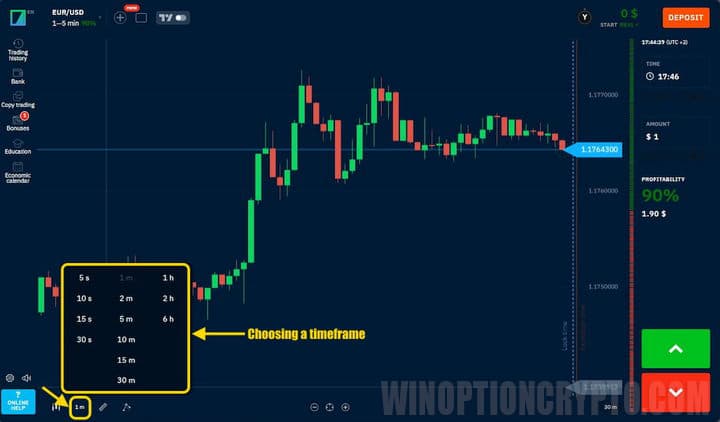
Timeframe settings are configured in the trading terminal. The most practical timeframes range from one minute to one day:
- Short-term: M1, M30;
- Medium-term: H1, H4;
- Long-term: D1.
A timeframe does more than just show how long it takes for a candle or bar to form — it is also the lens through which price changes over a given period are analysed. Beyond standard timeframes, some brokers offer custom intervals — such as two-hour or two-month timeframes — developed specifically to attract traders to their platforms.
Short-term timeframes offer more trading opportunities during calm market conditions. Trades on short timeframes should be based on technical analysis. According to Binarium experts, this approach can consistently deliver a win rate of around 80%. Finding your optimal timeframe takes practice — experimenting with different interval and strategy combinations is the most reliable way to get there.
Elder's Legendary Method for Filtering Out Losing Trades
Every experienced trader develops their own approach to timeframes. If you are just starting out and are not yet sure which timeframe to use or how to combine it with your tools and strategy, it is worth taking guidance from experienced traders who are willing to share their insights. 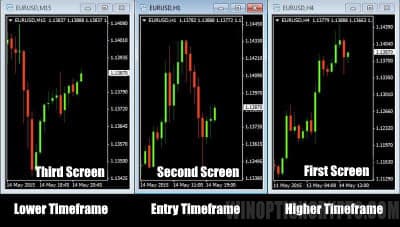
One of the most well-known frameworks was developed by the successful trader Alexander Elder. You may already be familiar with Elder's Three Screens strategy, named after him. Its core principle is the simultaneous use of three timeframes — one primary and two secondary. Elder argued that a trading decision should only be made after the forecast has been confirmed across all three timeframes.
Whether you follow Elder's method or develop your own approach to combining timeframes and strategies is entirely up to you. The key point is this: selecting the right timeframe is one of the most important steps toward reaching your goals. Analysis, indicator selection, and strategy choice all deliver results only when properly matched to the right timeframe.
Timeframes and Trading Strategies
Since timeframes are directly tied to strategy selection, let's look at the most effective combinations. Trading strategies broadly fall into four categories:
- technical;
- indicator-based;
- fundamental;
- candlestick analysis.
Technical strategies are based on technical analysis, with price levels and support and resistance lines as the primary tools. Almost all timeframes are compatible with this approach, but the hourly (H1) timeframe is generally considered the most effective.
Indicator-based strategies rely on technical indicators. Again, most timeframes work here, with the best choice depending on each indicator's entry parameters.
Fundamental strategies are the most thorough and well-grounded, drawing on in-depth fundamental analysis. For currency pairs — among the most widely traded assets — M5 and M15 are the most commonly used timeframes. For stock-based assets, longer timeframes ranging from one week to one month are more appropriate.
Price Action and candlestick pattern strategies work particularly well with H4.
Choosing a Timeframe for Trading on Binarium
 It would be unfair to push you toward any specific interval. Binarium experts recommend building practical experience through trial and error — it is the path to professional growth and knowledge grounded in your own practice. There is no industry consensus on which timeframe is universally superior.
Review the information above, try different options, and take note of which combinations work best and which fall short. To avoid unnecessary risk during this learning phase, practise and test strategies on a demo account.
Among the timeframes most widely used on our website, M1 and H1 stand out. Of all the available options, these two work especially well in combination with the main types of trading strategies and indicators. What's more, working with these timeframes does not require candlestick patterns, chart formations, or the economic calendar — technical analysis alone is sufficient to unlock the potential of these combinations and generate consistent profit.
Conclusion
We have covered the main timeframe types actively used in binary options trading on the Binarium platform. The general recommendation is to settle on the timeframe at which your strategy's indicators generate the highest proportion of profitable trades. Keep in mind, however, that this optimal timeframe will likely vary depending on the asset and the strategy involved — and even within a single financial instrument and trading method, it is worth experimenting with other intervals, particularly when the effectiveness of your approach starts to decline.
Remember: only practice will help you find the right timeframe. So don't be afraid to experiment on the demo account, working through different timeframe combinations in binary options trading.

To leave a comment, you must register or log in to your account.