
Over the years, traders have developed various approaches to managing trade size in binary options. The most widely known is the Martingale system. Its extreme risk profile — and the speed with which it can wipe out an account — led traders to develop an alternative: Anti-Martingale. This review explains what the Anti-Martingale system is, its advantages and limitations, and how to apply it in binary options trading.
Contents:
- Anti-Martingale: the opposite of Martingale
- The Parlay system
- Anti-Martingale, Parlay, and Accumulator — what's the difference?
- How to apply Anti-Martingale rules in the market
- Building an effective trading system using Anti-Martingale
- Tips for using Anti-Martingale safely
- Anti-Martingale in practice: a worked example
- Pros and cons
- Conclusion

Anti-Martingale: The Opposite of Martingale
Anyone who has traded binary options for any length of time will have encountered the Martingale system — one of the most widely used capital management approaches in both trading and gambling. One account attributes the name to an 18th-century London casino owner named John Henry Martingdale, whose house reportedly popularised the practice of doubling stakes after a loss. Make of that what you will.
Anti-Martingale is the mirror image of the classic system. Rather than increasing stake size after a loss, it increases after a win and reduces after a loss. The "anti" prefix captures this directly: it is the opposite principle.
The Parlay System
Anti-Martingale has several variations; Parlay is among the best known. Some binary options traders use the terms interchangeably, but they describe meaningfully different approaches:
|
Characteristic |
Anti-Martingale |
Parlay |
|
Stake changes |
Increases after a win; decreases after a loss |
Increases after a win; stays the same after a loss |
|
Goal |
Lock in profit during a winning run; limit losses during a losing run |
Maximise profit during a winning streak |
|
Risk |
Prolonged drawdown if a losing run follows a period of increased stakes |
Large drawdown because stakes cannot be reduced during a losing run |
The key difference comes down to what happens after a loss. Anti-Martingale reduces the stake; Parlay leaves it unchanged and rides out the losing run, betting on the next winning streak to follow.
Anti-Martingale, Parlay, and Accumulator — What's the Difference?
In trading and betting discussions, three terms frequently appear together: Anti-Martingale, Parlay, and Accumulator (also called an Express). They are often confused with one another, but they describe different things:
|
Characteristic |
Anti-Martingale |
Parlay |
Accumulator |
|
Type |
Capital management strategy |
Bet type |
Bet type (often used synonymously with Parlay) |
|
Goal |
Profit protection; loss minimisation |
High return through compounded odds |
High return through compounded odds |
|
Risk |
Extended drawdown |
High probability of losing the entire stake |
High probability of losing the entire stake |
|
Events covered |
One event at a time |
Multiple events in a single bet |
Multiple events in a single bet |
How to Apply Anti-Martingale Rules in the Market

Before using Anti-Martingale, determine your initial trade size and the increment by which it will increase after each winning trade. Starting small is sensible — the $1 minimum trade size at Pocket Option is a practical starting point.
One important point: no capital management method can convert a losing trading system into a profitable one. Before applying any position-sizing approach, you need a strategy or set of indicators that generates reliable signals. For free signals, see our review of the WinOptionSignals service.
To save time on manual calculations, use the Anti-Martingale calculator available on our website.
Building an Effective Trading System Using Anti-Martingale

Uncapped stake increases during a winning run sound appealing in theory. In practice, a single large losing trade following a string of wins can eliminate everything that was accumulated — and the psychological impact of that reversal should not be underestimated.
Experienced traders address this by setting a cap on the number of consecutive stake increases. After a defined number of winning trades, the trader returns to the minimum stake regardless of whether the next trade wins or loses. Here is a conservative example using a $1 initial stake and a $1 multiplier:
Trade 1 — $1.
Trade 2 — $2 ($1 + $1 increment).
Trade 3 — $3 ($2 + $1 increment).
After three consecutive wins, return to the $1 initial stake. The cycle also restarts from the beginning after each loss. This approach preserves accumulated profit rather than gambling it on the next trade.
Tips for Using Anti-Martingale Safely
To get the most from this approach while managing its risks, follow these guidelines:
- Trade volatile instruments with clearly defined trends.
- Trade only during active market sessions.
- Avoid opening trades ahead of major macroeconomic data releases — check the economic calendar in advance.
- Only trade options with a payout of at least 75%.
- Monitor the win rate of your strategy. If it falls below 60%, reconsider your trading approach before continuing.
Anti-Martingale in Practice: A Worked Example
The chart below shows five trades from one of the strategies described on this site. What matters here is not the specific entry and exit points, but the trade sizing at each step.
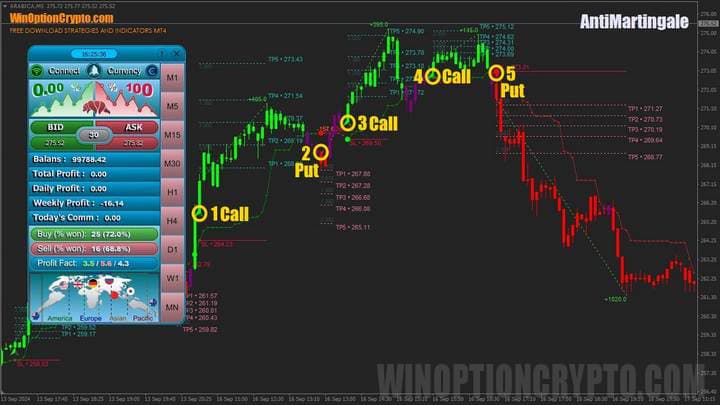
For this example, the initial stake and increment are both $1. After each winning trade, the stake increases by $1; after a loss, it resets to $1. Payout is 75%.
Trade 1
A Call signal appears. We open a Call option for $1 with a 3-candle expiration. The trade closes in profit: +$0.75.
Trade 2
A downward signal appears. We open a Put option for $2 (previous trade was a win, so the stake increases by $1). The trade closes at a loss: −$2.
Trade 3
A Call signal appears. Following the loss in Trade 2, we reset to the initial stake of $1. The trade closes in profit: +$0.75.
Trade 4
We open a Call for $2 (previous trade was a win). The trade closes in profit: +$1.50.
Trade 5
We open a Put for $3 (previous trade was a win). The trade closes in profit: +$2.25.
Total across five trades: +$0.75 − $2.00 + $0.75 + $1.50 + $2.25 = +$3.25.
Pros and Cons
Advantages
- Lower risk than the standard Martingale system.
- Profits can compound quickly during a sustained winning run.
- Losses are contained: after a loss, the stake resets to the minimum rather than escalating.
- The rules are straightforward and require no advanced mathematical knowledge.
Disadvantages
- Overall risk per series of trades is higher than using a fixed stake throughout.
- Not well suited to long-term use, as the probability of a damaging losing run increases over time.
- Account recovery after drawdown takes longer than with the Martingale system.
Conclusion
Anti-Martingale is a capital management approach in which trade size increases after a win and decreases after a loss. On the surface it appears to be an attractive way to grow an account. Like any position-sizing method, however, it has both advantages and real limitations.
Used correctly, it does not guarantee long-term profitability, and a run of losses can produce significant drawdown. The best results come from combining Anti-Martingale with a reliable trading strategy and consistent discipline.

To leave a comment, you must register or log in to your account.