
The Simple Scalper binary options strategy takes an aggressive approach to trend trading in financial markets. The method centres on identifying a price impulse at the very moment it begins to form. Because entries are made at the earliest stage of a developing trend, the strategy is particularly well suited to traders who prefer active binary options trading.
The system is notable for the clarity and consistency of its signals. New binary options traders will have no difficulty applying it in practice. Importantly, the indicators used by the system do not repaint or cancel their previous readings.
The developers charge $87 for this scalping strategy. In this review we examine how it works, how effective it is, and whether it is worth the price. At the end of the article you will find a link to download the system free of charge for evaluation purposes.
Contents:
- Key Features
- Installation
- Simple Scalper: Overview and Settings
- Trading Rules
- Opening a Call Option
- Opening a Put Option
- Conclusion
- Download Simple Scalper
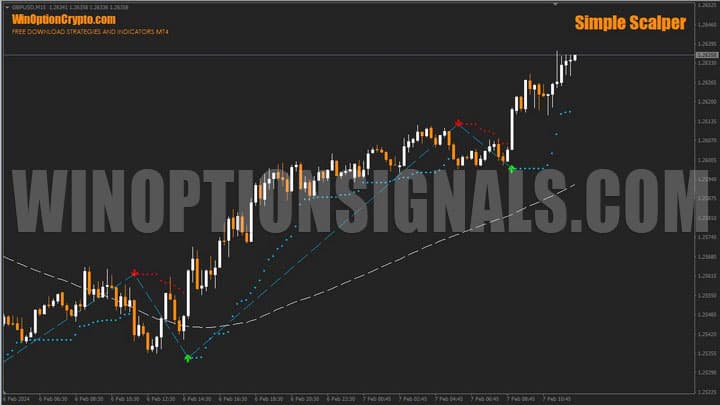
Key Features of the Simple Scalper Strategy
- Terminal: MetaTrader 4
- Timeframe: M15
- Expiration: 6 candles
- Option types: Call / Put
- Indicators: Direction.ex4, Moving Average.ex4
- Trading instruments: currency pairs, commodities, cryptocurrencies, stocks
- Trading hours: 08:00–21:00 UTC
- Recommended brokers: Quotex, Pocket Option
Installing the Simple Scalper Binary Options Strategy
Simple Scalper indicators are installed using the standard MetaTrader 4 procedure. Open MT4, select "File," then "Open Data Folder." In the directory that opens, navigate to "MQL4" and then "Indicators," and drag all the strategy files into that folder. Templates are installed the same way, but go into the "templates" folder instead. For a step-by-step walkthrough, see our video:
Simple Scalper Indicators: Overview and Settings
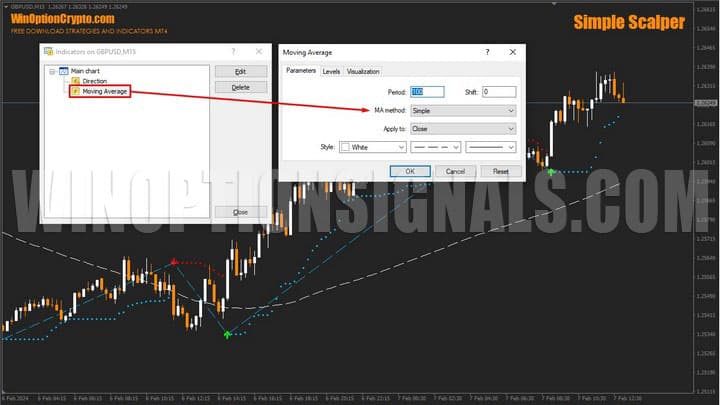
The Simple Scalper strategy uses two indicators: Direction and a Simple Moving Average with a period of 100 (SMA100).
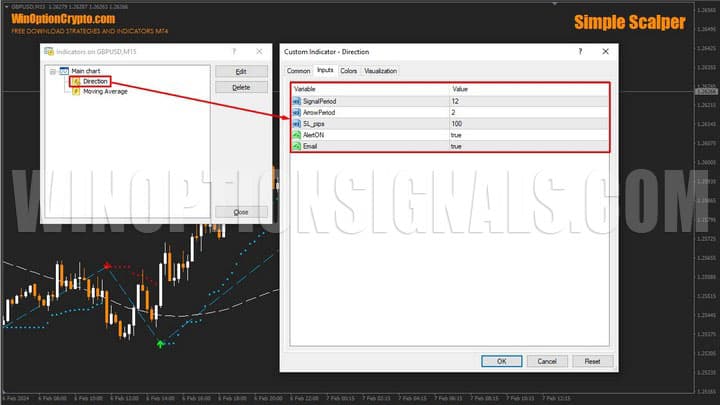
Direction is a proprietary indicator that combines elements of the standard Parabolic SAR, Zig-Zag, and an arrow signal overlay. As shown in the screenshot, it has a small number of configurable parameters. The two most important and sensitive are "Signal Period" — which controls how the chart is divided into swings — and "Arrow Period," which determines the calculation interval for the signal arrows. Additional settings cover the initial stop-loss value and alert configuration.
The second indicator needs no introduction. Moving Average is a standard tool built into MetaTrader 4. In this system it serves as a trend filter, preventing entries against the dominant trend direction.
For best results, we recommend trading volatile assets. Higher volatility provides sufficient price movement for option contracts to close profitably after a signal is received.
Backtesting on historical data showed strong results when holding positions open for 6 or more candles. This is on the longer side for scalping, but trend reversal signals need time to fully develop. You can experiment with the expiration time to find what works best for your chosen instrument — but always test any changes on a demo account with a reliable broker first.
Forex traders can also use this strategy beyond binary options — not only to identify high-quality entry points, but also to locate price levels at which to place protective stop orders and limit downside exposure.
Simple Scalper Trading Rules
Simple Scalper is a classic trend-following system. For a solid grounding in trend analysis — which underpins this strategy — we recommend the following articles:
- How does a trend work in markets?
- Identifying and using bullish and bearish trends
- Market phase transitions
- How to identify a ranging (flat) market
Why does trend alignment receive so much emphasis? Trading in the direction of an instrument's dominant trend increases the proportion of winning trades and, as a result, reduces overall losses and the likelihood of significant drawdown. A further benefit is that trading with the trend gives traders greater conviction in their decisions — which in itself tends to improve results.
Every trend system needs filters to reduce false signals against the main trend. In Simple Scalper, this role is filled by the 100-period moving average. When price is below SMA(100), only Put options are considered. When price is above SMA(100), only Call options are considered.
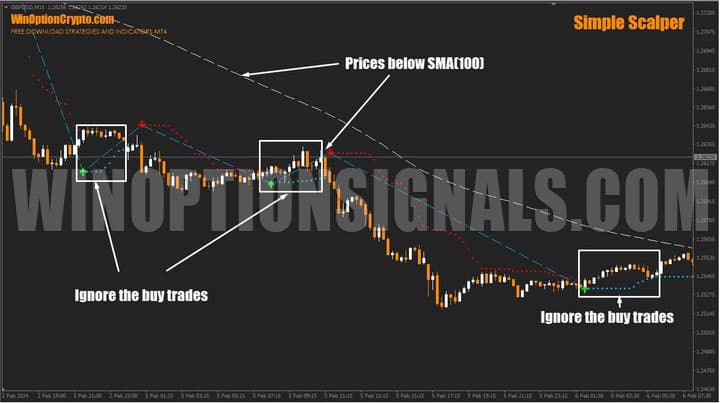
In the chart above, the dotted line represents the 100-period SMA. As shown, the filter prevented three false Call entries. While price remains below the moving average, the focus should be on finding Put entries — counter-trend price surges during a downtrend are typically short-lived and not worth trading.
The optimal filter period will vary by instrument. More volatile currency pairs generally benefit from a higher period value, while some commodity instruments may work better with a lower one. Select the period based on historical data for your specific instrument and timeframe. Ultimately, the right setting is the one you find most effective and comfortable to trade.
Opening a Call Option
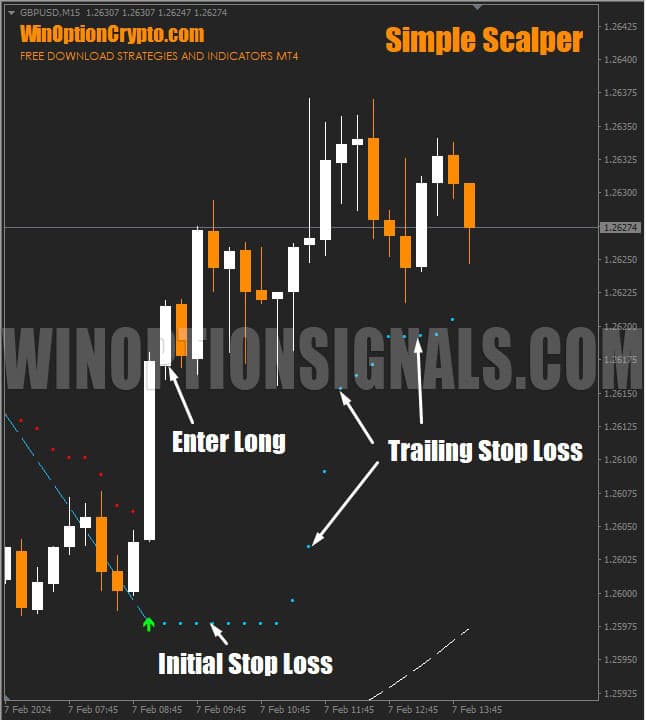
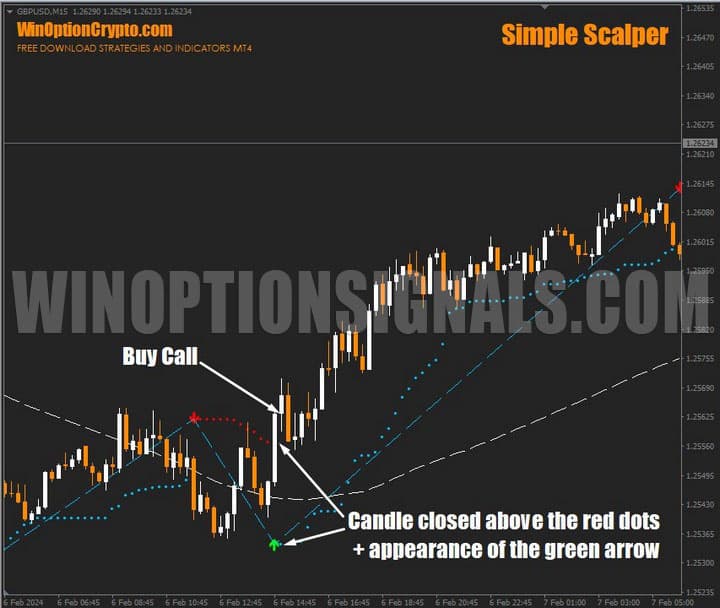
To open a Call option, first confirm that the asset's price is above SMA(100). Then wait for a candle to close above the red dots of the Direction indicator, accompanied by a green arrow. Open a Call at the start of the next candle.
Opening a Put Option
To open a Put option, first confirm that the asset's price is below SMA(100). Then wait for a candle to close below the blue dots of the Direction indicator, accompanied by a red arrow. Open a Put at the start of the next candle.
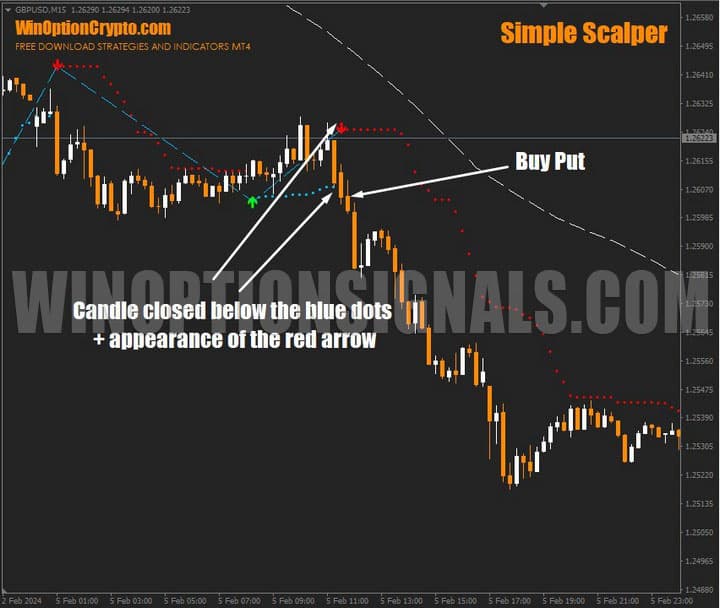
The recommended expiration is 6 candles.
Conclusion
Simple Scalper is built on a classic trading principle: entering on a trend-aligned level breakout. The SMA(100) determines the dominant trend direction — while price is below this filter, only Put options are taken; while price is above it, only Calls are taken.
The strategy is straightforward yet effective, and genuinely worth its modest price. Like any trend-based binary options system, it can be easily adapted from medium-term to short-term trading and back, without any changes to the core entry rules. The only adjustments needed are to the calculation periods of the Direction indicator and, where necessary, the trend filter. Before going live, we strongly recommend practising on a demo account and applying sound risk management and money management principles throughout.
Download the Simple Scalper Binary Options Strategy

To leave a comment, you must register or log in to your account.