
A sharp price spike on an asset's chart often prompts binary options traders to immediately open a trade to avoid missing out on potential profits. At such moments, emotions override common sense and rational analysis, causing traders to ignore the rules of their trading strategy. As a result, they enter the market late, often resulting in losses.

This behavior is called "Fear of Missing Out," or FOMO for short. The fear of missing out is one of the key psychological traps in binary options trading. It often leads to trades that traders later view as ill-considered. Ignoring this factor while still expecting consistent profits is simply not possible.
In this article, we'll examine the nature of this phenomenon in detail and offer specific practical methods for overcoming it. Those who read through to the end will learn to control FOMO and adopt a systematic approach to trading.
Contents:
- What is FOMO Exactly?
- Why Binary Options Traders Get Trapped
- A Practical Guide to Combating FOMO in Binary Options
- Conclusion
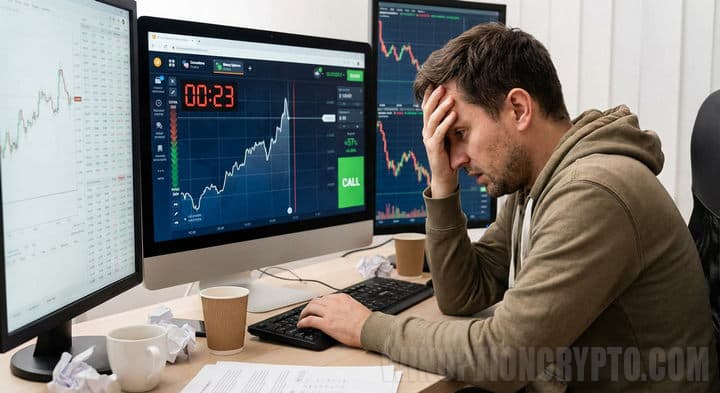
What Is FOMO Exactly?
It's commonly believed that FOMO is simply greed. However, this isn't entirely accurate. Greed is a calculated desire to get more than one currently has. FOMO, on the other hand, is an irrational, panicky fear of being left behind while others are making money. To understand its destructive nature, let's take a closer look at how the brain works.
This feeling is rooted in the survival mechanism of herd mimicry. For primitive humans, ignoring fellow tribespeople running toward a food source meant risking starvation. This mechanism, shaped alongside the instinct for self-preservation over millennia, remains embedded in our psyche today — it simply manifests in a different environment. The trading terminal becomes a modern habitat, and a large green candle on the chart is perceived as a signal that "the pack has found prey." At such moments, the brain stops analyzing trading signals and reacts impulsively: "Everyone is making money, and you're sitting on the sidelines. You need to act now!"
The binary options market is a near-perfect environment for triggering such reactions. High-speed trading and trades lasting just a few minutes leave no time for thoughtful analysis. Natural instincts kick in far faster. The situation is further compounded by the ease of opening a trade: entering the market requires just one click, removing the psychological barrier to impulsive action entirely.
As a result, a trader succumbing to FOMO makes a predictable and damaging mistake. They open a Call option at the very peak of an upward move, just as more disciplined market participants are beginning to take profits. The price makes a minor downward correction, and the trade closes out of the money. This is precisely why trades made under the influence of FOMO are considered errors — not because they necessarily end in losses, but because they are entered at an emotional peak, without analysis, and in violation of every rule in the strategy. At that point, this is no longer trading; it is an impulsive reaction driven by the fear of sitting out a sharp price move.
Why Binary Options Traders Get Trapped

Compared to other markets, the trap binary options traders fall into seems unusual, because it masquerades as safety and simplicity. It isn't a sudden collapse, but rather a slow, creeping swamp composed of three elements that perfectly reinforce one another.
Dopamine Loop
Binary options trades with short expiration times, such as one minute, generate instant feedback: you open a trade and see a result almost immediately. If the result is positive, the trader's brain receives a powerful surge of dopamine — the pleasure and reward hormone. This is the same mechanism that drives people to constantly check for likes on social media. Over time, the brain begins to anticipate not so much the profit as the "entry–anticipation–outcome" cycle itself. At this point, trading ceases to be an analytical exercise and becomes a gamble, the goal of which is simply to get another dopamine hit.
Devaluation of Analysis
The simplicity of the trading platform interface creates a dangerous illusion: that guessing the price direction is all it takes to succeed. This distorted thinking devalues the need for technical analysis, studying chart patterns, and using indicators. The trader's mind takes the path of least resistance: "Why spend 20 minutes analyzing when I can click a button and see the result in a minute?" This self-delusion leads to decisions based on gut feeling rather than objective data, turning trading into a coin toss.
The "Safe" Loss Trap
The claim that in binary options a trader risks only the amount of their bet is only partially true. Psychologically, the brain doesn't perceive a small loss — say, $10 — as an acceptable cost. It registers as a mistake that must be immediately corrected. This triggers an instinctive urge to recover the loss by increasing the size of the next position. As a result, the perceived safety of a single loss becomes the catalyst for a series of reckless, ever-escalating trades that ultimately destroy the account.
All three factors — dopamine dependency, the illusion of simplicity, and a false sense of security around losses — converge to create a perfect storm. Traders find themselves in a vicious cycle where the desire for quick results leads them to skip analysis, and the apparent painlessness of losses pushes them toward increasingly risky behavior. This is the essence of the binary options trap: it is built not on market complexity, but on the vulnerabilities of the human psyche.
A Practical Guide to Combating FOMO in Binary Options
Fighting FOMO is not a matter of willpower or trying to "overpower" an ancient survival instinct. Instead of that inherently losing battle, it is far more effective to focus on tools and procedures that can be applied mechanically, stripping emotion of its influence over trading decisions.
Step 1: Learn to Recognize the Danger
You can't fight what you can't recognize. A trader's first task is therefore to learn to identify FOMO in real time. Pay attention to the following physical and mental markers:
- Physical signs: your heart starts beating faster, your breathing becomes shallow, your palms sweat, and you instinctively lean closer to the screen.
- Mental signs: thoughts fixate on the missed opportunity — "It's taking off without me!", "I need to get in now!", "This is a real chance, I can't miss it!"
As soon as you notice the first symptoms, say to yourself: "This is FOMO." Even simply naming the state is often enough to create distance between you and the emotion, shifting from panic mode to conscious analysis.
Step 2: Your Trading Strategy Is the Best Medicine
FOMO feeds on chaos and uncertainty — it thrives when a trader has no clear rules but still feels the urge to open a trade. With that in mind, make a strict, clearly written trading plan your primary weapon. It should be as specific as possible to eliminate any ambiguity about what the market is telling you, whatever the situation.
The most important rule, which should be treated as law: "No signal from the trading system, no trade." Even if the price "flies into space" after you held back, you haven't lost — you've won, because you demonstrated discipline and stayed true to your own rules. Remember: a trader's job is not to catch every market move, but to take only those trades that are fully consistent with their strategy.
Step 3: The 10-Minute Rule
In our experience, this is one of the most effective techniques during a severe FOMO attack. The idea is simple: if you see what looks like a "departing train" and feel an overwhelming urge to jump on it, impose a 10-minute trading ban on yourself. During this time, the emotion subsides and you can assess the situation with a clearer head. More often than not, it becomes obvious that it's already too late to enter that trade.
What's more, the market won't disappear after those 10 minutes — new trading opportunities will always emerge.
Step 4: Keep a Journal of Impulsive Trades
In your trading journal, record any trades you made under the influence of FOMO. Note the reason for the entry: "I gave in to my emotions," "I was afraid of missing out." At the end of each week, calculate how much those trades cost you. Seeing a concrete figure — for example, "–$125 in one week due to FOMO" — is the most powerful form of self-correction. It gives you undeniable proof that giving in to this impulse is a direct path to losses.
Step 5: Redefine Your Trading Goal
As long as your primary goal remains "making money on this trade," you will remain especially vulnerable to FOMO. Try replacing it with a different objective: "executing my trading strategy perfectly."
Under this approach, a profitable but impulsive trade is considered a failure, because it violated the system's rules. A losing trade executed strictly according to plan becomes a success, because you acted with discipline and consistency. This fundamentally changes your relationship with trading: you begin to derive satisfaction not from a random win, but from your own professionalism and ability to keep your emotions in check.
Conclusion
FOMO in binary options trading is not a sign of weakness — it is a powerful primal instinct that cannot be defeated by direct confrontation. Instead, it needs to be stripped of its influence over trading decisions. To achieve this, build an impenetrable wall of rules, rituals, and procedures around your trading system. Your strategy is your reliable shield, your trading journal is your mirror, and the "10-minute rule" is your emergency brake.
Ultimately, FOMO is under your control — not the other way around. And it is this capacity for self-control that separates a professional binary options trader from a novice.

To leave a comment, you must register or log in to your account.