
 Every investor, in any market, aims not only to limit losses but to improve overall financial results. Binary options traders are no exception. Trading binary options carries elevated risk — the chance of losing the staked amount is greater than the chance of earning a return.
To illustrate: if the payout on a winning option is 75%, the minimum win rate required to break even is 100% / (100% + 75%) = 57%. If the practical result falls below this, the trader's account balance erodes steadily. To trade profitably, at least 7 out of every 10 options need to close in profit. One effective approach to improving these odds and protecting the deposit is hedging. Hedging can significantly reduce exposure and, under the right conditions, generate returns from both sides of a position. It can also be combined with money management and risk management principles for a comprehensive approach to deposit protection.
Hedging — A Practical Approach to Risk Reduction
Hedging is not a standalone trading strategy — it complements the trader's existing system. The decision to open a hedging position is made based on a signal from the primary trading system, which should deliver a profitable win rate of at least 60%.
Below are three real trading scenarios where hedging can be applied.
1. An option that would be a loss if closed immediately is known as Out-of-the-Money (OTM). On an open Call position, this means quotes have fallen below the strike price; on a Put, they have risen above it. The further the current price is from the strike, the deeper the option is out of the money.
Many traders reach for hedging to cover the losses of a trade that has already gone wrong — when the more honest response would be to accept the mistake and close the position.
Example:
A trader stakes $10, but the market moves against them. The logical next step might seem to be opening a position in the opposite direction at the next price extreme — but in binary options this rarely helps. The initial analysis was flawed, and the second trade does not change the underlying conditions that led to the loss. Both positions close at a loss. Hedging was not effective here.
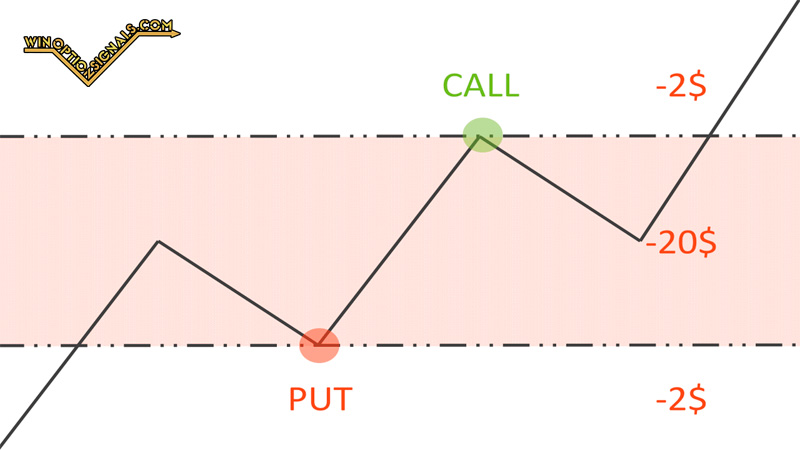
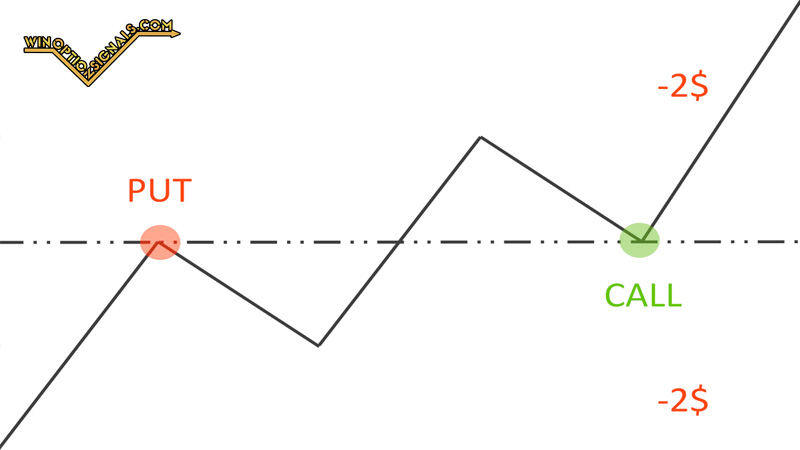
2. At-the-Money (ATM) describes an option that neither profits nor loses — the trader gets their stake back. This occurs when the opening and closing price of the contract are identical.
Example:
A Put option is open and quotes suddenly move to the resistance line and break through it. The trader waits for the new support level to be confirmed — when price touches the line from the other side — and then opens a Call position for the same amount and with the same expiration time as the original contract. The two positions cancel each other out, resulting in a breakeven outcome. By hedging at this point, the trader avoids a net loss.
3. An option that would produce a profit if closed at the current price is called In-the-Money (ITM). A Call option is in the money when quotes exceed the strike price; a Put option is in the money when the reverse is true. The further the current price is from the strike, the more deeply in the money the contract is.
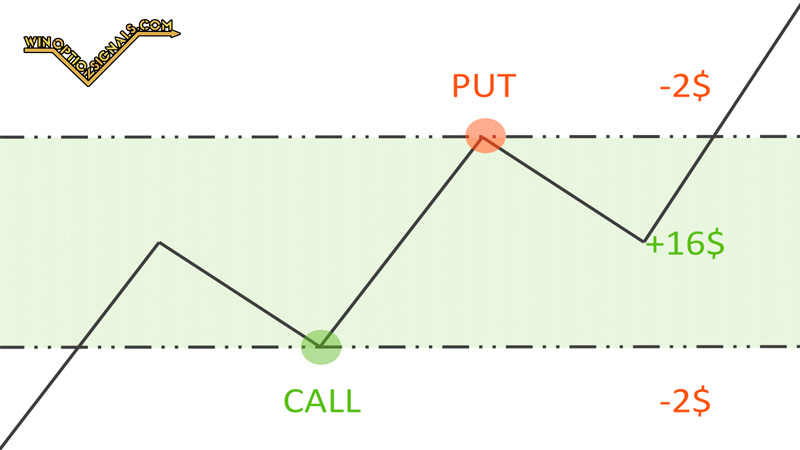
To execute this type of hedged trade, identify recent highs and lows within a defined period, then open Put positions at the top of the range and Call positions at the bottom. This channel-based approach is particularly effective during periods of limited price movement. In favourable conditions, both positions close in profit.
Example:
A signal from the trading strategy triggers a Call position. The trend is favourable — price rises and approaches the upper boundary of the channel. At this point, a second trade is opened in the opposite direction (Put), with the same stake and expiration time as the first. Regardless of how the market develops from here, the trader either reaches breakeven or closes both contracts in profit.
Step-by-Step Hedging Process
A hedged position is built as follows:
- A signal is received from the trading strategy;
- A trade is opened with a chosen expiration time;
- Price moves in the expected direction, but the strategy then signals a reversal;
- A second trade is opened in the opposite direction. The expiration time must match the first contract so that both close simultaneously;
- Wait for the outcome.
Example 1
EUR/GBP currency pair, H4 timeframe.
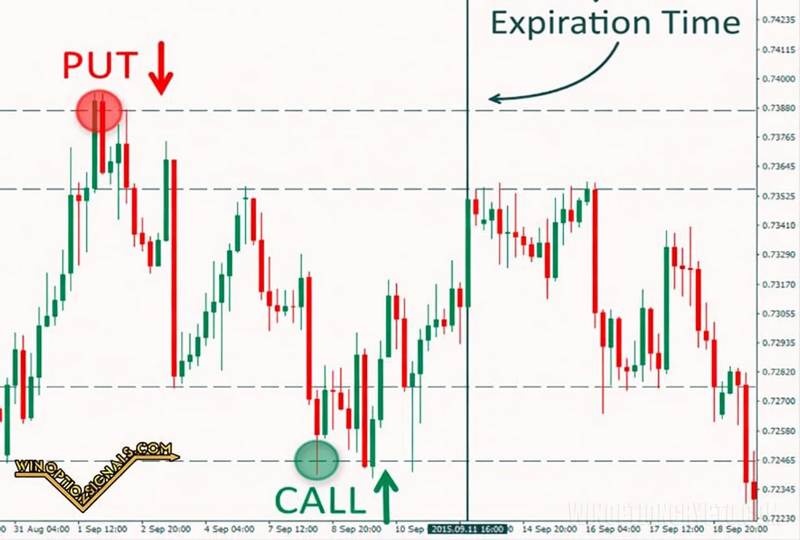
Price is moving within a sideways channel, with support and resistance levels marked on the chart. When price touches the upper boundary, a Put position is opened. Quotes then travel to the lower boundary — the support level — at which point a Call position becomes valid. By expiration, both trades close in profit, with price remaining within the defined channel throughout.
Example 2
EUR/GBP currency pair, M5 timeframe.
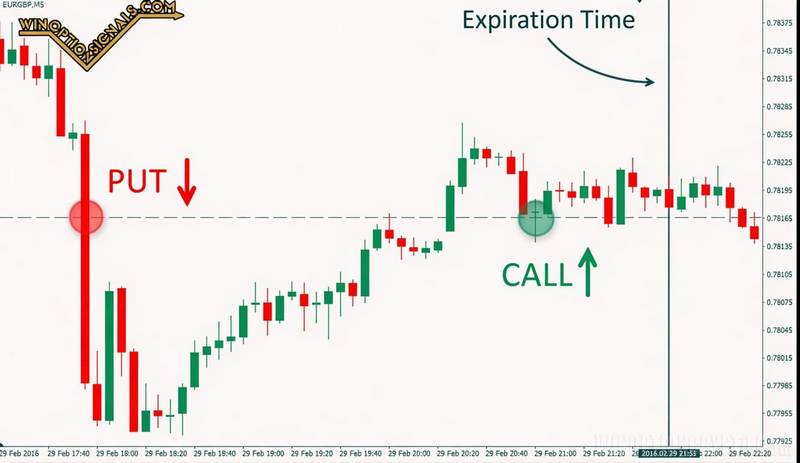
When quotes break below the support level, a Put option is opened with a 4-hour expiration. Price initially moves as expected. A new support level forms, but quotes then reverse and push upward. After bouncing from resistance and pulling back, price breaks through the level on the second attempt. Recognising the shift, the trader waits for price to retest the key level and then opens a Call position — with the same expiration time as the original contract. The first trade closes at a loss; the second closes in the money.
Summary
Hedging is a well-established approach to capital management, widely used by investors across markets. Originally developed for Forex, it translates effectively to binary options — and in favourable conditions, can generate returns from both sides of a position simultaneously. Traders apply it across all option types, from turbo to long-term contracts.
Before using hedging, confirm that your broker supports flexible expiration settings — without this, the approach will not work as intended. Your underlying strategy must also deliver a win rate of at least 60% to make hedging worthwhile.

To leave a comment, you must register or log in to your account.