
Quite a large number of things in our world occur in cycles, from fashion trends to the movement of planets. Pricing in financial markets works in a similar way. The value of a given asset is shaped by the influence of people — or rather, their behavior, which is driven by the development cycles of society.
In the first half of the last century, a theory was developed stating that the price of an asset moves in waves and follows a clear structure. Its author was the American financier Ralph Nelson Elliott. This theory is known as Elliott Wave Theory.
It is quite extensive, but holds great interest for traders around the world. In this article we will cover the main ideas behind the American financier's work. For those who wish to explore wave theory more deeply, specialized literature is available.

Elliott Wave Theory: The 5-3 Structure
Elliott's theory states that any trend consists of 5 waves, followed by a three-wave correction.
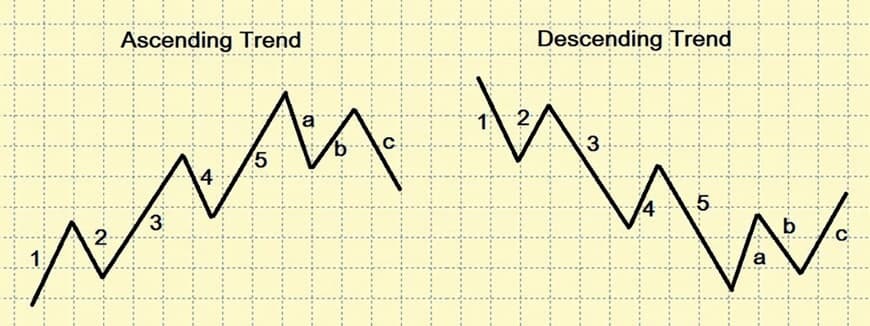
At first glance this may seem straightforward, but in practice things are quite different. Most traders face the same challenge — correctly identifying where a wave begins and where it ends. In other words, finding precise entry and exit points is difficult.
One of the tools that helps apply wave theory more effectively is Fibonacci numbers. Elliott himself used these when developing his theory. Fibonacci levels, when drawn correctly along impulse waves, make it possible to calculate the length of corrective waves.
Applying Elliott Wave Theory in Practice
Below are a few tips to help you identify waves.
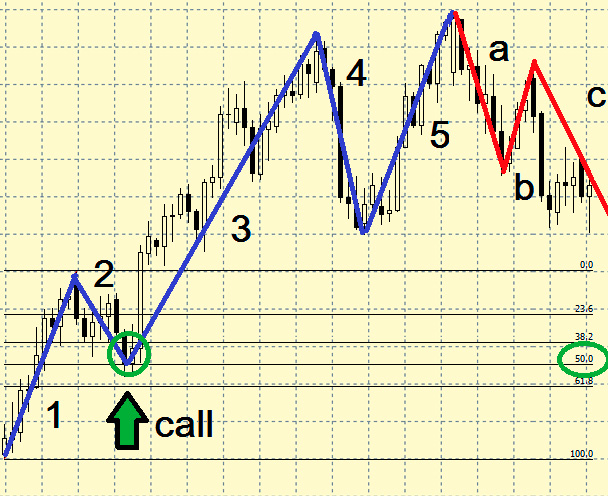
- Wave No. 1. Marks the emergence of a trend. In most cases, it begins to form after the price breaks through an important support or resistance level.
- Wave No. 2. Marks a pullback, the size of which is a portion of Wave No. 1. The second wave can never be larger than the first.
- Wave No. 3. Of greatest interest to traders. This is typically the longest wave in the cycle and is where the maximum profit is made.
- Wave No. 4. Marks a minor pullback. The price should not cross the high of the first wave.
- Wave No. 5. The final impulse. Marks a weakening trend, most often accompanied by indicator divergence and declining volume.
- Wave A. The beginning of a trend reversal. The wave length is relatively small, as there are still market participants expecting the trend to continue.
- Wave B. Shorter than both waves A and C.
- Wave C. The strongest and longest of the corrective waves. At this point, the previous trend can be considered over.
Wave theory applies to any timeframe. On a higher timeframe, a single wave represents a complete 8-wave cycle on a lower one.
Accurately counting every wave is not always possible — only experienced traders can manage this consistently. For this reason, traders who use Elliott Wave Theory typically look to open positions at the very start of the third wave, as it is the longest and offers the greatest profit potential. The entire analytical process centers on locating it. To help identify waves on a chart, additional tools such as Fractals or ZigZag indicators can be used.
We recommend testing all new strategies and indicators for binary options without risking your main deposit. A good option is to try them out using a risk-free demo account with a reliable broker.
Not sure how this strategy or indicator works? Leave a comment below, and subscribe to our YouTube channel WinOptionCrypto — we'll answer your questions in upcoming videos.

To leave a comment, you must register or log in to your account.