
The Alligator indicator is based on Bill Williams' TC Profitunity trading system. It is one of the most well-known tools in stock and currency trading, used by many traders with varying degrees of success. The system continues to generate debate: some traders use it profitably, while others find it less effective. TC Profitunity is a multi-layered system made up of several subsystems that interact continuously.
An indicator based on this system allows traders to monitor several timeframes simultaneously. This article covers its application to the binary options market.

How to Use the Alligator Indicator
The Alligator can be used on any terminal with a timeframe of H1 or higher. It is a trend indicator suitable for monitoring various currency pairs.
Trading with this indicator can be carried out around the clock. The expiration time is set to one candle.
Instructions for installing indicators in MetaTrader 4:
How the System Works
Bill Williams, the developer of the Alligator, along with other market participants, held that current market conditions reflect the aggregate opinions of all traders. This means that price analysis alone provides sufficient information for making forecasts.
To work effectively with the Alligator, it helps to understand the following:
- How to determine the direction of market movement?
- How to identify a turning point on a bar chart?
- How does the Alligator fan work?
The indicator fan consists of three Moving Averages (MAs) with periods of 5, 8, and 13. The first smoothed moving average is shifted forward by 3 bars; the second and third by 5 and 8 bars respectively. This configuration forms the Alligator's "mouth".
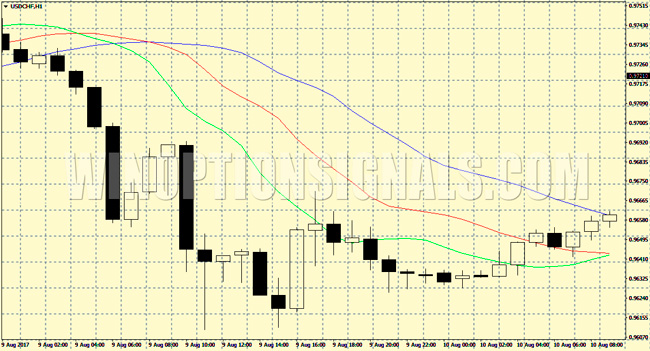
The indicator provides a comprehensive view spanning several timeframes. An open "mouth" therefore indicates that the same trend is present across multiple fractal levels.
However, to trade profitably, it is also necessary to identify the trend on the current timeframe — not just the indicator direction. The trend is determined from candle closing prices. To do this, open the "Line" chart and, starting from the indicator's low point, draw a line along the uptrend. This line shows the slope of the trend.
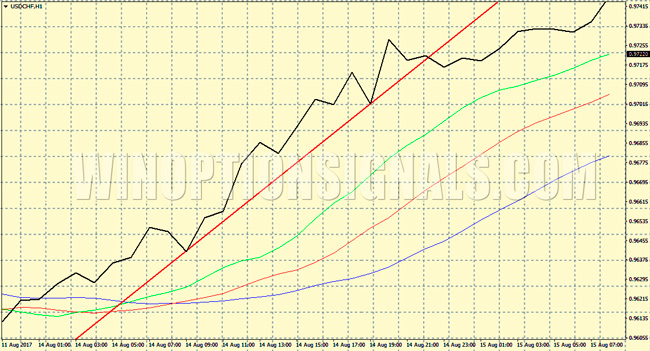
These actions should be performed on charts that display closing prices. On a bar chart, the angle of the trendline is harder to judge accurately because of the volume of data displayed.
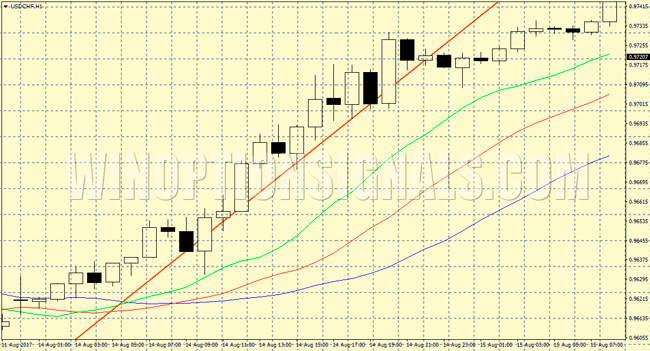
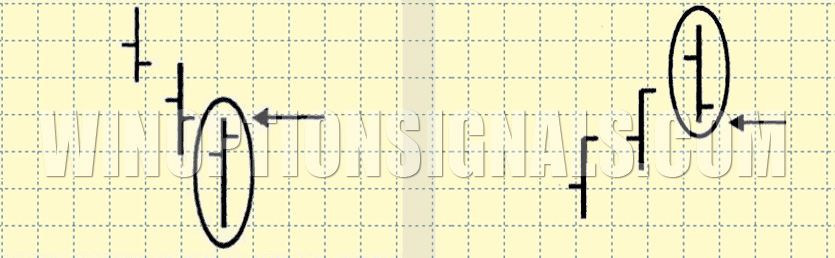
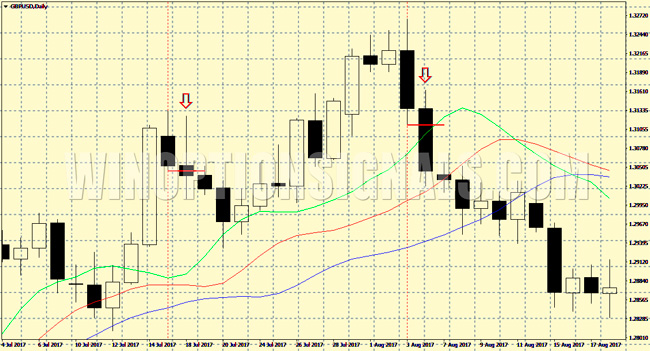
The next and final step is identifying the moment when market sentiment shifts. This shift is detected at the highs of the current trend and indicates the direction of future movement. In an uptrend, a bullish reversal bar is a candle with a lower low relative to the previous bar, and a closing price above its midpoint. This signal indicates that sellers are weakening and a trend change is approaching.
A bearish reversal is the mirror image: a candle whose high is above the previous bar's high, with a closing price below its midpoint. This bar appears before an uptrend turns into a downtrend.
Trading Rules
A Call option should be opened under the following conditions:
- the indicator lines are pointing downward;
- the current price is below the indicator lines.
Once these conditions are met, wait for a bullish reversal signal to appear on the chart below the indicator lines. As soon as the price on the following bar breaks above the high of that reversal bar, a Call option can be opened.
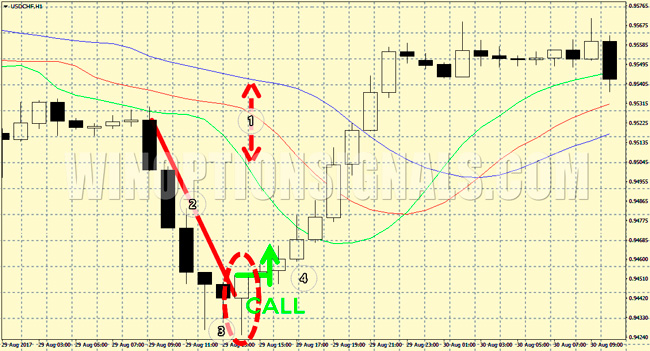
A Put option can be opened under the following conditions:
- the indicator lines are pointing upward;
- the current price is above the indicator lines.
Once these conditions are met, wait for a bearish reversal signal to appear on the chart above the indicator lines. If the price on the following bar breaks below the reversal bar's low, open a Put option.
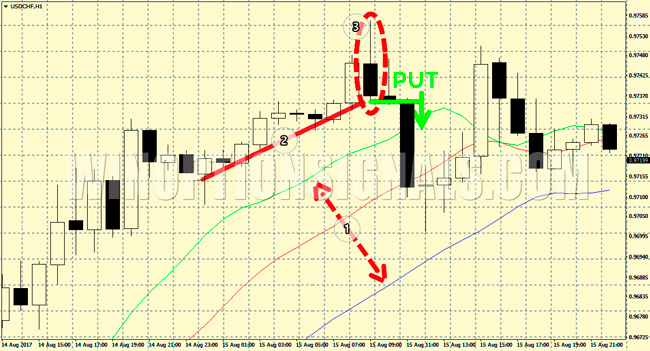
These strategies are long-term in nature and are not recommended on timeframes below one hour. The expiration time is always set to one candle. This is because Alligator trading involves trading against the current trend, and a reversal signal on the chart may turn out to be a correction rather than a true reversal.
Despite the relatively long timeframes involved, the flow of signals is fairly consistent. H4 or D1 are the recommended timeframes.
Trade Examples with the Alligator Indicator
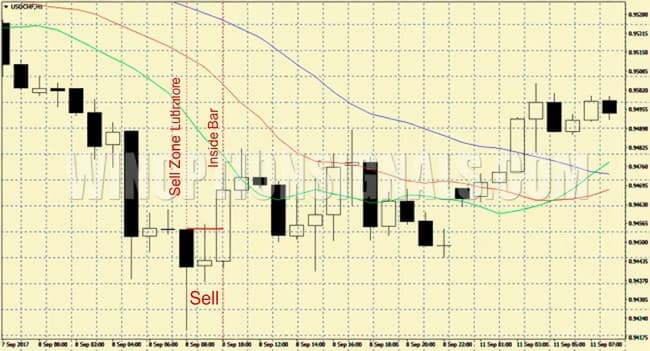
As an example, consider the USD/CHF currency pair on the hourly timeframe. First, the direction of the current trend and indicator lines is determined. Once they point downward, wait for a bullish reversal signal. After price breaks above the high of the reversal bar — which in this example happened on the following candle — a Call option with a one-hour expiration is opened. The trade closes in profit.
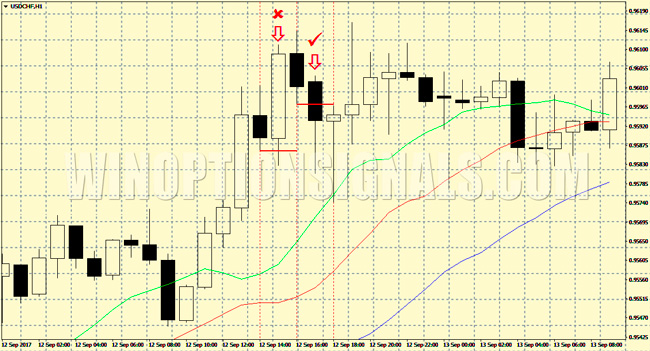
It is important to note that this system does not eliminate false signals for binary options trading. In the chart below, for example, price briefly dropped below the bearish reversal bar's low before moving back up — indicating a correction rather than a reversal. Within this strategy, three consecutive false signals of this type are unusual. If this does occur, it is recommended to return to the initial trade size to minimise risk.
The Alligator indicator works well on the daily chart, which is recommended for beginners as one of the more straightforward tools for binary options trading. For this reason, brokers sometimes reduce payouts on longer-term trades, as the daily chart is generally considered more predictable than intraday charts.
Conclusion
The Alligator indicator is a well-established trading tool whose effectiveness has been demonstrated across many market conditions. It reflects trends across multiple timeframes, giving traders a broad view of the market. By working with the Alligator, traders can promptly identify shifts in sentiment and changes in trend direction.
Download the Alligator Indicator
Not sure how a particular strategy or indicator works? Leave a comment below, and subscribe to our YouTube channel WinOptionCrypto — we'll answer your questions in upcoming videos.
See Also:
- How to make money on binary options
- Pros and cons of trading binary options
- How to make a profit by trading on clean charts
- How to adapt a Forex strategy to Binary Options?
To leave a comment, you must register or log in to your account.